The SQE2 Client Interview and Attendance Note




Download for free and judge it yourself.

You sit the SQE2 client interview and attendance note twice, once on each oral day, and it is the only station where an actor marks you on how you treat a person. This free PDF gives you a routine for the whole hour: ten minutes to prepare, twenty-five to interview, twenty-five to write the note by hand.
Updated October 2026 · checked against the SRA’s SQE2 assessment specification (applicable from 1 September 2026), its performance indicators and sample questions on 7 October 2026.
How the station works
On oral day 1 the interview is set in Property Practice; on oral day 2, in Wills and the Administration of Estates. You read an email from a partner or a secretary, sometimes with documents, for 10 minutes. You then interview the client, who is in the room, for 25 minutes. Finally you have 25 minutes in a separate room to write the attendance note and legal analysis by hand. The SRA treats the interview and its note as one of your 16 assessments.
| Stage | Time | Marked by |
|---|---|---|
| Preparation | 10 minutes | Not marked, but your notes booklet is read with the note |
| Interview | 25 minutes | The assessor playing the client, on skills only |
| Attendance note | 25 minutes, handwritten | A solicitor, on skills and application of law, including ethics |
Each criterion is graded from A, superior performance, to F, poor performance, with A worth 5 marks and F worth 0. Skills and application of law carry equal weight across SQE2, and there is one pass mark for SQE2 as a whole. Ethics and professional conduct issues are not flagged: you have to spot them yourself.
What the markers look for
In the interview
Listening and effective questioning; explaining in a way the client understands; a professional, courteous manner that respects diversity; a client-focused approach; and a relationship that builds trust and confidence. You need enough preliminary advice to win that trust, not detailed advice.
In the attendance note
Recording all the relevant information, identifying appropriate next steps and giving client-focused advice, then applying the law correctly and comprehensively and dealing with any ethical issue honestly and with integrity.
The SRA publishes performance indicators for each criterion. They reward a mix of open and closed questions, plain explanations of terms such as “restrictive covenant” or “nil rate band”, and calm control of the interview. They mark down interrupting, repeating what the client has already said, jargon and a note full of facts with no bearing on the advice.
A routine for the hour
- Prepare: read the email for the partner’s specific questions, read the note to candidates for anything you need not cover, then plan issues, facts to find and an ethics radar on one sheet.
- Interview: welcome and agenda, the client’s story, explore each issue, summarise, preliminary advice, close with next steps. Move to the summary at 18 minutes whatever is left.
- Write: seven headings every time, from instructions and key facts to issues and advice, professional conduct and two lists of next steps.
The routine is our method, not an SRA rule. The guide sets it out with time budgets, a printable preparation sheet, a question bank and a decision tree for the moment someone other than the client starts giving instructions.
What is inside the PDF
- How the station runs, the two practice areas and who marks what
- The eleven criteria on one page, with the SRA’s performance indicators condensed
- A ten-minute preparation sheet
- A six-stage interview, a question bank and plain-English explanations
- Difficult moments and the ethics that hide in the room
- An attendance note template, with a weak and a strong line compared
- Two worked examples: a Wills interview and a Property interview, each with a full note
- Ten exam traps, ten self-test questions and a checklist
For interview technique in more depth, read our posts on the SQE2 client interview step by step, building rapport and the dos and don’ts. To check your readiness for every SQE2 station, use the SQE2 readiness checklist.
Frequently asked questions
Who marks the SQE2 client interview?
The assessor who plays the client, a trained actor, marks the interview on skills only. A solicitor marks the attendance note on skills and on application of law.
How long is the attendance note, and is it typed?
You have 25 minutes, and you write it by hand. The marker also reads the notes you made during preparation and the interview; anything you cross out is not marked.
Do I have to give full advice in the interview?
No. The SRA says you do not need detailed advice at that stage, but you do need enough preliminary advice, and to address enough of the client’s concerns, to establish trust and confidence. The detail goes in the note.
Which practice areas are used?
Property Practice on oral day 1 and Wills and the Administration of Estates on oral day 2.
Is the guide free?
Yes. Enter your details on this page and we email you the PDF straight away.
Free guides, practice questions and tools, written for the SQE as it is now. No fluff or sales pitches: just quality information and insights.
What does this document cover?
Resources Library
Solicitors Accounts for the SQE

Resitting SQE1: The Comeback Guide
How to Get Your SQE Funded by Your Employer
Ethics and Professional Conduct for the SQE
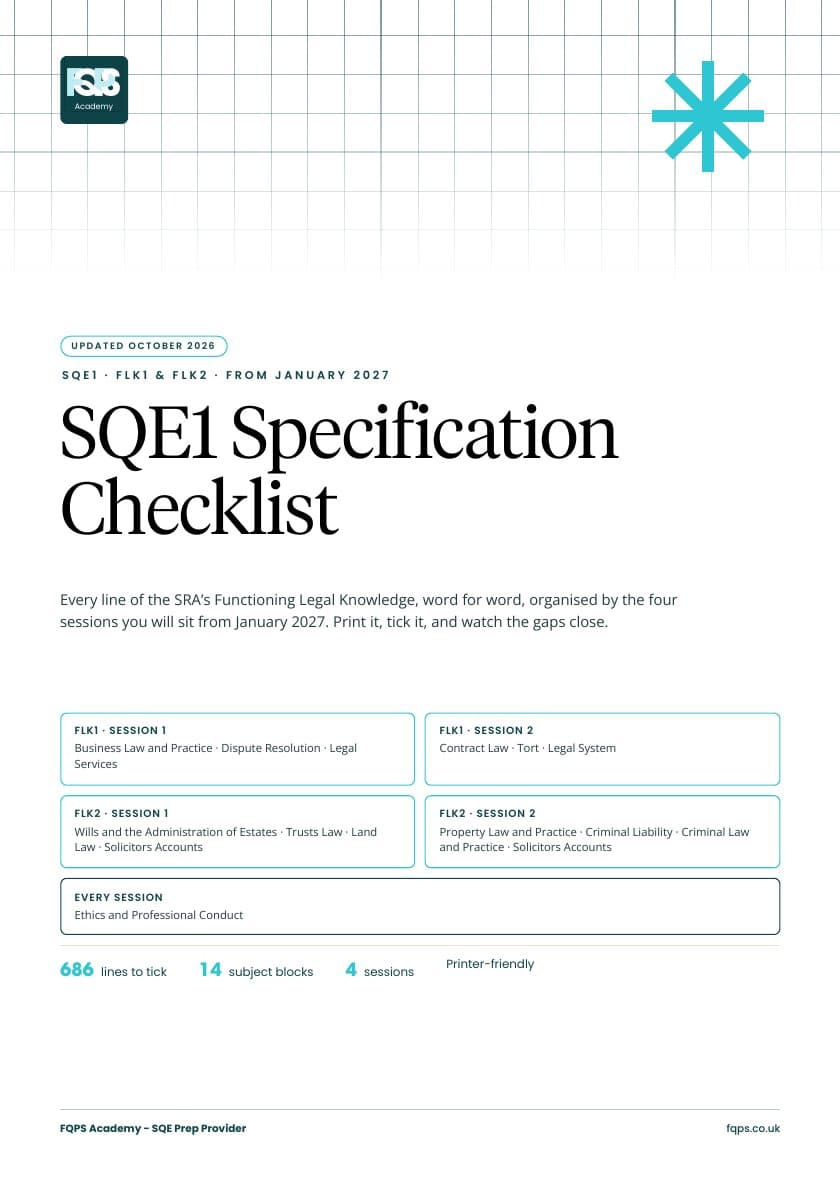
SQE1 Specification Checklist: January 2027
Everything You Need to Know - About QWE
SQE2 Advocacy: Confidence in the Courtroom
How to Calculate Income Tax: SQE 2027 Guide
We put our heart into designing valuable SQE resources, so don't hesitate to use them!
Enjoy our WhatsApp
Support Group.
Book a 30-minute 1:1 call. Get free support.
Download our free SQE Prep Notion Template.
Listen to our podcasts and online webinars.
QWE Job Listings for SQE Students.
The FQPS Academy
Legal Blog.
Get access to free Downloads & Tools.
People are talking
The mentor support at FQPS Academy was incredible. I felt guided and encouraged throughout my entire SQE1 preparation.
SQE1 Prep Course
The smart study plans and AI-driven support at FQPS Academy made my SQE prep efficient and stress-free. Highly recommend!
SQE1 Prep Course
FQPS Academy's flexible study plans were perfect for balancing my studies with part-time work. The support was top-notch!
SQE1 Prep Course
Switching careers was daunting, but FQPS made my transition to law smooth and manageable. Excellent resources and guidance!
QWE Confirmation
Preparing for the SQE1 was a breeze with FQPS Academy. Their tailored support and clear guidance were invaluable.
SQE1 Prep Course
FQPS Academy's approach to learning was perfect for me. The personalised feedback helped me focus on what really mattered.
SQE1 Prep Course
FQPS Academy's comprehensive resources and supportive mentors were key to my success in passing the SQE1. Truly excellent.
SQE1 Prep Course
Returning to study law after years in another field was challenging, but FQPS Academy made it achievable. Great experience!
QWE Confirmation
I loved the blended learning approach at FQPS Academy. It kept me engaged and helped me retain the material effectively.
SQE1 Prep Course
The detailed feedback and continuous support at FQPS Academy were outstanding. I felt prepared and confident for my exams.
SQE2 Mocks
FQPS Academy's resources and support helped me navigate the SQE1 as an international lawyer. Couldn't have done it without them!
SQE1 Prep Course
The proactive support and clear guidance from FQPS Academy's mentors made all the difference in my SQE1 prep. Highly recommend!
SQE1 Prep Course
Changing careers to law was a big step, but FQPS Academy's support system made it achievable. Their resources are top-notch!
QWE Confirmation
FQPS Academy's revision cards were incredibly helpful for quick reviews. The structured approach really worked for me.
SQE1 Prep Course
The 24/7 mentor support was a lifesaver! FQPS Academy truly understands the needs of their students. Highly recommend!
SQE1 Prep Course
FQPS Academy's intensive MCQ sessions and mock exams were game-changers. I felt ready and confident on exam day!
SQE1 Prep Course
FQPS Academy's personalised study plans were a huge help. The AI detection and prevention of burnout feature was particularly beneficial.
SQE1 Prep Course
FQPS Academy made my career change to law seamless. Their support and resources are second to none. Fantastic experience!
QWE Confirmation