How to Calculate Income Tax: SQE 2027 Guide




Download for free and judge it yourself.

Most income tax questions on SQE1 come down to a calculation you can do in three steps: total income, net income, then taxable income and tax. This free guide is a worksheet: fill in each table and you have the answer. It is updated for the 2027 sittings, with the 2026/27 rates and a fully worked example.
2027 edition · checked against the SRA’s SQE1 assessment specification and HMRC’s rates on 2 October 2026.
What the SQE tests in 2027
Income tax is examined in SQE1 FLK1, Business Law and Practice, for employees, sole traders, partners, shareholders, lenders and debenture holders, and in FLK2 for personal representatives during the administration of an estate. From January 2027 both sit in Session 1 of their paper.
Two rules from the SRA decide how to revise. First, where a question needs the value of a relief, exemption, rate or threshold, the SRA says it will be provided: you are tested on the method and on when each relief or exemption applies, not on memorising figures. Second, the law examined is the law as it stands four calendar months before the first day of the assessment window.
| Sitting | Law cut-off | Tax year in force |
|---|---|---|
| SQE1 January 2027 | 11 September 2026 | 2026/27 |
| SQE1 July 2027 | 12 March 2027 | 2026/27 |
| SQE2 January, April and July 2027 | 26 September 2026, 20 December 2026, 27 March 2027 | 2026/27 |
| SQE2 October 2027 | 28 June 2027 | 2027/28 |
Step 1: total income
Add up the gross income of the tax year (6 April to 5 April), leaving out capital receipts such as the sale of a house or shares, which belong to capital gains tax. Sort it into three types, because each has its own rates and they are taxed in a fixed order:
1. Non-savings income
Employment income, trading profits and property income (rent).
2. Savings income
Interest, for example from a bank account, debentures or loans.
3. Dividend income
Dividends from company shares.
Leave out exempt income
Income from ISAs, NS&I Savings Certificates, and Premium Bond and National Lottery prizes.
On the accruals basis, a sole trader’s or partner’s trading profit is chargeable receipts, less expenses incurred wholly and exclusively for the trade, less capital allowances. Since 2024/25 the cash basis is the default for sole traders and for partnerships whose partners are all individuals (never LLPs): receipts less payments, with equipment other than cars deducted as an expense instead of capital allowances. A trader can opt out to the accruals basis shown here. A partner is taxed on their own share of the firm’s profit. A company paying yearly interest to an individual (for example on a loan or an unlisted debenture) deducts 20% first: use the gross amount, and deduct the tax at the end.
Step 2: net income
Deduct any reliefs the scenario gives you. The two to know for the SQE:
Qualifying loan interest
Interest on a loan used (main cases) to buy a share in a partnership, or put money into it as capital or a loan, while a partner (not a limited partner); to buy plant or machinery for use in a partnership or the borrower’s job (interest due within 3 years after the end of the period or tax year of the loan); to buy ordinary shares in, or lend to, a close company (not a close investment-holding company) in which the borrower owns more than 5%, or owns shares and works for most of their time; to pay inheritance tax before the grant (a loan to the personal representatives): interest for the first 12 months only. Never an overdraft or credit card.
Trading loss relief
s64: against total income of the tax year of the loss, the previous year, or both. It uses as much income as the loss covers, even if the personal allowance is wasted. s72: a loss in the first 4 tax years of a trade, against total income of the 3 previous tax years, earliest first. s83: carried forward, against later profits of the same trade only. s89: a terminal loss (final 12 months), against profits of the same trade in the final tax year and the 3 before it.
Qualifying loan interest and loss relief set against total income (s64, s72) share one cap: the greater of £50,000 and 25% of adjusted total income. Any part of a loss set against profits of the same trade is not capped (always the case for s83 and s89).
Step 3: taxable income and tax
Deduct the personal allowance of £12,570 to find taxable income. Where adjusted net income is over £100,000, the allowance falls by £1 for every £2 over, to nil at £125,140. The law sets it where it saves the most tax: normally against non-savings income first, then savings, then dividends. Then tax each type in order, filling the bands from the bottom:
| Band | Taxable income | Non-savings | Savings | Dividends |
|---|---|---|---|---|
| Basic | First £37,700 | 20% | 20% | 10.75% |
| Higher | £37,701 to £125,140 | 40% | 40% | 35.75% |
| Additional | Over £125,140 | 45% | 45% | 39.35% |
| Allowance | Amount | Applies to |
|---|---|---|
| Starting rate for savings | Up to £5,000, less £1 for every £1 of taxable non-savings income | Savings income |
| Personal savings allowance | £1,000 / £500 / nil | Basic / higher / additional rate taxpayer |
| Dividend allowance | £500 | The first dividends |
Welsh taxpayers pay the Welsh rates on non-savings income. For 2026/27 the Senedd kept 10p in each band, so the totals are the same 20%, 40% and 45%. Savings and dividends are taxed at UK rates. Add up the tax on each slice for the liability, then deduct any tax already paid, such as PAYE.
Worked example
Amir is a partner in a firm in England. In 2026/27 his share of the trading profit is £56,000; he also has £1,400 of bank interest and £2,600 of dividends, and pays £1,500 of interest on the loan he took out to buy into the partnership. Total income is £60,000; net income, after the qualifying loan interest, is £58,500; taxable income, after the £12,570 personal allowance, is £45,930.
| Slice | Rate | Tax |
|---|---|---|
| £37,700 non-savings income at the basic rate | 20% | £7,540.00 |
| £4,230 non-savings income at the higher rate | 40% | £1,692.00 |
| £500 savings income in the personal savings allowance | 0% | £0.00 |
| £900 savings income at the higher rate | 40% | £360.00 |
| £500 dividends in the dividend allowance | 0% | £0.00 |
| £2,100 dividends at the upper rate | 35.75% | £750.75 |
| Income tax liability | £10,342.75 |
His taxable income is above £37,700, so he is a higher rate taxpayer with a £500 personal savings allowance. His taxable non-savings income is over £5,000, so the starting rate for savings does not apply, and his dividends, taxed last, fall in the higher rate band.
Five exam traps
- Start from gross income; tax already paid comes off at the end.
- Keep the order: non-savings, then savings, then dividends.
- Income taxed at 0% still uses up the bands.
- Match the personal savings allowance to the taxpayer’s top band.
- Adjusted net income over £100,000? Reduce the personal allowance first.
Collection and anti-avoidance
Employees pay through PAYE, deducted by the employer. Sole traders and partners use Self Assessment: the online return and the balancing payment are due by 31 January after the tax year. They also make payments on account on 31 January and 31 July, each half of last year’s Self Assessment tax (none if that was under £1,000, or if more than 80% of last year’s tax was deducted at source).
The SRA also lists the scope of anti-avoidance provisions: the general anti-abuse rule (Finance Act 2013) lets HMRC counteract tax advantages from abusive arrangements, and the settlements rules tax a parent on income from capital they gave their minor, unmarried child, unless it is £100 or less a year.
Estates: personal representatives
Personal representatives pay income tax on estate income received during the administration: 20% on non-savings and savings income and 10.75% on dividends, with no personal allowance, personal savings allowance, starting rate or dividend allowance. If the estate’s income for a tax year is £500 or less, none is due; over £500, all of it is taxable. Beneficiaries are taxed on the grossed-up income they receive, with a credit for the tax the PRs paid (form R185).
Frequently asked questions
Are tax rates given in the SQE1 exam?
Yes. The SRA’s assessment specification says that where a question requires the value of an exemption, a relief, a rate or a threshold, it will be provided. You still need to know which reliefs and exemptions exist, their conditions and the order of the calculation.
Which tax year applies to SQE1 in 2027?
2026/27. The law cut-off is 11 September 2026 for the January 2027 sitting and 12 March 2027 for July 2027, and both fall in the 2026/27 tax year (6 April 2026 to 5 April 2027).
In what order is income taxed?
Non-savings income first, then savings income, then dividends. In 2026/27 the law sets the personal allowance and reliefs where they save the most tax, which normally means against non-savings income first.
What changes from April 2027?
From 6 April 2027 (Finance Act 2026) savings rates rise to 22%, 42% and 47%; property income becomes its own slice after other non-savings income, at 22%, 42% and 47% (Wales: rates to be set by the Senedd); reliefs and the personal allowance go against income other than property, savings and dividends first; PRs pay 22% on savings and property income; companies deduct 22% from interest. These apply from 2027/28: not examined in SQE1 January or July 2027, but in SQE2 October 2027 (cut-off 28 June 2027). The Budget on 28 October 2026 falls before the July 2027 cut-off: check for changes with immediate effect.
Free guides, practice questions and tools, written for the SQE as it is now. No fluff or sales pitches: just quality information and insights.
What does this document cover?
Resources Library
Time Limits for SQE1
Qualifying as a Foreign Lawyer: the SQE Route
Solicitors Accounts for the SQE
The SQE2 Client Interview and Attendance Note
Resitting SQE1: The Comeback Guide
How to Get Your SQE Funded by Your Employer
Ethics and Professional Conduct for the SQE
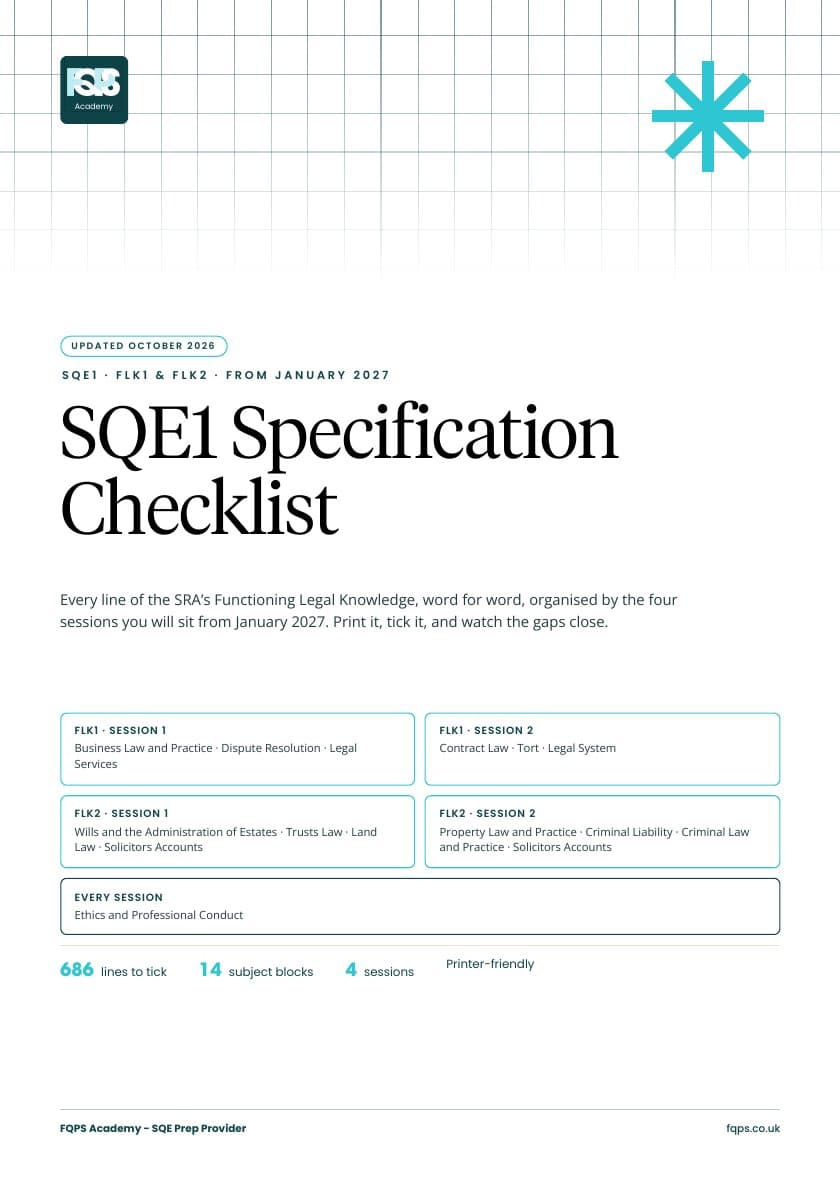
SQE1 Specification Checklist: January 2027
Everything You Need to Know - About QWE
SQE2 Advocacy: Confidence in the Courtroom
We put our heart into designing valuable SQE resources, so don't hesitate to use them!
Enjoy our WhatsApp
Support Group.
Book a 30-minute 1:1 call. Get free support.
Download our free SQE Prep Notion Template.
Listen to our podcasts and online webinars.
QWE Job Listings for SQE Students.
The FQPS Academy
Legal Blog.
Get access to free Downloads & Tools.
People are talking
The mentor support at FQPS Academy was incredible. I felt guided and encouraged throughout my entire SQE1 preparation.
SQE1 Prep Course
The smart study plans and AI-driven support at FQPS Academy made my SQE prep efficient and stress-free. Highly recommend!
SQE1 Prep Course
FQPS Academy's flexible study plans were perfect for balancing my studies with part-time work. The support was top-notch!
SQE1 Prep Course
Switching careers was daunting, but FQPS made my transition to law smooth and manageable. Excellent resources and guidance!
QWE Confirmation
Preparing for the SQE1 was a breeze with FQPS Academy. Their tailored support and clear guidance were invaluable.
SQE1 Prep Course
FQPS Academy's approach to learning was perfect for me. The personalised feedback helped me focus on what really mattered.
SQE1 Prep Course
FQPS Academy's comprehensive resources and supportive mentors were key to my success in passing the SQE1. Truly excellent.
SQE1 Prep Course
Returning to study law after years in another field was challenging, but FQPS Academy made it achievable. Great experience!
QWE Confirmation
I loved the blended learning approach at FQPS Academy. It kept me engaged and helped me retain the material effectively.
SQE1 Prep Course
The detailed feedback and continuous support at FQPS Academy were outstanding. I felt prepared and confident for my exams.
SQE2 Mocks
FQPS Academy's resources and support helped me navigate the SQE1 as an international lawyer. Couldn't have done it without them!
SQE1 Prep Course
The proactive support and clear guidance from FQPS Academy's mentors made all the difference in my SQE1 prep. Highly recommend!
SQE1 Prep Course
Changing careers to law was a big step, but FQPS Academy's support system made it achievable. Their resources are top-notch!
QWE Confirmation
FQPS Academy's revision cards were incredibly helpful for quick reviews. The structured approach really worked for me.
SQE1 Prep Course
The 24/7 mentor support was a lifesaver! FQPS Academy truly understands the needs of their students. Highly recommend!
SQE1 Prep Course
FQPS Academy's intensive MCQ sessions and mock exams were game-changers. I felt ready and confident on exam day!
SQE1 Prep Course
FQPS Academy's personalised study plans were a huge help. The AI detection and prevention of burnout feature was particularly beneficial.
SQE1 Prep Course
FQPS Academy made my career change to law seamless. Their support and resources are second to none. Fantastic experience!
QWE Confirmation