SQE2 Changes 2026 & 2027: Every Update, and What Comes Next
Last updated: 9 October 2026. Checked against the SQE2 assessment specification, the SRA's news item of 30 September 2026, the SRA's October 2026 consultation and its March 2026 board papers.
The SQE2 format is not changing: it is still 16 assessments, four oral and 12 written, with one pass mark. But how SQE2 is marked has changed. Ethics now carries its own mark. Your interview notes now count. Tax figures come in an attachment. And the SRA is already consulting on the next round of changes, due from September 2027.
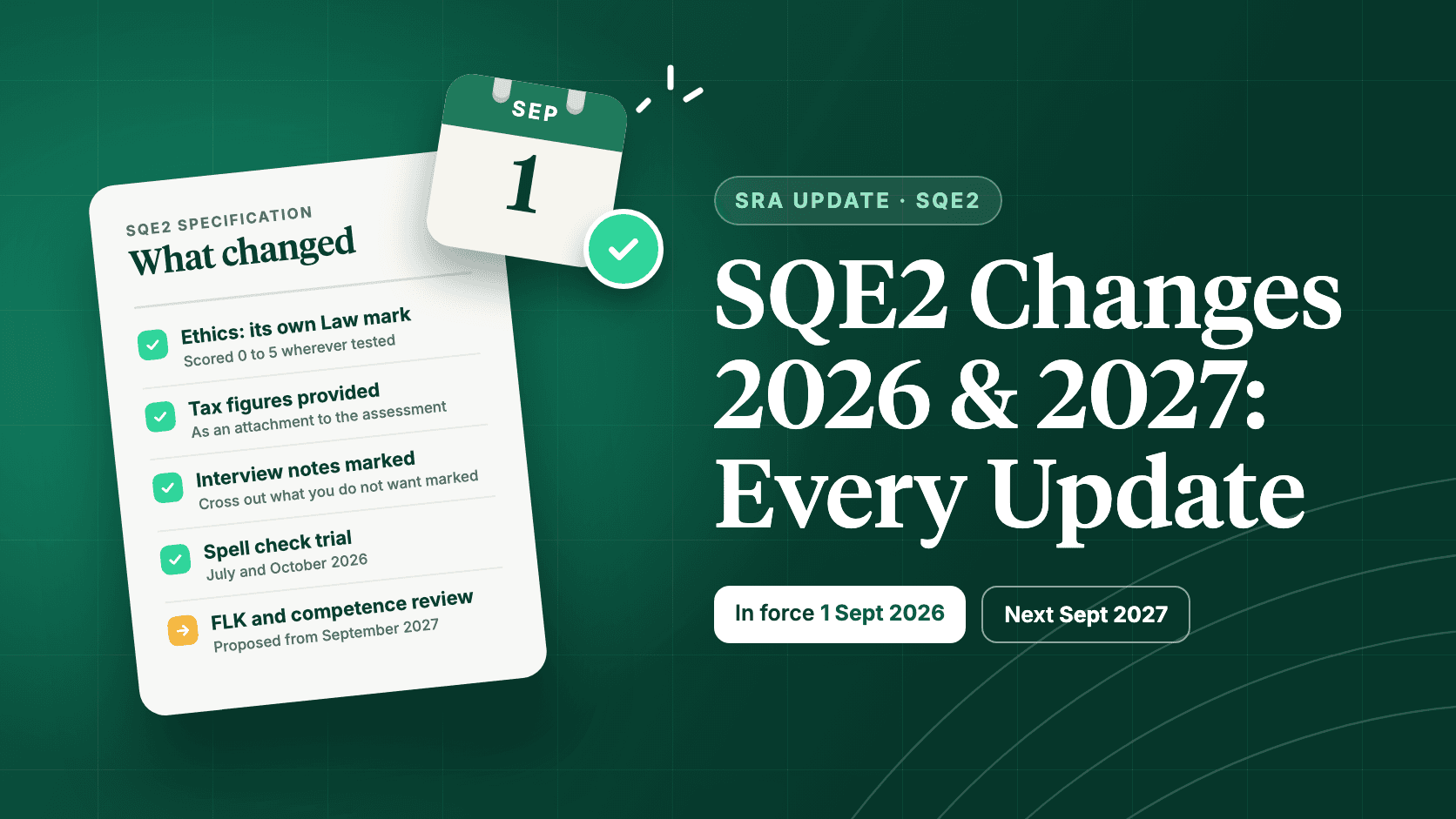
- From 1 September 2026: ethics is a separate Law criterion, money laundering is examinable in Property Practice, practice areas use the SQE1 names, and tax figures are provided.
- Clarified 30 September 2026: tax figures come as an attachment; your interview notes are marked with your attendance note; anything crossed out is not marked.
- Spell check: trialled in July and October 2026. Not yet confirmed for January 2027.
- April 2027: the window starts a week earlier and runs four weeks.
- Coming next: a rewrite of the competence statement and FLK (consultation until 3 December 2026, effective September 2027) and an independent review of the SQE due in early 2027.
SQE2 changes at a glance
| Change | Applies from | What it means for you |
|---|---|---|
| Ethics marked as its own Law criterion | 1 September 2026 | A missed conduct point now shows as its own mark |
| Interview notes marked with the attendance note | Clarified 30 September 2026 | Your notes count; cross out what you do not want marked |
| Tax figures provided in an attachment | 1 September 2026, clarified 30 September | Know when reliefs apply; look up the numbers |
| Money laundering examinable in Property Practice | 1 September 2026 | AML is no longer a business-only topic |
| Practice area names aligned with SQE1 | 1 September 2026 | New labels, same content |
| Performance indicators and application of law guidance updated | September 2026 | Re-read both before you practise |
| Legal research mapped to the competence statement | 1 September 2026 | A clearer account of what the station tests |
| Spell check on the written platform (trial) | July and October 2026 | Spelling help only; marking guidance unchanged |
| April window starts earlier and runs four weeks | April 2027 | A week less runway |
The first sitting run entirely on the new specification was October 2026. If you are sitting in 2027, all of this applies to you.
The SQE2 change timeline
- 26 May 2026Spell check tool announced for the July written assessments
- 1 September 20262026 annual review changes take effect
- 30 September 2026SRA clarifications for "October 2026 SQE2 onwards"
- 8 October to 3 December 2026Consultation on the competence statement and FLK
- Early 2027Independent technical review of the SQE due to report
- April 2027Final competence statement and FLK due; longer April SQE2 window
- September 2027Competence statement and FLK changes take effectAhead of the January 2028 SQE1. The first SQE2 sitting affected is not yet confirmed.
Changes to how SQE2 is marked
These are the changes that move marks, so start here.
Ethics and Professional Conduct now has its own mark
Until September 2026, every station that tested the law had two Law criteria: apply the law correctly and comprehensively. Ethics sat inside them. There is now a third: identify any ethical and professional conduct issues and exercise judgment to resolve them honestly and with integrity. It appears in the attendance note, advocacy, case and matter analysis, legal research, legal writing and legal drafting.
Where a station tests an ethics point, you get a 0 to 5 mark for it and the Law mark is split equally three ways. Where it does not, your results show N/A. The SRA says the aim is more visibility and feedback for candidates, and better tracking of ethics performance. Skills and application of law stay equally weighted overall.
What has not changed about ethics
- It is pervasive. It can arise in any station.
- It is never flagged. You have to spot it.
- Spotting is not enough. You must resolve it: say what you would do.
The specification now says questions can draw on SRA warning notices and names two: Non-Disclosure Agreements and SLAPPs (Strategic Lawsuits Against Public Participation). The examinable rules are the SRA Principles, the Code of Conduct for Solicitors, RELs, RFLs and RSLs, and the Code of Conduct for Firms as it applies to managers and compliance officers.
Read the NDA and SLAPP warning notices as you would a practice-area topic. End every practice answer by asking whether there is a conduct issue, and if there is, write a sentence resolving it. Our free SQE ethics and professional conduct guide covers the rules.
Your interview notes are now marked
This clarification is the one most likely to change what you do in the room. In each client interview and attendance note assessment you get two booklets:
Written during 10 minutes of preparation and the 25-minute interview.
Handwritten in 25 minutes after the interview.
In either booklet. Strike through what you want ignored.
The attendance note marker receives both booklets and marks both. You can cross-refer to your interview notes, but you do not have to: the marker considers them either way. So a fact you captured in your notes but had no time to copy across is not necessarily lost. The flip side is that a wrong first impression in your notes is in front of the marker too, unless you cross it out.
Keep interview notes legible enough for a marker to follow. Use the attendance note for analysis, advice, next steps and ethics rather than re-copying facts. Finish with a 30-second sweep, crossing out anything you would not want judged. The interview itself is still marked on skills only, by the assessor playing the client. Our step-by-step client interview guide covers the station.
Updated performance indicators and marking guidance
The SRA has updated the SQE2 performance indicators, which describe performance above and below the standard of a newly qualified solicitor, to reflect the ethics criterion. The guidance on correct and comprehensive application of law now lists three parts: legally correct, legally comprehensive, and ethics. Broadly, applying the right principles to the facts earns "legally correct", and the depth and completeness of your analysis earns "legally comprehensive". Each criterion is still graded from A (5 marks) to F (0).
Sources: SRA, Assessment information for October 2026 SQE2 onwards (30 September 2026); SQE2 assessment specification.
Changes to what SQE2 examines
Tax figures now come as an attachment
Tax can arise in Property Practice, Wills and the Administration of Estates, and Business Law and Practice, and a question may ask you to calculate a figure. Where you need the value of a relief or exemption, or a rate or threshold, it is now provided in an attachment to that assessment.
The SRA adds two warnings. Do not assume everything in the attachment is needed. And work out what you need from your own analysis: if you find the conditions for a relief are met, use the attachment to check its value. The attachment tells you how much, never whether.
Stop memorising rates, and learn the conditions: for each relief, be able to say in one sentence when it applies. Practise opening attachments on the Pearson platform too. The toolbar copy button does not work on PDF attachments, so use CTRL + C, then CTRL + SHIFT + V. Our free guide on how to calculate income tax covers the method.
Money laundering is examinable in Property Practice
Money laundering used to sit only in Business Law and Practice, with financial services. It is now examinable in Property Practice too (money laundering only). Conveyancing is where most solicitors meet the risk: source of funds, unexplained deposits, rushed buyers. The right answer is usually a conduct answer as well as a legal one, so it overlaps with the new ethics mark.
Practice area names now match SQE1
You will now see Criminal Law and Practice, Wills and the Administration of Estates and Business Law and Practice, alongside Dispute Resolution and Property Practice. The content is the same. The labels simply match the SQE1 FLK you revised.
Legal research is mapped to the competence statement
The specification now explains how the legal research station maps to the Statement of Solicitor Competence, highlighting B2: Undertake legal research. Annex 4 shows legal research is the only SQE2 skill mapped to B2. The station is otherwise unchanged: a partner's email, a set of sources (some deliberately irrelevant) and 60 minutes. It is the one station where you can be expected to cite specific cases and statutes. See our SQE2 legal research guide.
Sources: SQE2 assessment specification; SQE2 Annex 4; SRA news, 30 September 2026.
Changes to the exam platform and timetable
The spell check trial
A spell check tool was added to the Pearson VUE platform for the written assessments and trialled in July 2026, following recommendations by the SQE Independent Reviewer. On 30 September the SRA extended the trial to October 2026. The tool flags spelling only: no grammar correction, writing help or content suggestions. You can try it on the SQE2 practice platform.
What spell check does not change
The marking guidance still applies. You should not lose marks for spelling mistakes that do not affect legal accuracy, clarity or certainty and that spell check would normally flag, for grammar errors that do not affect accuracy or make your text inaccessible, or for poor formatting. But spell check will not necessarily catch names, addresses, dates or values, and the SRA's example of a grammar error that can matter is tense. Proofread those by eye.
The April 2027 window moves and grows
April is the biggest SQE2 sitting: 2,966 candidates were graded in April 2026, against 1,141 in January. From April 2027 the window starts in the third week of the month and runs about four weeks: written assessments 20 to 22 April and 4 to 6 May, orals 26 April to 14 May. Seat reservation forms go out on 5 January 2027, with a deadline of 8 January.
Sources: SRA, spell check tool (26 May 2026); booking windows; SRA statistical reports for January and April 2026.
What has not changed
- 16 assessments: four oral over two half days, 12 written over three half days.
- The timings, from the 25-minute interview to the 60-minute case and matter analysis.
- Negotiation tested inside other stations, at least once in every sitting.
- Legal materials provided for every station except legal research. No books or notes.
- The law cut-off: four calendar months before the window. For January 2027, 26 September 2026.
- One pass mark for SQE2 as a whole.
What comes next: the SQE2 changes on the way
Some of what follows is confirmed and some only proposed. Each item is labelled.
ProposedA rewrite of the competence statement and FLK
On 8 October 2026 the SRA opened a consultation, Review of the Statement of Solicitor Competence and the SQE Functioning Legal Knowledge, running until 3 December 2026. It comes more than ten years after the competence statement was first published, and draws on six focus groups with more than 140 professionals. Final versions are due in April 2027 and changes take effect in September 2027, ahead of the January 2028 SQE1. The SRA has not said which SQE2 sitting will be first affected. On the usual annual cycle that would be October 2027, but it is not confirmed.
It matters for SQE2 because every SQE2 station is mapped to the competence statement, and SQE2's examinable law is a subset of the FLK.
Proposed changes to the competence statement
- Technology and AI: research done "appropriately and responsibly", with AI outputs checked against primary sources; drafting that uses precedents "and technology, including AI". The SRA links this to AI hallucinations in court submissions.
- Ethics: prioritising duties that conflict, raising concerns about unethical behaviour, and obligations when dealing with litigation funders, marketers and referrers.
- Supervision and wellbeing: a new supervision section, prompted partly by the Mazur judgment, and a new competence on your own health and wellbeing.
Proposed changes to the FLK in SQE2 practice areas
| Practice area | Proposed additions | Proposed removals or limits |
|---|---|---|
| Property Practice | Rent review types; tenant's termination under s.27 LTA 1954; listed buildings and conservation areas | Short residential leases confirmed not examinable |
| Wills and the Administration of Estates | Spouse's right to the matrimonial home on intestacy; post-death variations and disclaimers; personal representatives' fiduciary duties; letters of wishes | Inheritance tax anti-avoidance |
| Criminal Law and Practice | Section 18 PACE searches; breach of sentence and committals for sentence (Sentencing Act 2026); fines and discharges | None |
| Business Law and Practice | Restructuring plans and moratoriums; stamp duty on share transfers | Tax anti-avoidance; business property relief moves to Wills |
| Dispute Resolution | Freezing orders, search orders and strike out | Pre-action protocols limited to four claim types |
No new practice areas are proposed: the SRA considered adding family and social welfare law and decided against it. None of this applies before September 2027.
Source: SRA consultation and Annexes 2 to 4, published 8 October 2026.
ConfirmedAn independent technical review of the SQE
The SRA has appointed ETS, a large US educational testing organisation, to review how valid, reliable and fair the SQE is. The review is expected in early 2027, and the SRA says it will "make changes where they are needed". It covers an assessment that, in the SRA's last reporting year, delivered 33,085 assessments to 16,200 candidates.
Not confirmedSpell check from January 2027
The SRA's March 2026 board report expected spell check "for deliveries later in 2026". The specification keeps the existing guidance "until further notice". As of 9 October 2026, January 2027 is not confirmed, so practise with and without it.
ExpectedA new fee for 2027/28
SQE2 costs £3,086 for 2026/27, up from £2,974. Under the SRA's contract with Kaplan, fees rise every year with inflation plus a small uplift for Welsh translation. The 2026/27 fee was confirmed in March 2026, so expect the 2027/28 fee around spring 2027.
ExpectedLonger windows, the same oral cities
The SRA expects SQE2 windows of at least three weeks as numbers grow, possibly four or five. Orals use up to five London centres plus Birmingham, Cardiff and Manchester, and Kaplan found no evidence of enough demand elsewhere. Orals are only held in England and Wales; the written papers ran in 37 countries.
Sources: SRA Board, SQE report, March 2026; SQE overview paper.
Your SQE2 changes checklist
- Read the current specification's sections on ethics, taxation, application of law, and spelling and grammar.
- Read the SRA warning notices on NDAs and SLAPPs.
- Add money laundering to your Property Practice revision.
- Learn the conditions for each tax relief, not the figures.
- Keep interview notes readable and cross out what you do not want marked.
- Try spell check on the practice platform, then proofread names, dates and figures by eye.
- Re-read the updated performance indicators.
- Sitting from October 2027? Watch for the final competence statement and FLK in April 2027.
The bottom line
For 2026 and 2027 the SQE2 you sit looks the same, but it is marked differently. Two habits matter most: resolve every ethics point you spot, because it now carries its own mark, and treat your interview notes as part of your answer, because they are marked. Beyond that, learn tax conditions rather than figures, and proofread what spell check cannot see.
Booking for January? Our SQE2 January 2027 booking guide has every deadline.
Practise against the new marking
FQPS SQE2 Preparation gives you 6 live 1:1 mocks a month with a solicitor and written feedback, plus a personal study plan. £189 a month, no minimum term.
Keep reading
SQE2 changes: FAQ
Is the SQE2 format changing in 2027?
No. SQE2 remains 16 assessments, four oral and 12 written, across five practice areas, with one pass mark for SQE2 as a whole. The changes are to the specification, the marking criteria and the April window.
When did the latest SQE2 changes take effect?
The 2026 annual review changes apply to assessments from 1 September 2026, starting with the October 2026 SQE2. The SRA published further clarifications on 30 September 2026.
How is ethics marked in SQE2 now?
Ethics and Professional Conduct is a separate, third Law criterion. Where a station assesses an ethics point it is marked from 0 to 5 and the station's Law mark is split equally three ways. Where it does not, your results show N/A.
Are tax rates given in SQE2?
Yes. Where you need the value of a relief or exemption, or a rate or threshold, it is provided in a tax attachment to that assessment. You still need to know which reliefs apply and when.
Are SQE2 interview notes marked?
Yes. The attendance note marker sees both your interview notes and your attendance note, and both are marked. Anything you cross out is not marked.
Is there spell check in the SQE2 written assessments?
A spell check tool was trialled in the July and October 2026 written assessments. It flags spelling only. The SRA has not yet confirmed whether it will be available from January 2027.
Is money laundering tested in SQE2 Property Practice?
Yes, from 1 September 2026. Money laundering is examinable in Property Practice, and money laundering and financial services in Business Law and Practice.
What SQE2 changes are planned for 2027 and 2028?
The SRA is consulting until 3 December 2026 on changes to the Statement of Solicitor Competence and the FLK, covering technology and AI, ethics and new FLK topics. Final versions are due in April 2027, taking effect from September 2027. An independent technical review of the SQE is due to report in early 2027.
Stay up to date
Never miss the latest SRA updates. Receive product updates, news and customer stories right into your inbox.

Keep reading
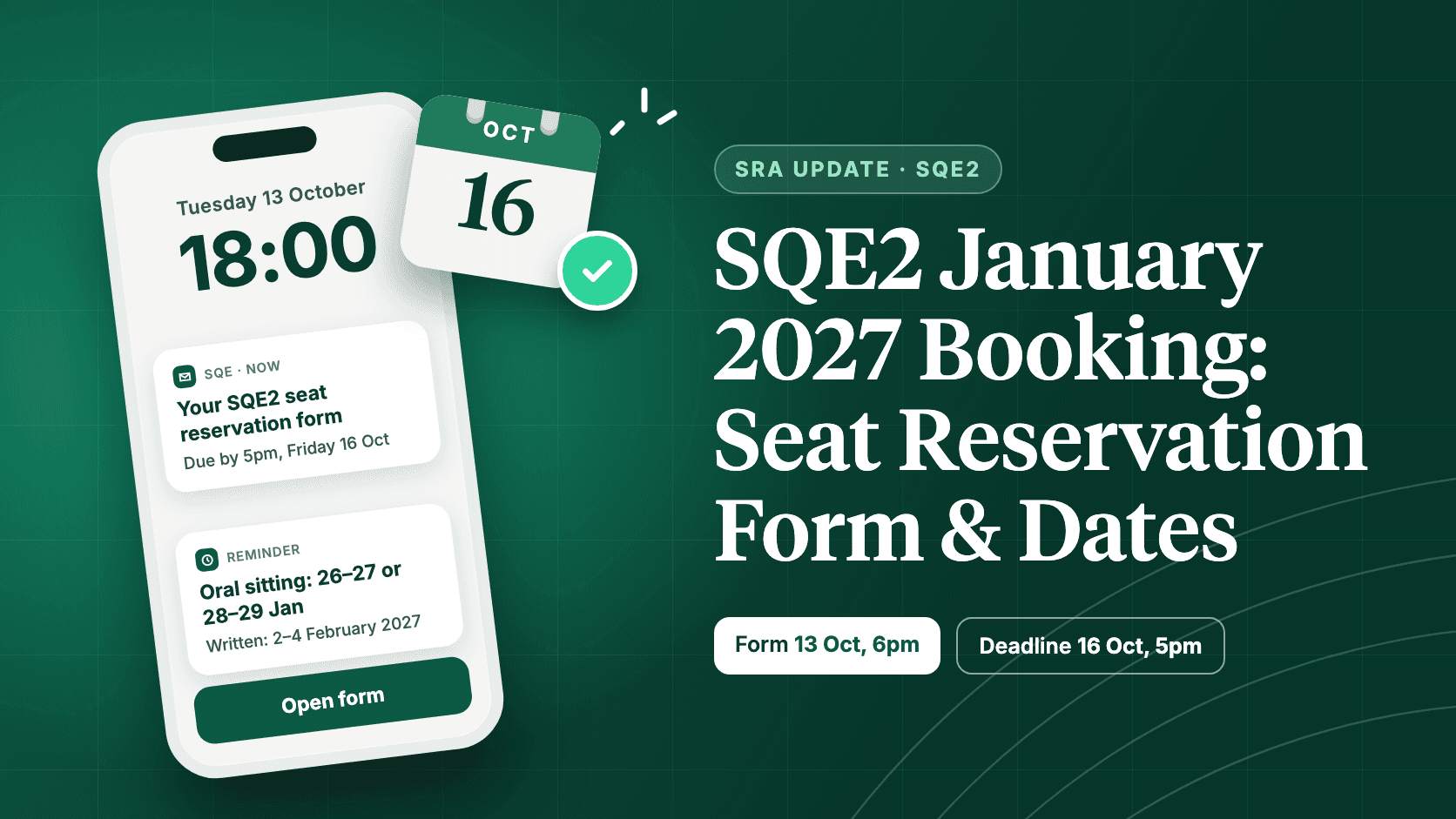
Your SQE2 January 2027 seat reservation form is emailed from 6pm on 13 October 2026 and closes at 5pm on the 16th. Three days, then a 48-hour payment window.
Read the article

Your SQE1 seat reservation form is sent at 6pm on 22 September 2026 and closes on the 24th. Two days — here are the pre-booking steps to finish first.
Read the article

From the January 2027 sitting, each SQE1 FLK has 170 questions (85 per session, 340 overall) with subjects grouped by session and time unchanged. What changed, why, and how to prepare.
Read the article