Published 14 October 2026. Every study, statement and figure below is linked in the sources at the end.
Every SQE1 candidate now has a free chatbot that will explain land law at 2am, build a revision timetable in seconds and write as many practice questions as you ask for. Some of that is genuinely useful. Some of it can quietly cost you the exam. This guide sets out what AI is good for in SQE preparation, where it lets candidates down, and the rules we suggest you follow, based on how the real SQE1 questions are written and on what the research says about AI-written questions.
- The real exam is written by people. Kaplan, the SRA's assessment provider, says solicitors write, edit and review SQE questions, with at least three solicitors of England and Wales involved in each review, and that it has not used AI-generated questions in any SQE assessment.
- AI is a good explainer and planner, as long as it works from material you can check.
- AI is a poor question writer. In published studies, around one in five ChatGPT-written practice questions contained a factual or conceptual error, and around half had item-writing flaws.
- AI does not know which law your sitting tests. SQE1 examines the law as it stood four calendar months before the assessment window opens, and general AI tools are often out of date or mix in other jurisdictions.
- Never let AI be the judge of its own accuracy. The SRA says this in terms. Check every legal point against a primary source or the SRA's specification.
Can you use AI to prepare for the SQE?
Yes, but for the right jobs. Think of a general AI chatbot as a well-read study partner who has never sat the SQE, is not sure which year it is, and will never admit when it is guessing. That partner can help you understand, organise and rehearse. It should not be the one who decides what the law is, or who sets the questions you use to judge whether you are ready.
That distinction matters more for SQE1 than for most exams. SQE1 is two papers, FLK1 and FLK2. From January 2027 each paper has 170 single-best-answer questions in two sessions of 85, so you have about 108 seconds per question. Fewer than half of first-time candidates passed in July 2026. A candidate who has trained on questions that are slightly wrong, slightly out of date or slightly too easy is training for a different exam.
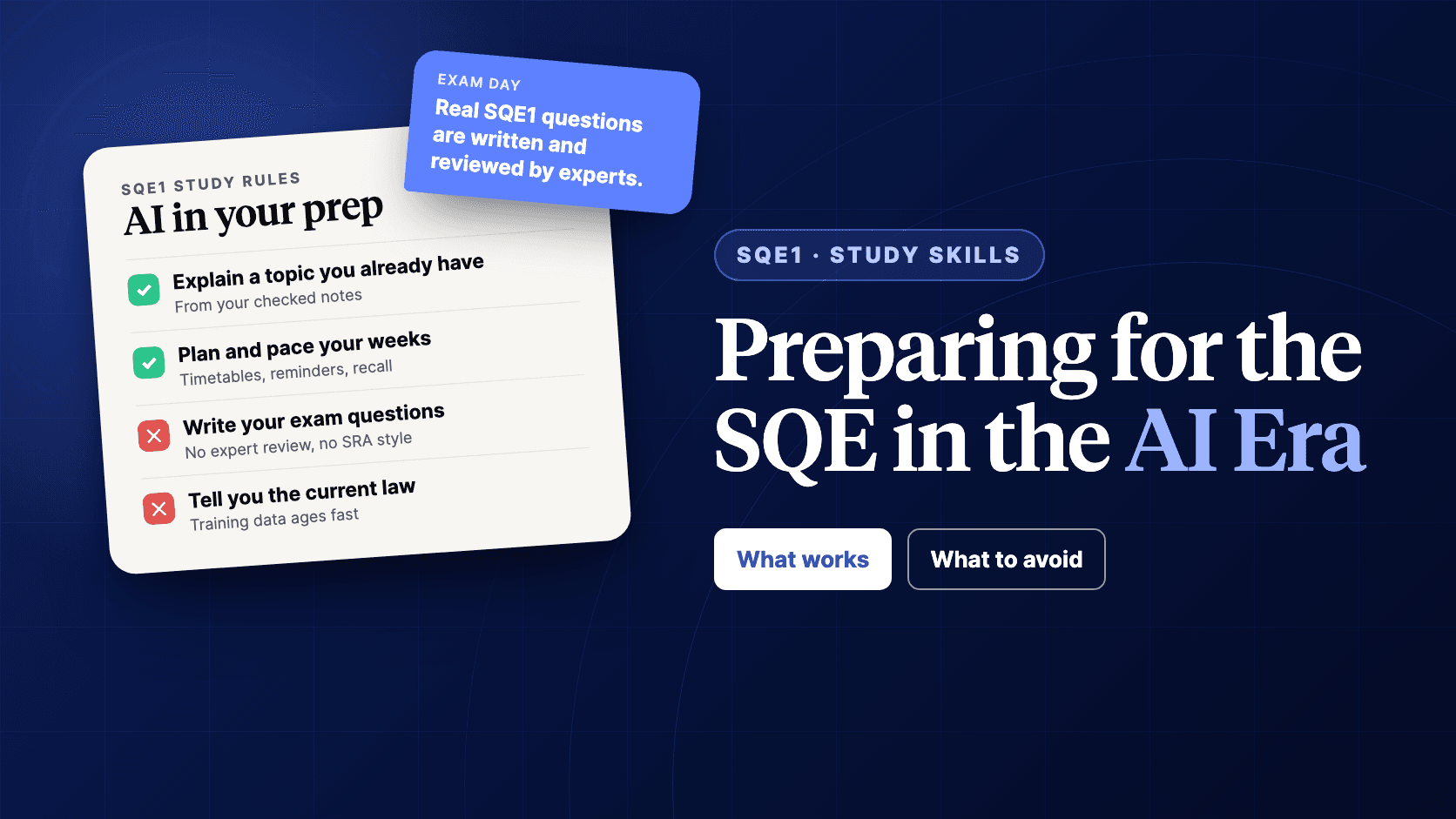
Explain a topic in plainer words, plan your weeks, quiz you on notes you have already checked, and turn your own material into recall prompts.
Tell you what the current law is, write the questions you rely on to judge readiness, or mark its own answers as correct.
The SRA's SQE1 assessment specification, legislation.gov.uk, gov.uk guidance, the SRA Standards and Regulations and the official sample questions.
How real SQE1 questions are made
To see why AI-written practice questions fall short, it helps to know what they are imitating. The SQE is run for the SRA by Kaplan, and the process behind each question is slow, human and heavily checked.
- Written and reviewed by solicitors. Kaplan told Legal Cheek in April 2025 that it employs a team of solicitors who write, edit and review SQE questions, and that each question's review involves a minimum of three solicitors of England and Wales. Kaplan said AI may be one of several tools assisting question development, but that it has not used any AI-generated questions in any SQE assessment.
- A fixed format. Each question is a single best answer item: a factual scenario, a question, and five options. All five should be plausible; only one is the best answer. The questions test whether you can apply the law to facts, not just recall it.
- Quality assurance before each sitting. The SRA's quality assurance report for 2024/25 describes a question writing methodology, sign-off of every assessment by Kaplan's Head of Quality Assurance, review of a sample of questions by the SRA's own subject experts (people who have practised as solicitors and worked in legal education), and an SRA check on the composition of every paper.
- Statistics after each sitting. An independent psychometrician analyses how every question performed, checks for bias and reports to the Assessment Board. SQE1 reliability has been above 0.9 in every sitting the report covers, against a 0.8 benchmark for high-stakes tests.
- A pass mark set by solicitors. SQE1 is standard-set using the Angoff method: panels of qualified solicitors judge, question by question, how a just competent newly qualified solicitor would perform. The Assessment Board then approves the pass mark.
- A law cut-off date. Candidates are examined on the law in force four calendar months before the first assessment in the window. The SRA publishes the exact date for each sitting.
Set against that process, a question produced in a few seconds by a chatbot, with no named author, no reviewer and no cut-off date, is a different thing. It may still be useful for recall. It is not a reliable model of the exam.
The SRA has published 220 official SQE1 sample questions, including 50 released in November 2025 that had been used in previous exam papers, with performance data. They are the closest thing you can get to the real style. Use them as your yardstick for any other question source, AI or not. Our guide to free SQE1 sample questions lists where to find them.
What AI is good at in SQE preparation
Used carefully, a general AI tool can save you time on the work around revision. These are the uses we think are worth it.
1. Explaining something you already have in front of you
Paste in a passage from your course notes or the assessment specification and ask for a plainer explanation, an analogy or a worked example. Because you supplied the source, you can check the answer against it. This is where AI is strongest.
2. Planning and pacing
Turning "seven weeks, 14 subjects, two papers" into a weekly plan, a spaced-repetition schedule or a timed-practice routine is admin, not law. AI does it well, and mistakes are harmless.
3. Quizzing you on notes you have verified
Ask the tool to test you on your own checked notes, one question at a time, and to tell you which part of the notes the answer comes from. The value is in the retrieval practice, not in the questions themselves.
4. Rehearsing explanations out loud
Explaining a rule in your own words, then asking the tool to point out gaps against the source you gave it, is a fast way to find what you do not really understand.
5. Practising clear written English for SQE2
For candidates whose first language is not English, AI can help with grammar, structure and concision in practice writing. It cannot tell you whether your legal analysis would score well against the SRA's assessment criteria; that needs a qualified marker.
Where AI lets SQE candidates down
It states things that are not true, confidently
Researchers at Stanford tested general AI models on verifiable questions about US federal court cases and found legal "hallucinations" between 58% of the time (GPT-4) and 88% of the time (Llama 2). Even specialist legal research tools built on retrieval hallucinated between 17% and 33% of the time in a follow-up study. The English courts have seen the results. In Ayinde v Haringey and Al-Haroun v Qatar National Bank (2025), the Divisional Court dealt with submissions in which 18 of 45 citations in one case did not exist, and said freely available generative AI tools are not capable of conducting reliable legal research. In Harber v HMRC (2023), a litigant in person relied on nine tribunal decisions that turned out not to exist.
The SRA's own advice is blunt: do not trust an AI system to judge its own accuracy. In August 2026 it issued a formal warning notice on the misuse of AI, reminding solicitors that they must check AI output and remain responsible for its accuracy.
It does not know which law your sitting tests
SQE1 tests the law in force at a fixed cut-off date. A general AI model was trained on material up to some earlier point, mixed with older commentary, and it will rarely tell you which version of the law it is describing. Recent changes are exactly where it slips: the abolition of section 21 "no fault" possession notices in England from 1 May 2026, the new £2.5 million cap on 100% agricultural and business property relief from 6 April 2026, the Arbitration Act 2025, and the SQE1 format itself, which changes in January 2027. We go through these in detail in a follow-up article.
It writes questions that look right but do not test what the exam tests
Writing a good single best answer question is a specialist skill, and the research on AI-written questions is consistent:
| Study | What it found |
|---|---|
| Camarata et al., Advances in Physiology Education, 2025 (65 ChatGPT questions) | 49% had item-writing flaws; 22% had factual or conceptual errors. Usable only when supervised by a subject expert trained in question writing. |
| Law et al., BMC Medical Education, 2025 (100 ChatGPT-4o questions against 100 human-written, high-stakes exam) | AI questions were easier, tested mainly lower-order skills, and had more factual errors (6% vs 4%), more irrelevant items (6% vs 0%) and more inappropriate difficulty (14% vs 1%). Human review "remains essential". |
| Artsi et al., BMC Medical Education, 2024 (systematic review of 8 studies) | Every included study found AI-written questions that were faulty or unsuitable for exams. AI is a supplement to human question writers, not a replacement. |
These studies are in medical education; we found no published study of AI-written law exam questions. The pattern is the same problem SQE candidates face: questions that read well but are easier, shallower or wrong.
An easier, recall-style question feels like progress. That is the danger. If your practice scores are built on questions that are easier than the exam and occasionally wrong, they will overstate how ready you are.
It mixes up jurisdictions and professional rules
General models learn mostly from American material. English, Scottish and US rules differ on everything from land registration to criminal procedure, and solicitors' professional conduct in England and Wales is governed by the SRA Standards and Regulations, which replaced the SRA Handbook in November 2019. Older and foreign material is all over the internet, and ethics runs through every SQE1 session.
Getting an answer right is not the same as setting a fair question
In March 2023, GPT-4 answered 70 of the SRA's 90 sample SQE1 questions correctly (78%) in a test reported by the Law Society Gazette; GPT-3.5 had managed 50% two months earlier. That is impressive, but it means roughly one answer in five was wrong, and the author warned that the model still makes things up with confidence. A tool that gets one in five answers wrong will also write some wrong questions and wrong explanations, and nothing on the screen tells you which ones.
When you revise, you cannot tell a correct AI explanation from a wrong one, because if you could, you would not need it. Expert review exists to catch exactly the errors that a learner cannot see.
10 rules for using AI in SQE preparation
- Start from the SRA's material. Your syllabus is the SQE1 assessment specification and the Functioning Legal Knowledge it lists. Use that, not the AI, to decide what to learn.
- Give the AI a source, and make it stay inside it. Paste the passage you want explained and tell it to answer only from that text and to say when the text does not cover the point.
- Never take a rule, section number or case name on trust. Check statutes on legislation.gov.uk (and look for unapplied changes), tax rules on gov.uk, and professional conduct in the SRA Standards and Regulations.
- Ask "as at what date?" If a point could have changed since 2024, check it, and check the SRA's cut-off date for your sitting.
- Do not judge your readiness on AI-written questions. Use the official sample questions and expert-written mocks for that. AI questions can drill recall; they cannot tell you whether you would pass.
- Treat every AI explanation as a draft. If you add it to your notes, mark where you verified it.
- Keep an error log. When AI tells you something wrong, write it down. Patterns appear fast, and they show you which topics to check most carefully.
- Watch for the wrong jurisdiction. Terms such as "attorney", "felony", "Rule 1.7", "missives" (a Scottish conveyancing term), or EU law presented as if Brexit never happened are warning signs.
- Never ask AI to mark its own work. "Are you sure?" invites it to change a right answer as readily as a wrong one.
- Keep AI out of the exam room habits. You will have 108 seconds a question and no assistant. Most of your practice should be timed, unaided, in the January 2027 session format.
Prompts that keep AI honest
You get better results when you narrow the job. These are examples you can adapt.
| Job | Example prompt |
|---|---|
| Explain from a source | "Using only the text below from my notes, explain the difference between a fixed and a floating charge to someone new to company law. If the text does not cover something, say so rather than filling the gap." |
| Retrieval practice | "Quiz me on the notes below, one short question at a time. After I answer, quote the line of the notes that holds the answer. Do not add law that is not in the notes." |
| Find gaps in your understanding | "Here is my explanation of the rule against perpetuities and the extract it is based on. List anything in my explanation that the extract does not support." |
| Plan | "Build a 10-week SQE1 plan for 15 hours a week covering the FLK1 and FLK2 subjects listed below, with a timed 85-question session every weekend from week 4." |
Notice what none of these prompts ask: "What is the current law on...?" or "Write me 50 SQE1 questions on...". Those are the two jobs where AI is least reliable and you are least able to spot the errors.
What about paid AI question banks?
A growing number of SQE1 products now sell AI tutors, AI explanations or AI-generated questions, often thousands of them, sometimes from websites that are only weeks or months old. Some say a person reviews what the AI drafts; some describe automated checks; some say nothing about review at all. In the products we looked at in October 2026, none named a qualified solicitor who writes or reviews its questions.
If questions are produced by the same kind of general model you can use for free, and no qualified person checks each one, the risks above do not go away because you paid for them. Before you buy, ask who wrote and reviewed the questions, what their qualifications are, and the date the law was last checked. We set out a full two-minute check before you pay, and quote what 12 SQE1 products say about themselves, in a separate article.
How FQPS Academy approaches content
At FQPS Academy, every question, explanation and revision card is written and reviewed by legal experts before students see it. Our questions follow the SRA's single best answer format and the SQE1 assessment specification, and our full mocks follow the January 2027 format of two sessions of 85 questions per paper.
We think that is the minimum standard for anything you use to judge whether you are ready for an exam that costs £2,006 to sit (SQE1, from September 2026).
The bottom line
AI is a useful study tool and a poor source of truth. Use it to explain, organise and rehearse material you can check. Do not use it to tell you the law, and do not use AI-written questions to decide whether you are ready. The SQE1 questions you will face on the day were written by solicitors, reviewed by several more, standard-set by a panel of solicitors and analysed by a psychometrician. Prepare with material that has been through a comparable human check.
Sit a free full SQE1 mock in the 2027 format
Create a free FQPS account and get one full FLK1 and one full FLK2 mock (2 × 85 questions each, January 2027 format), written and reviewed by legal experts. No card needed.
Keep reading
Preparing for the SQE with AI: FAQs
Can I use ChatGPT to prepare for the SQE?
Yes, for explaining material you supply, planning your revision and quizzing you on notes you have already checked. Do not rely on it to state the current law of England and Wales or to write the questions you use to judge your readiness: general AI tools make confident legal errors, can be out of date, and the SRA advises never to trust an AI system to judge its own accuracy.
Are real SQE1 questions written by AI?
No. Kaplan, which runs the SQE for the SRA, has said that its solicitors write, edit and review SQE questions, with at least three solicitors of England and Wales involved in each question's review, and that it has not used any AI-generated questions in any SQE assessment. Questions also go through SRA quality assurance, psychometric analysis and Angoff standard setting by qualified solicitors.
Are AI-generated SQE practice questions reliable?
Not on their own. Studies of ChatGPT-written multiple-choice questions found item-writing flaws in around half and factual or conceptual errors in around one in five, and found AI questions easier and more recall-based than human-written ones. The researchers concluded that expert review is essential. Use AI questions for light recall practice at most, and judge your readiness on official samples and expert-written mocks.
How well does ChatGPT do on SQE1 questions?
In a 2023 test reported by the Law Society Gazette, GPT-4 answered 70 of the SRA's 90 sample SQE1 questions correctly (78%), while GPT-3.5 scored 50%. That means roughly one answer in five was still wrong, and the author warned that it states wrong answers confidently. A tool that gets answers wrong will also produce some wrong questions and explanations.
Which law is tested in SQE1?
SQE1 tests the law in force four calendar months before the first assessment in the window. The SRA publishes the exact cut-off date for each sitting. General AI tools rarely tell you which version of the law they are describing, so check any recent change against legislation.gov.uk, gov.uk and the SRA's assessment specification.
Does the SRA approve SQE prep courses or question banks?
No. The SRA says it does not regulate, endorse, accredit or recommend training providers, and does not review or approve any training courses or materials. It is up to you to check who wrote a provider's content and whether it matches what the SQE tests.
What is the best way to use AI for SQE revision?
Give the tool a source you trust, such as your notes or an extract from the assessment specification, and ask it to explain, summarise or quiz you only from that source. Use it for planning and pacing. Check any legal rule it states against a primary source, keep a log of its mistakes, and do most of your practice timed and unaided.
Is FQPS Academy content written by AI?
No. Every FQPS Academy question, explanation and revision card is written and reviewed by legal experts before students see it, and follows the SRA's single best answer format and the SQE1 assessment specification.
Sources
- Legal Cheek, Kaplan's use of AI for SQE 'question development' comes under scrutiny amid US Bar row, 25 April 2025 (Kaplan's statement on question writing and AI).
- SRA, SQE quality assurance report 2024/25, published 21 April 2026.
- SRA, Review of the first sitting of SQE1 (Angoff standard setting).
- SQE website, Cut-off date for the law upon which candidates are examined, and Important changes to SQE1 for January 2027 onwards, 10 September 2026.
- SRA, SQE update, December 2025 (50 new sample questions; 220 in total).
- SRA, Risk Outlook: the use of artificial intelligence in the legal market, 20 November 2023, and Misuse of AI: warning notice, 17 August 2026.
- SRA, SQE trademark (the SRA does not review or approve training courses or materials), updated 28 January 2026.
- Camarata T et al., LLM-generated multiple choice practice quizzes for pre-clinical medical students: prevalence of item writing flaws, Advances in Physiology Education 49(3), 2025, doi:10.1152/advan.00106.2024.
- Law AK et al., AI versus human-generated multiple-choice questions for medical education: a cohort study in a high-stakes examination, BMC Medical Education 25:208, 2025.
- Artsi Y et al., Large language models for generating medical examinations: systematic review, BMC Medical Education 24:354, 2024.
- Dahl M, Magesh V, Suzgun M, Ho DE, Large Legal Fictions: Profiling Legal Hallucinations in Large Language Models, Journal of Legal Analysis, 2024; Magesh V et al., Hallucination-Free? Assessing the Reliability of Leading AI Legal Research Tools, 2024/2025.
- R (Ayinde) v London Borough of Haringey; Al-Haroun v Qatar National Bank [2025] EWHC 1383 (Admin), 6 June 2025; Harber v HMRC [2023] UKFTT 1007 (TC).
- Andrew Gilbert, Law Society Gazette, Revealed: could ChatGPT pass the SQE?, 19 January 2023, and ChatGPT aces SQE resit, 24 March 2023.
- SRA SQE1 statistical report, July 2026, via sqe.sra.org.uk/sqe-results/reports.
The SQE and SOLICITORS QUALIFYING EXAMINATION trade marks are the property of and are used under licence from the Solicitors Regulation Authority. FQPS Academy is an independent SQE preparation provider and is not affiliated with or endorsed by the SRA or Kaplan. This article is general information, not legal or regulatory advice; check the SRA and SQE websites for the rules that apply to you.
Stay up to date
Never miss the latest SRA updates. Receive product updates, news and customer stories right into your inbox.

Keep reading
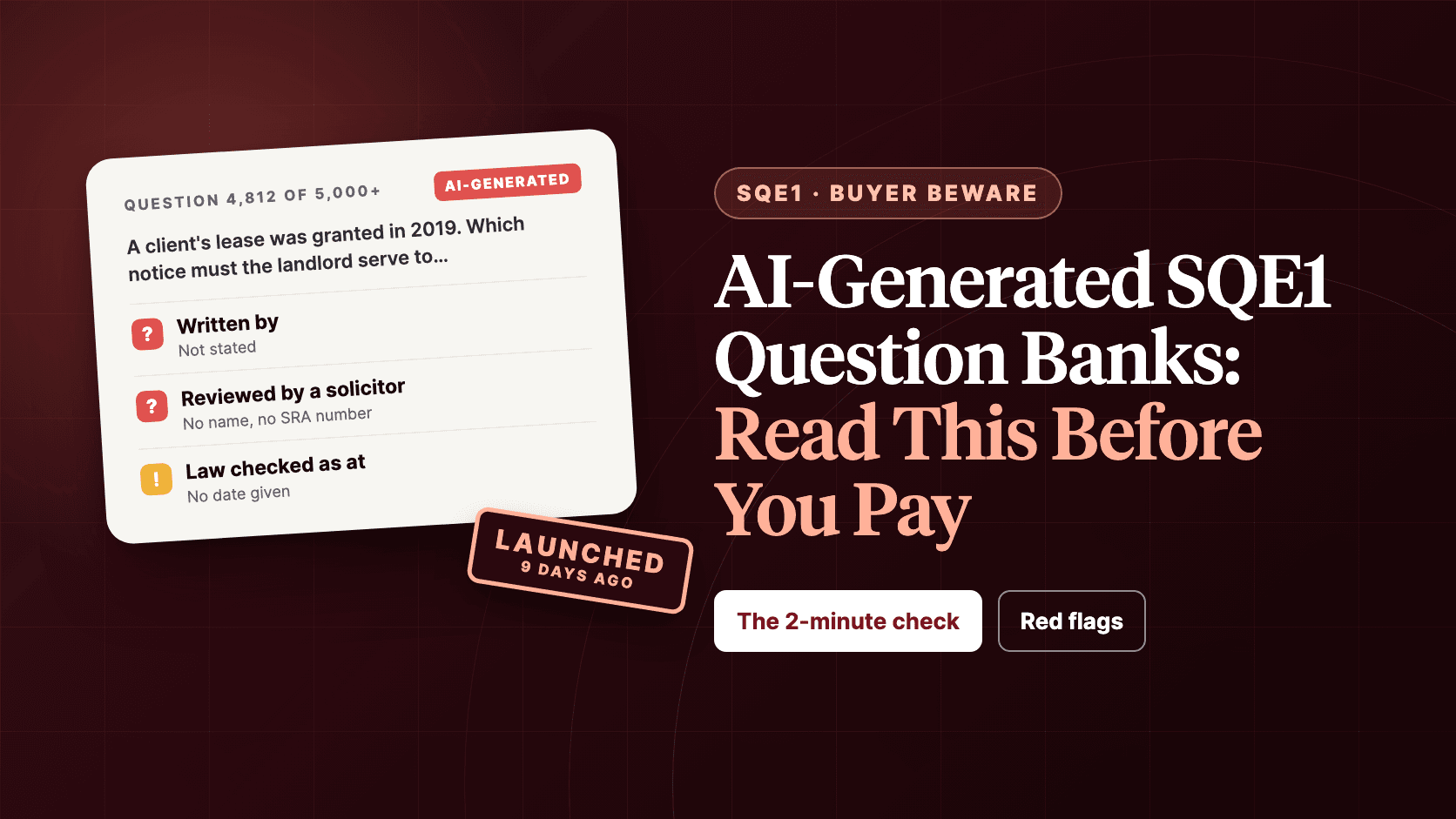
New AI SQE1 question banks appear every week. Why unreviewed AI questions are no better than a free chatbot, what the research shows, and a two-minute check before you buy.
Read the article
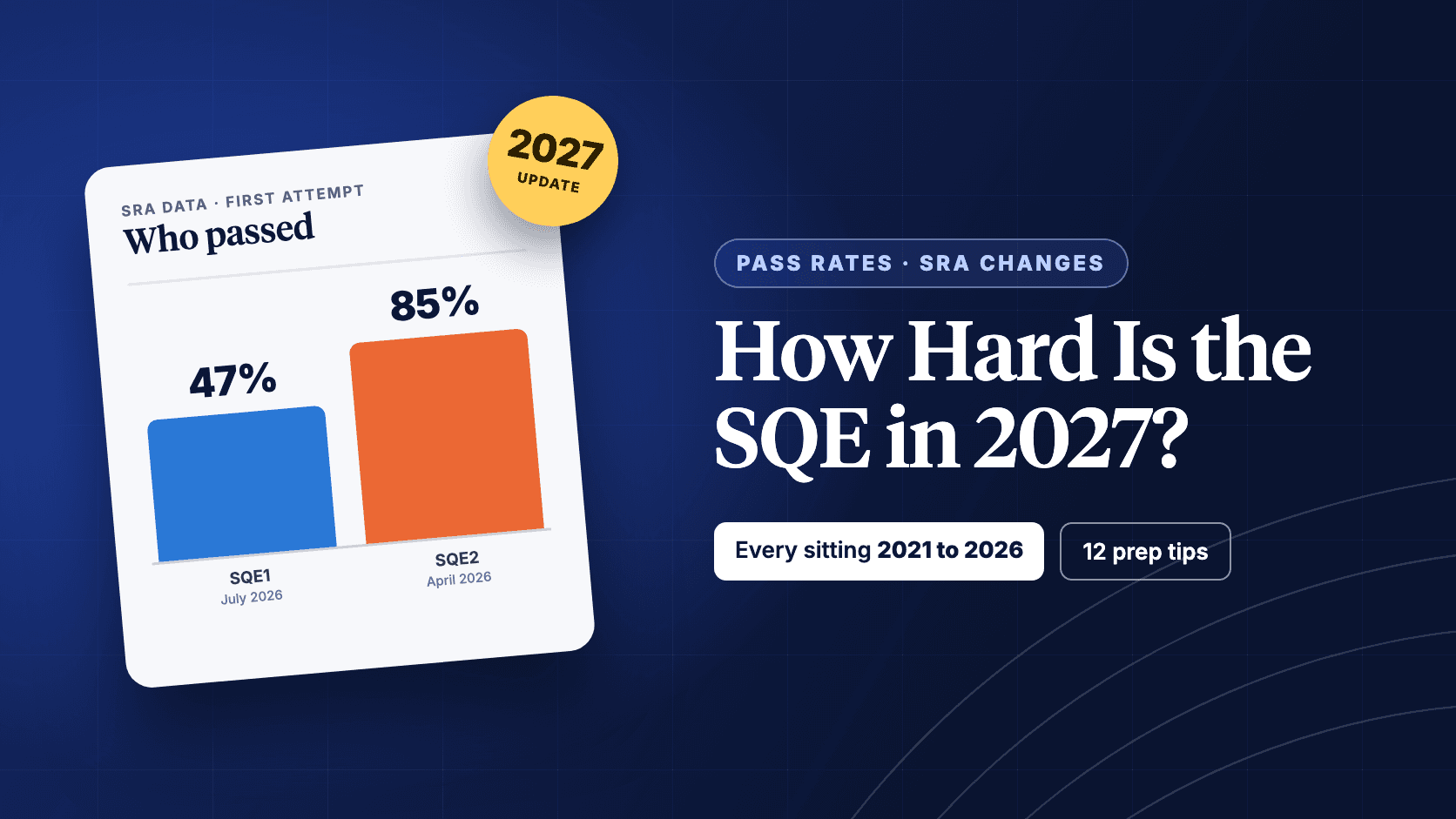
How hard is the SQE? Every SRA pass rate since 2021, why SQE1 fails half of first-timers, what changes in 2027, and 12 preparation tips built on the data.
Read the article
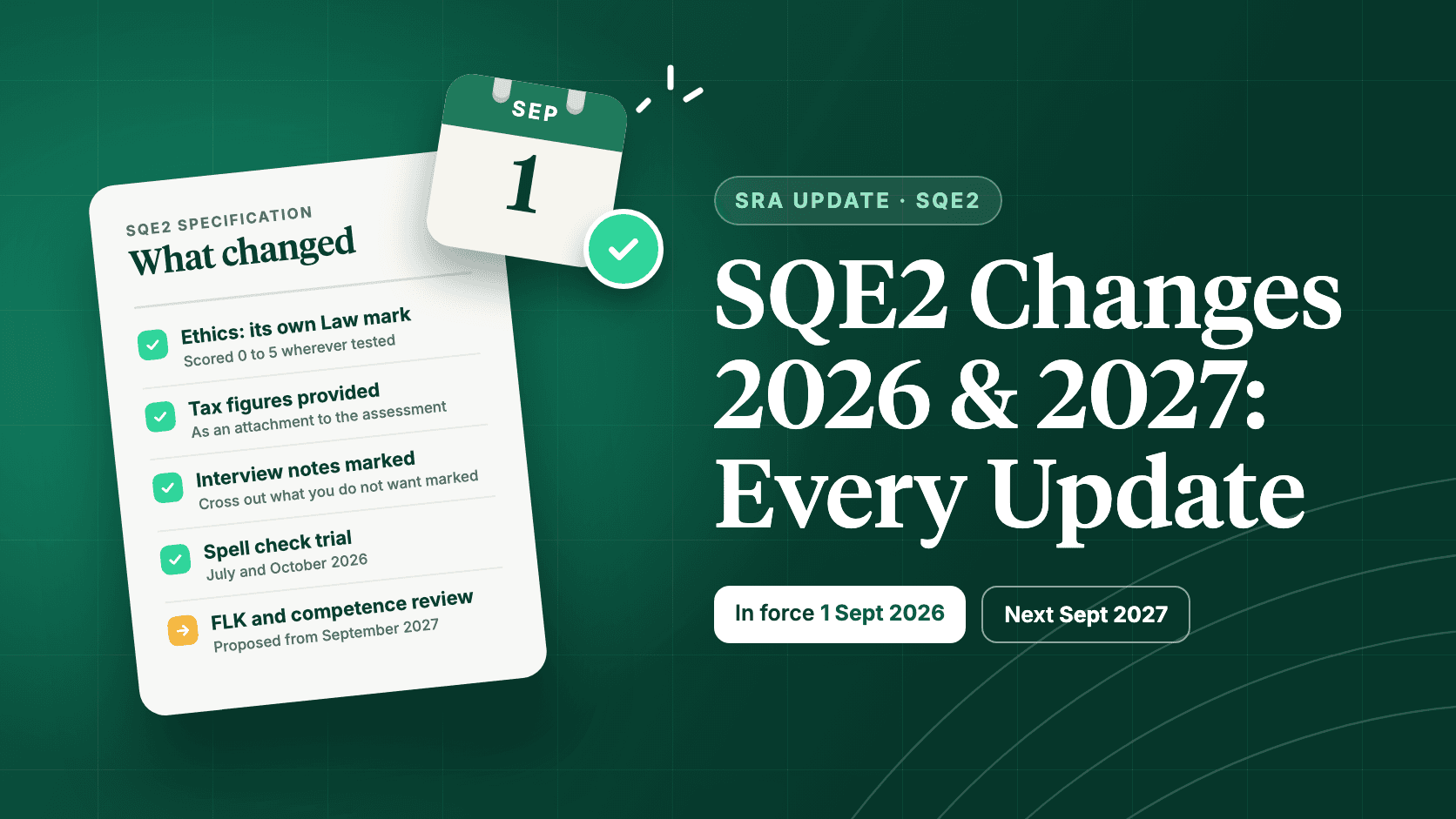
The SQE2 format is not changing, but the marking is. Every change from September 2026, the SRA's 30 September clarifications, and what is proposed for 2027.
Read the article