How Hard Is the SQE in 2027? Pass Rates, SRA Changes and How to Prepare
Updated 9 October 2026 with the SRA's July 2026 SQE1 results. Every figure is from the SRA's own statistical reports, each linked in the sources at the end.
The SQE is hard, but not in the way most people expect. SQE1 is the real filter: fewer than half of first-time candidates passed it in July 2026. SQE2 passes most people who reach it. And from January 2027 the SQE1 papers change shape. This is the 2027 edition of our guide How Hard is the SQE?, rebuilt around five years of SRA data and the latest SRA changes.
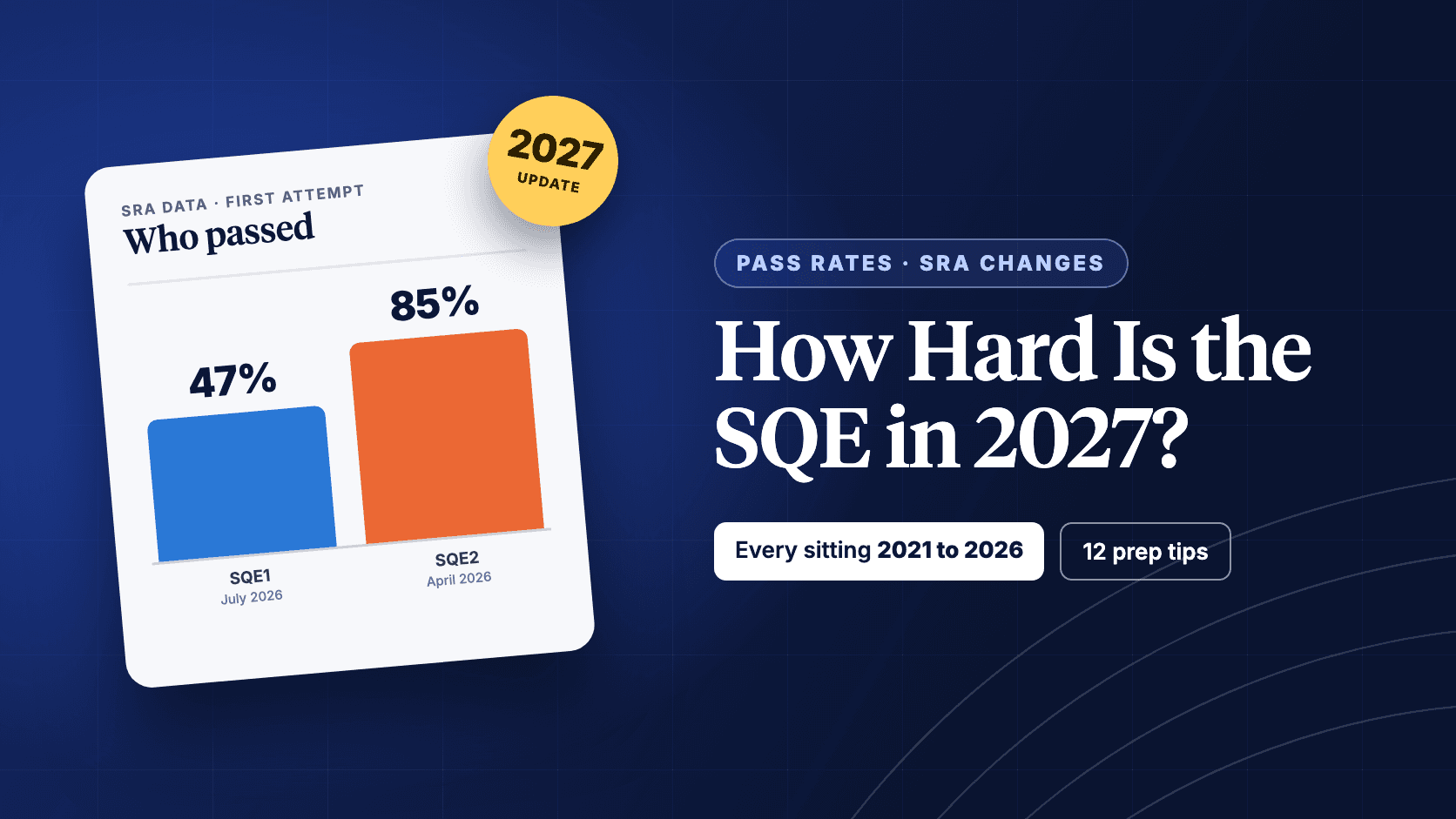
- SQE1 is the hard part. 47% of first-time candidates passed SQE1 in July 2026, and 58% in January 2026. Since the first sitting, first-attempt rates have run from 46% to 60%.
- SQE2 passes most candidates. 85% passed at the first attempt in April 2026, the highest rate yet. SQE2 first-attempt rates have run from 69% to 85%.
- Most people get there in the end. Of everyone who attempted SQE1 up to July 2025, 66% have now passed; for SQE2 it is 85%.
- Resits are much harder. The SRA says around 20% of SQE1 resitters typically pass.
- 2027 changes the papers, not the standard. From January 2027, each FLK paper has 170 questions in two sessions of 85, in the same time, so you get 108 seconds a question instead of 102.
- International and qualified lawyers pass at lower rates, and the gap is widest in SQE2 for candidates whose first language is not English (74% against 87% in April 2026).
How hard is the SQE, really?
The SRA describes the SQE as a single, rigorous assessment for everyone who wants to qualify as a solicitor in England and Wales. It has two parts:
Two multiple-choice papers, FLK1 and FLK2. From January 2027: 170 single-best-answer questions each, 340 in all. You must pass both.
16 practical stations: 4 oral (two interviews, two advocacy) and 12 written, across five practice areas. One pass mark for the whole assessment.
Qualifying work experience, a degree or equivalent, and character and suitability. Qualified lawyers do not need QWE.
So the honest answer to "how hard is the SQE?" is this: SQE1 is hard because of its breadth and its pace, and roughly one first-time candidate in two fails it at any given sitting. SQE2 is hard in a different way. It tests whether you can do the work of a new solicitor, but by the time you sit it you have already passed SQE1, so the cohort is stronger and the pass rate is higher.
The standard does not move between sittings. The SRA is clear that pass rates vary because the candidates sitting each time vary, not because one paper was easier. Results are now reported as a scaled score from 0 to 500, with 300 as the passing score (SQE1 since January 2024, SQE2 since January 2025).
SQE1 pass rates 2021 to 2026: what the SRA data shows
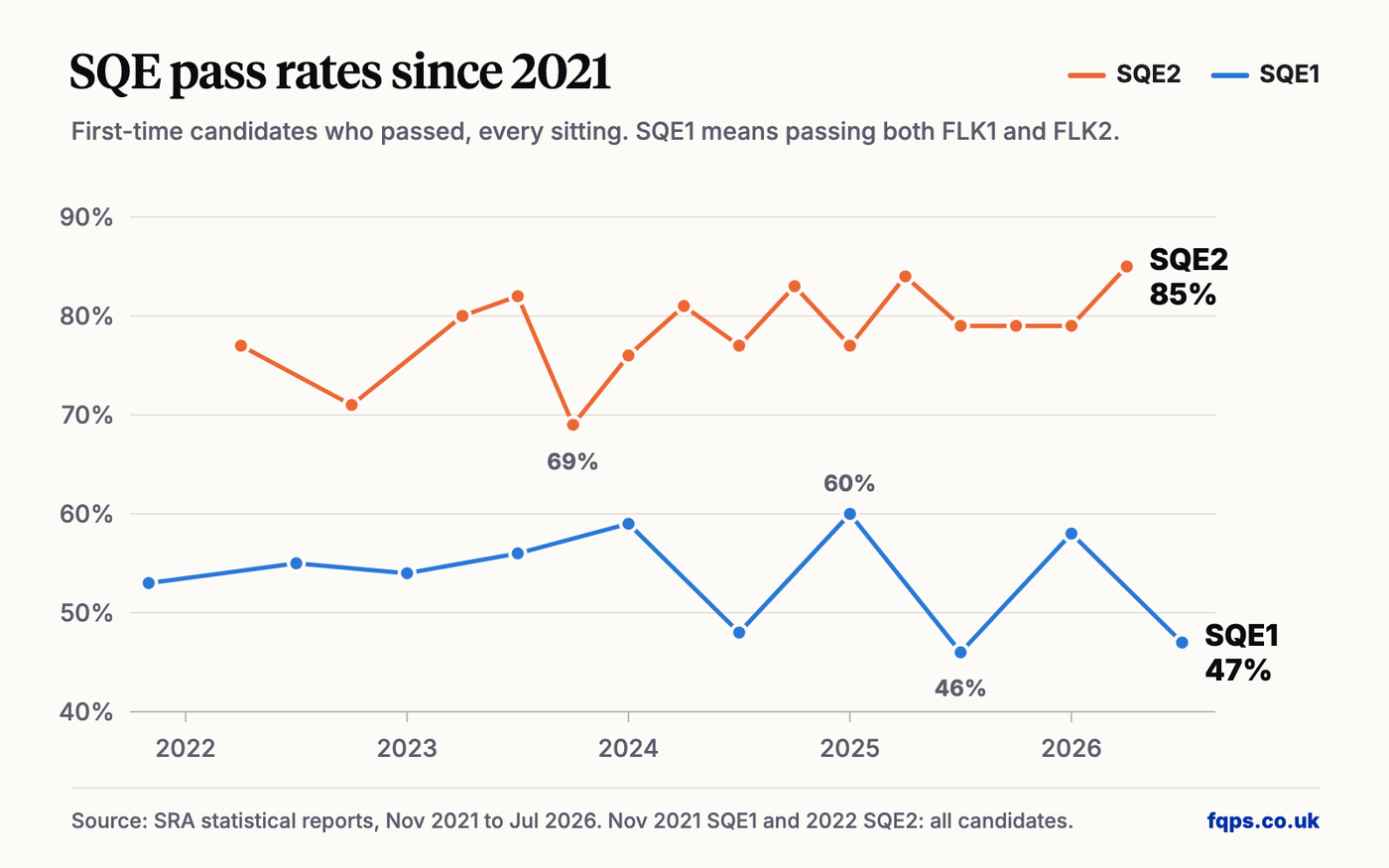
There have been ten SQE1 sittings. The most recent, July 2026, saw 6,315 candidates sit both papers and 5,012 sit them for the first time. 47% of those first-timers passed; across all candidates, including resitters, 42% passed.
SQE1 first-attempt pass rate, January vs July sittings
Candidates sitting both FLK1 and FLK2 for the first time. Since 2024, every January sitting has passed 58% or more and every July sitting 48% or less.
2023
2024
2025
2026
2022
2023
2024
2025
2026
Source: SRA SQE1 statistical reports, January 2023 to July 2026. The first sitting, November 2021, passed 53%.
The pattern above is the most useful thing in the SQE1 data. January sittings pass far more candidates than July sittings: 58% to 60% at every January since 2024, against 46% to 48% every July. The exam is the same standard both times. The difference is who sits it. The SRA's annual report shows July cohorts carry more resitters (in July 2025, 23% of FLK1 and 26% of FLK2 candidates were resitting, the highest proportions to date), and resitters pass at much lower rates.
Do not pick a sitting for its pass rate. A January sitting will not make you more likely to pass; being ready will. Pick the sitting that gives you enough preparation time, then sit full mocks until you are passing them comfortably.
SQE1 pass rates by sitting: the full table
FLK1 has had the higher pass rate at every sitting. In July 2026, 54% of first-time candidates passed FLK1 and 52% passed FLK2. The average scores were 291 on FLK1 and 289 on FLK2, and the median FLK2 score was 297: the typical July candidate finished just below the line.
| Sitting | FLK1 (1st attempt) | FLK2 (1st attempt) | SQE1 (1st attempt) | SQE1 (all) | 1st-attempt candidates |
|---|---|---|---|---|---|
| Nov 2021* | 67% | 54% | 53% | 53% | 1,073 |
| Jul 2022 | 67% | 59% | 55% | 53% | 1,736 |
| Jan 2023 | 62% | 58% | 54% | 51% | 2,827 |
| Jul 2023 | 68% | 59% | 56% | 53% | 3,005 |
| Jan 2024 | 66% | 63% | 59% | 56% | 5,580 |
| Jul 2024 | 57% | 52% | 48% | 44% | 4,168 |
| Jan 2025 | 66% | 64% | 60% | 56% | 5,908 |
| Jul 2025 | 54% | 50% | 46% | 41% | 4,736 |
| Jan 2026 | 65% | 61% | 58% | 53% | 6,760 |
| Jul 2026 | 54% | 52% | 47% | 42% | 5,012 |
* November 2021 was the first sitting, so every candidate was a first-timer and the SRA reported one rate. Before January 2024, pass marks were percentages (between 52% and 57%); since then the passing score is 300 out of 500. Sources: SRA SQE1 statistical reports, November 2021 to July 2026.
SQE2 pass rates 2022 to 2026
SQE2 has run 15 times. In April 2026, the largest sitting yet, 2,966 candidates were graded and 83% passed; among the 2,763 sitting for the first time, 85% passed. That beats the previous high of 84% in April 2025.
SQE2 first-attempt pass rate, every sitting
All 16 stations, one overall pass mark. The lowest sitting was October 2023 (69%); the highest is the latest, April 2026 (85%).
* The April and October 2022 reports gave one rate for all candidates. Source: SRA SQE2 statistical reports, April 2022 to April 2026.
| Sitting | 1st attempt | All candidates | 1st-attempt candidates |
|---|---|---|---|
| Apr 2022 | 77%* | 77% | 726* |
| Oct 2022 | 71%* | 71% | 646* |
| Apr 2023 | 80% | 77% | 923 |
| Jul 2023 | 82% | 79% | 944 |
| Oct 2023 | 69% | 64% | 542 |
| Jan 2024 | 76% | 73% | 833 |
| Apr 2024 | 81% | 79% | 2,097 |
| Jul 2024 | 77% | 74% | 860 |
| Oct 2024 | 83% | 81% | 840 |
| Jan 2025 | 77% | 75% | 940 |
| Apr 2025 | 84% | 82% | 2,577 |
| Jul 2025 | 79% | 76% | 809 |
| Oct 2025 | 79% | 78% | 1,140 |
| Jan 2026 | 79% | 80% | 873 |
| Apr 2026 | 85% | 83% | 2,763 |
* The April and October 2022 reports gave one pass rate and one candidate count for all candidates. Sources: SRA SQE2 statistical reports, April 2022 to April 2026. The July 2026 SQE2 report is not yet published.
Why is SQE2 so much higher? Because almost everyone sitting it has already proved their legal knowledge. The SRA's annual report is explicit: candidates who had passed SQE1 passed SQE2 at between 79% and 85% in 2024/25, while candidates who reached SQE2 without sitting SQE1 (mostly transitional, LPC-route candidates) passed at only 47% to 62%. The SRA adds that LPC graduates "cannot rely" on their LPC studies to pass SQE2.
How many people pass the SQE eventually?
A single sitting's pass rate makes the SQE look harsher than it is. In January 2026 the SRA published a four-year review of every sitting up to July 2025. It counts how many of the people who ever attempted each part have now passed it.
Out of everyone who has ever attempted each part, how many passed, and at which attempt
All SQE sittings from November 2021 to July 2025.
SQE1: 66.1% have passed (54.3% first time, 9.9% second, 1.9% third)
SQE2: 84.5% have passed (79.6% first time, 4.6% second, 0.3% third)
Source: SRA, "The SQE four years on: facts and figures" (29 January 2026).
Two things stand out. First, most people who pass SQE1 pass it first time: 82% of everyone who has passed SQE1 did so at their first attempt (94% for SQE2). Second, resits are steep. The SRA says that "typically, around 20%" of SQE1 resitters pass. In the 2024/25 annual report, SQE1 resitters passed at 25% in January 2025 and 20% in July 2025, and second attempts at SQE2 passed at between 53% and 75%, against 77% to 84% for first attempts.
You have up to three attempts at each part, within six years of your first SQE assessment. The SRA's own advice to resitters is to consider taking more time, or putting in more work or training, between sittings rather than rebooking the next window by default.
What changes in 2027 (and since our 2025 guide)
Our original guide covered the 2025 papers. Here is what is different now, from the SRA's announcements and the live assessment specifications.
| What | Before | Now and in 2027 |
|---|---|---|
| SQE1 questions per FLK paper | 180 (2 × 90) | 170 (2 × 85) from January 2027 |
| SQE1 questions in total | 360 | 340 |
| Time per session | 2 hours 33 minutes | 2 hours 33 minutes (unchanged) |
| Time per question | About 102 seconds | About 108 seconds |
| Subjects per session | Spread across both sessions | A fixed set of subjects in each session; ethics still tested throughout |
| Exam fees | SQE1 £1,934, SQE2 £2,974 | SQE1 £2,006, SQE2 £3,086 (from September 2026) |
| SQE2 format | 16 stations, one pass mark | Unchanged |
| SQE2 ethics marking | Part of the Law mark | A separate third Law criterion, marked 0 to 5 where an ethics point arises (from September 2026) |
| Tax figures (SQE1 and SQE2) | Not provided | Rates, thresholds and relief values provided where needed |
| Money laundering in SQE2 | Not listed for Property Practice | Also examinable in Property Practice |
| SQE2 April window | Fourth week of April | Starts a week earlier (20 April 2027) and runs four weeks |
SQE2 changes apply to assessments from 1 September 2026; SQE1 changes from the January 2027 sitting. Sources: SRA SQE1 assessment changes announced September 2026; SQE2 specification for assessments from 1 September 2026; SQE website, "How much does the SQE cost?". The pass standard does not change.
Two more changes are on the way but not yet final. The SRA is consulting until 3 December 2026 on a revised Statement of Solicitor Competence and Functioning Legal Knowledge, covering areas such as technology and AI and ethics. Final versions are due in April 2027, to take effect from September 2027, ahead of the January 2028 SQE1. And an independent technical review of the SQE is due to report in early 2027. For the full list, see our SQE 2027 changes hub, the SQE1 January 2027 format change and our SQE2 changes guide.
Six more seconds per question helps, and fixed subjects per session make each sitting more predictable. But the SRA has kept the blueprint and the standard the same, and the pass mark is set so that the standard holds. Expect the papers to feel slightly less rushed, not easier to pass.
Why is SQE1 so hard? Four reasons in the data
1. The syllabus is wide, and every subject counts
FLK1 covers Business Law and Practice, Dispute Resolution, Contract, Tort, the Legal System of England and Wales, Constitutional and Administrative Law and EU Law, and Legal Services. FLK2 covers Property Practice, Wills and the Administration of Estates, Solicitors Accounts, Land Law, Trusts, and Criminal Law and Practice. Ethics and professional conduct run through both. There is no choice of questions and no subject you can safely drop.
2. Some subjects sink more candidates than others
The SRA's annual report breaks scores down by subject. On average, candidates scored below the passing standard in most of them.
Average SQE1 score by subject, against the pass standard (300)
Mean scaled score of every candidate, January and July 2025 combined. Bars to the left mean the average candidate scored below the passing standard in that subject.
Source: SRA, SQE Annual Report 2024/25 (published 21 April 2026), tables 14 and 15. "Legal System" covers the legal system of England and Wales, constitutional and administrative law and EU law.
The SRA names Business Law and Practice and Dispute Resolution (FLK1) and Property Practice and Wills and Intestacy (FLK2) as the subjects candidates "continue" to find hardest. It also found the biggest gaps between passing and failing candidates in Tort and Business Law and Practice on FLK1, and Land Law and Criminal Law and Practice on FLK2. Those are the subjects where weaker candidates lose the most ground.
Ethics is the surprise: it is the highest-scoring subject on both papers. That is no reason to skip it. Ethics appears in every session, and the SRA tests it pervasively, inside questions on other subjects.
3. The questions test application, not recall
Every SQE1 question is a single-best-answer question: a short scenario and five plausible options, of which one is best. Knowing a rule is not enough; you have to spot which rule the facts engage and apply it under time pressure. The SRA publishes official sample questions that show the style.
4. Your academic record matters more than your background
In a report published in November 2025, Kaplan, which runs the SQE, analysed which candidate characteristics explain SQE scores. The two factors it could measure that mattered most for SQE1 were the ranking of your university (about 12% of the variation in scores) and your degree classification (about 11%). Ethnicity alone accounted for 7.6%. Parents' education (0.3%) and occupation (0.1%) were negligible once other factors were taken into account.
First-attempt pass rate by undergraduate degree classification
Along with university ranking, the strongest factor the SRA can measure.
Source: SRA SQE1 July 2026 and SQE2 April 2026 statistical reports. Third-class degrees were 1% of SQE1 candidates; too few sat SQE2 to report.
The most encouraging finding is the one that gets least attention: most of the variation in SQE scores is not explained by anything the SRA records. Kaplan's report leaves about 67% unexplained, and the SRA suggests factors such as motivation, aptitude and study time, adding that how a candidate prepares may matter more than demographics. In other words, preparation is the variable you control.
What makes SQE2 hard?
SQE2 assesses six skills (client interviewing and attendance note, advocacy, case and matter analysis, legal research, legal writing and legal drafting) across five practice areas: criminal litigation; dispute resolution; property practice; wills and intestacy, probate administration and practice; and business organisations, rules and procedures. You sit four oral stations in person in England and Wales and twelve written stations at a test centre, and you resit all 16 if you fail.
The 2024/25 annual report shows where candidates struggle:
- Written skills score lower than oral skills. Advocacy averaged 364 and interviewing 340, while legal writing averaged only 314, the lowest of the six skills.
- Business is the weakest practice area (average 312, against 349 for dispute resolution). The two lowest-scoring stations were Legal Research in Business Organisations and Legal Writing in Criminal Litigation (both 307).
- Your SQE1 score predicts your SQE2 result. SQE1 performance explains 23.5% of the variation in SQE2 scores, more than any other measured factor.
- Language shows up most in SQE2. In April 2026, first-time candidates whose first language is English passed at 87%; those with another first language at 74%.
Since September 2026 there are also new marking rules: ethics is a separate third criterion within the Law mark, interview notes are marked alongside the attendance note, and a spell check tool was trialled in the July and October 2026 written assessments. Our SQE2 changes guide explains each one.
How hard is the SQE for foreign and qualified lawyers?
The SQE is open to lawyers qualified anywhere, and they make up a large share of candidates: 28% of first-time SQE1 candidates in July 2026 said they were already qualified lawyers, and 30% said English was not their first language. A third went to school outside the UK. The SRA reports SQE assessments delivered in 37 countries in 2024/25.
The data shows these candidates find the SQE harder on average, and that the gap is widest at SQE2:
| First-attempt pass rate | SQE1, July 2026 | SQE2, April 2026 |
|---|---|---|
| Not a qualified lawyer | 48% | 85% |
| Qualified lawyer | 45% | 75% |
| First language: English | 50% | 87% |
| First language: another language | 42% | 74% |
| Went to school outside the UK | 44% | n/a |
Sources: SRA SQE1 July 2026 and SQE2 April 2026 statistical reports (first-attempt candidates, SQE1 column). The SQE2 report does not break down schooling.
Across every sitting to July 2025, the SRA puts the overall pass rate for candidates whose first language is not English at 47% for SQE1 (56% for native speakers) and 63% for SQE2 (81%). Being a qualified lawyer abroad is not, on its own, an advantage: English law is different from every legal system the SRA has reviewed, and SQE2 rewards writing the way an English solicitor writes.
Can you skip part of the SQE?
Possibly part of it. Exemptions are only available to qualified lawyers, and the SRA is blunt about SQE1: it says SQE1 exemptions "are very rare", and only one has been granted since 2021. SQE2 exemptions are more realistic if your qualification gives you practising rights in the areas SQE2 covers and you have at least two years of professional legal experience. Three rules catch people out:
- You cannot get an exemption from a part you have already failed, or one you have sat and are awaiting results for.
- Apply to the SRA before booking the assessment you want to be exempt from.
- Qualified lawyers do not need qualifying work experience, but must show English or Welsh proficiency, for example by passing SQE2 or with an IELTS (Academic) UKVI score of 7.5 if exempt from SQE2.
SQE1 and the SQE2 written stations run at Pearson VUE centres in the UK and many other countries; the SQE2 oral stations are held in person in Birmingham, Cardiff, London or Manchester. Our free guide Qualifying as a Foreign Lawyer: the SQE Route walks through every step, and the SQE2 exemption finder lists exemptions by jurisdiction.
Who passes the SQE? What else the SRA can measure
Overall pass rates for apprentices to July 2025, against 66% and 85% for all candidates. Four days a week in practice seems to help.
Candidates who declare a disability perform at least as well as others. Those with a reasonable adjustment for a neurodivergent condition scored slightly higher.
April 2026 SQE2: 90% of 16 to 24s passed first time, 81% of 25 to 34s, 59% of 35 to 44s and 52% of 45 to 54s.
July 2026 SQE1: 49% of first-timers with some QWE passed, against 45% of those without.
The SRA's reports also show differences by ethnicity: in July 2026, 57% of White first-time candidates passed SQE1, against 38% of Asian and 28% of Black candidates. The SRA says this is a long-standing pattern across legal and professional assessments with "multiple, complex factors", and that ethnicity alone explains under 8% of the variation in SQE1 scores. If you have a disability or condition, ask early for reasonable adjustments; if cost is a barrier, the SRA runs a fund for disadvantaged candidates.
How to prepare for the SQE in 2027: 12 tips from the data
These are our recommendations, each tied to something the SRA figures show.
- Put most of your time into SQE1. It is where around half of candidates fall at each sitting, and your SQE1 score also predicts how you do at SQE2.
- Aim well above 300, not at it. In July 2026 the median FLK2 candidate scored 297. Passing candidates averaged between 332 and 390 in every subject in 2024/25. Treat a comfortable margin in full mocks, not a scrape, as your sign that you are ready.
- Start with the subjects that sink candidates. Business Law and Practice, Dispute Resolution, Property Practice and Wills score lowest. Tort, Land Law and Criminal Law and Practice separate passes from fails most sharply.
- Keep ethics and Solicitors Accounts in every week. Ethics appears in every session; accounts questions sit inside both property and wills sessions from 2027. Our free ethics guide covers the rules most tested.
- Train at the 2027 pace. 85 questions in 2 hours 33 minutes is about 108 seconds each. Practise whole 85-question sessions, not short sets, so the pace becomes automatic.
- Practise in the 2027 session groupings. Each session now has a fixed set of subjects (for example, FLK1 session 1 covers business, dispute resolution and legal services). Revise and mock in those groups.
- Learn to eliminate, not just to recall. With five plausible options, the skill is ruling out four. Review every wrong answer and every lucky guess, and write down why the best answer wins.
- Use the official material first. The SRA's assessment specification and sample questions define what can be tested. Our SQE1 readiness checklist turns the January 2027 specification into a tick list.
- If you need a resit, give it time. With around 20% of SQE1 resitters typically passing, a rushed rebooking is the worst option. Diagnose your weak subjects from your result, rebuild them, and only rebook when your mocks have moved. Our SQE1 resit guide sets out a plan.
- For SQE2, practise writing above all. Legal writing is the lowest-scoring skill, and the oral stations score highest. Write attendance notes, letters and drafts under time, and get them marked against the SRA's assessment criteria by someone qualified.
- If English is not your first language, write every day. The language gap is 13 points at SQE2. Timed writing in plain, precise English, reviewed by a solicitor, is the most direct fix.
- Plan the whole route, not just the exam. Check booking windows and the law cut-off (four calendar months before each window), start recording your QWE, and use our QWE checker to see what counts.
A sample six-month SQE1 plan
This is an example of how we would shape six months of full-time study; part-time candidates usually need longer. It is our suggestion, not an SRA requirement.
- Month 1Baseline and the weakest subjectsSit one full FLK1 and FLK2 mock cold to find your gaps, then start with Business Law and Practice, Dispute Resolution and Property Practice.
- Months 2 to 3Cover the whole syllabusWork through every FLK subject with daily question practice and weekly review of wrong answers. Ethics and accounts every week.
- Month 4Switch to session practiceTimed 85-question sessions in the 2027 subject groupings. Track your score by subject.
- Months 5 to 6Full mocks and targeted repairA full FLK1 and FLK2 mock every week or two, each followed by focused work on the subjects that dropped.
- Final fortnightConsolidate, do not cramRevisit your error log, rest, and confirm your ID, test centre and timings.
Sit a free full SQE1 mock in the 2027 format
Create a free FQPS account and get one full FLK1 and one full FLK2 mock (2 × 85 questions each, January 2027 format). No card needed.
What the SQE costs in 2026 and 2027
The SRA's fees rose for assessments from September 2026. All fees are VAT exempt and are paid when you book.
| Fee | Up to Sept 2026 | From Sept 2026 |
|---|---|---|
| SQE1 (FLK1 and FLK2 together) | £1,934 | £2,006 |
| One FLK paper (resit) | £967 | £1,003 |
| SQE2 (oral and written together, or a full resit) | £2,974 | £3,086 |
| SQE1 and SQE2, first attempts | £4,908 | £5,092 |
| Appeal: first stage / final | £350 / £850 | £350 / £850 |
Source: SQE website, "How much does the SQE cost?", read 9 October 2026. Appeal fees are refunded if the appeal is upheld.
On top of the exam fees come preparation costs, travel to an SQE2 oral venue, and the SRA's admission fee (£100). Because resits cost the same as first attempts and pass at lower rates, the cheapest SQE is the one you pass first time. For preparation, our SQE course prices page compares the main providers, each price checked and linked to its source.
Key SQE dates for 2026 and 2027
- 8 October to 3 December 2026SRA consultation on the Statement of Solicitor Competence and FLKFinal versions due April 2027, effective September 2027.
- 13 October 2026 (6pm) to 16 October (5pm)SQE2 January 2027 seat reservation formsSee our SQE2 January 2027 booking guide.
- From 27 October 2026SQE2 October 2026 assessmentsResults 23 February 2027.
- 23 November 2026SQE1 January 2027 booking closesSee our SQE1 January 2027 booking guide.
- 11 to 22 January 2027SQE1 January 2027: the first sitting in the new formatFLK1 11 to 15 January, FLK2 18 to 22 January. Results 9 March 2027.
- 26 January to 4 February 2027SQE2 January 2027Oral 26 to 29 January, written 2 to 4 February. Results 20 May 2027.
- From 20 April 2027SQE2 April 2027, a week earlier than before
- 12 to 23 July 2027SQE1 July 2027FLK1 12 to 16 July, FLK2 19 to 23 July.
Source: SQE website, assessment dates and booking windows, read 9 October 2026. All dates are UK time. Full list: SQE1 and SQE2 exam dates.
The bottom line: is the SQE too hard?
No, but it is unforgiving of under-preparation. SQE1 fails around half of first-time candidates at each sitting, and resits succeed far less often than first attempts. SQE2 passes most candidates who reach it, but written skills and language are where it bites.
The data also points to what works. Strong candidates pass at the first attempt, most of the variation in scores comes down to things no demographic table can see, and the subjects that sink people are the same every year. Prepare for those, practise at the real pace, and give yourself a margin above 300.
Practise SQE2 with a solicitor
SQE2 Preparation includes 6 live 1:1 mocks a month with a solicitor and written feedback, for £189 a month. No minimum term.
Keep reading
How hard is the SQE? FAQs
How hard is the SQE exam?
SQE1 is the hard part: between 46% and 60% of first-time candidates have passed at each sitting, and 47% passed in July 2026. SQE2 passes most candidates who reach it, with first-attempt rates between 69% and 85%. Of everyone who has attempted SQE1, 66% have now passed; for SQE2 the figure is 85%.
What is the SQE1 pass rate in 2026?
In January 2026, 58% of first-time candidates passed SQE1 (53% of all candidates). In July 2026, 47% of the 5,012 first-time candidates passed (42% of all candidates). FLK1 first-attempt pass rates were 65% and 54%, and FLK2 61% and 52%.
What is the latest SQE2 pass rate?
At the April 2026 sitting, 85% of the 2,763 first-time candidates passed SQE2, and 83% of all 2,966 graded candidates. It is the highest SQE2 first-attempt rate so far. The July 2026 SQE2 report has not yet been published.
Why is the SQE1 pass rate lower in July than in January?
The standard is the same at every sitting; the cohort differs. July sittings include more resitting candidates, who pass at much lower rates, so the overall and first-attempt rates have been lower in July (46% to 48% at first attempt since 2024) than in January (58% to 60%).
Is the SQE harder than the LPC?
They test different things. The SRA says the SQE tests whether a candidate is ready to practise as a solicitor, which is more demanding than the LPC's focus on readiness for a training contract. LPC graduates who take SQE2 have lower pass rates, and the SRA says they cannot rely on their LPC studies to pass it.
Is the SQE changing in 2027?
Yes. From January 2027 each SQE1 paper has 170 questions in two sessions of 85, with a fixed set of subjects per session and the same 2 hours 33 minutes per session. SQE2's format is unchanged, but since September 2026 ethics is marked as a separate criterion and tax figures are provided. The SRA is also consulting on changes to the competence statement and FLK from September 2027.
How hard is the SQE for foreign lawyers?
On average, harder. In July 2026, 45% of first-time SQE1 candidates who were qualified lawyers passed, against 48% of others. At SQE2 in April 2026 the gap was wider: 75% against 85%. Candidates whose first language is not English passed SQE2 at 74%, against 87%. Qualified lawyers do not need qualifying work experience and may apply for exemptions, but SQE1 exemptions are very rare.
How many times can you sit the SQE?
You have up to three attempts at each part of the SQE, within six years of your first SQE assessment. At SQE1 you resit only the FLK paper you failed; at SQE2 you resit all 16 stations. The SRA says around 20% of SQE1 resitters typically pass.
What is the SQE pass mark?
Results are reported as a scaled score from 0 to 500, and the passing score is 300 for FLK1, FLK2 and SQE2. The pass mark is set so that the standard stays the same from one sitting to the next.
How long should I study for the SQE?
The SRA does not set a study time. As a rough guide, we suggest around six months of full-time study for SQE1, and longer part-time. The SRA's research suggests factors such as study time and preparation explain much of the variation in scores that background does not, so plan for enough time to pass full mocks with a margin.
How much does the SQE cost in 2027?
For assessments from September 2026, SQE1 costs £2,006 (£1,003 per FLK paper) and SQE2 costs £3,086, so £5,092 for both at the first attempt. Resits cost the same as the original fee. All SQE fees are VAT exempt.
Sources
- SRA SQE1 statistical reports, November 2021 to July 2026, and SQE2 statistical reports, April 2022 to April 2026: sqe.sra.org.uk/sqe-results/reports (latest: SQE1 July 2026, published 29 September 2026; SQE2 April 2026, published 27 August 2026).
- SRA, SQE Annual Report 2024/25, published 21 April 2026.
- SRA, The SQE four years on: facts and figures, 29 January 2026, and Kaplan, Examining candidate characteristics and factors that influence scores in the SQE, November 2025.
- SQE website: How much does the SQE cost? and assessment dates and booking windows, read 9 October 2026.
- SRA, SQE exemptions (updated 24 September 2026) and Applying for an SQE1 exemption (updated 6 August 2026).
The SQE and SOLICITORS QUALIFYING EXAMINATION trade marks are the property of and are used under licence from the Solicitors Regulation Authority. FQPS Academy is an independent SQE preparation provider and is not affiliated with or endorsed by the SRA or Kaplan. This article is general information, not legal or regulatory advice; check the SRA and SQE websites for the rules that apply to you.
Stay up to date
Never miss the latest SRA updates. Receive product updates, news and customer stories right into your inbox.

Keep reading
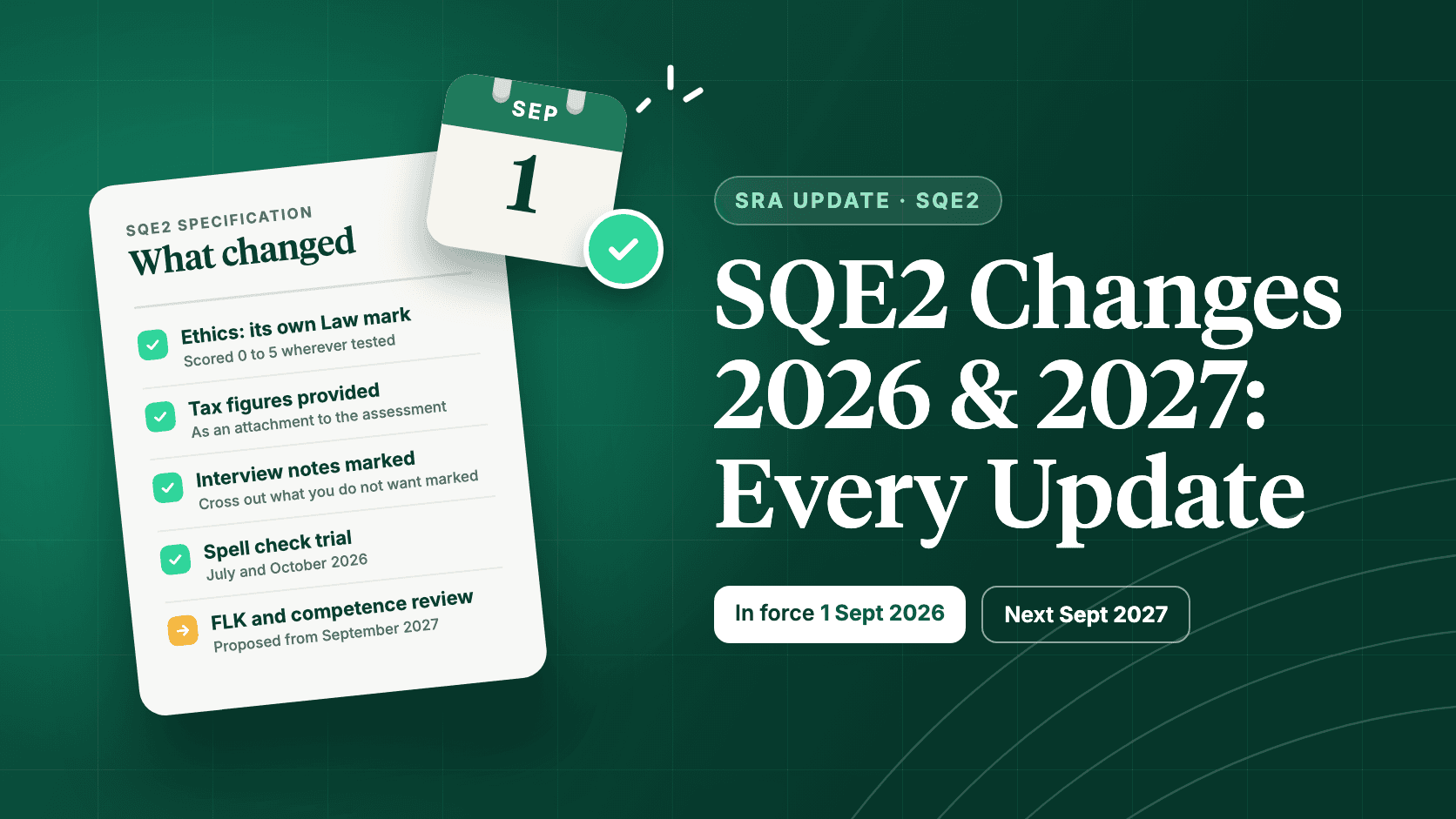
The SQE2 format is not changing, but the marking is. Every change from September 2026, the SRA's 30 September clarifications, and what is proposed for 2027.
Read the article
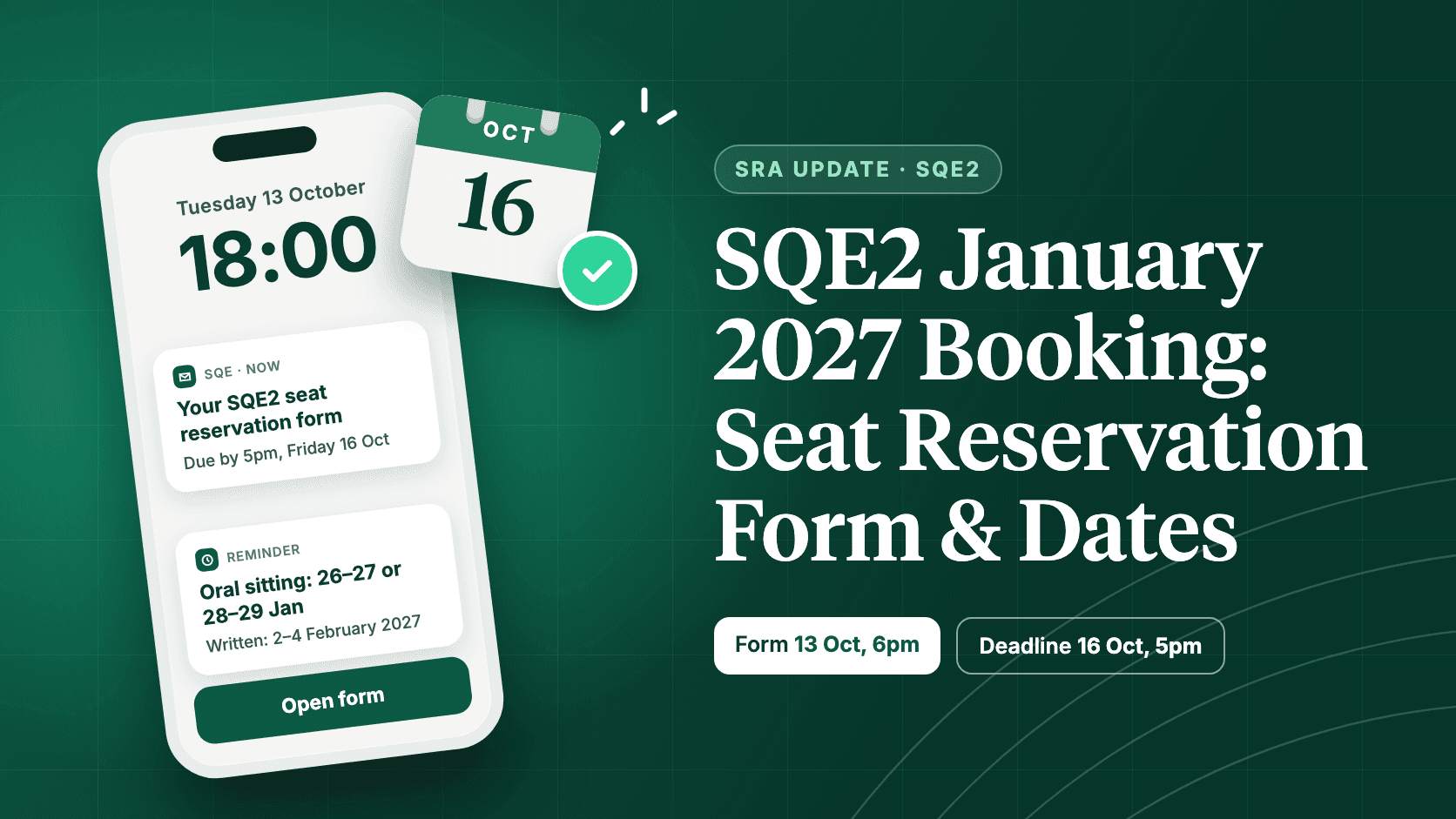
Your SQE2 January 2027 seat reservation form is emailed from 6pm on 13 October 2026 and closes at 5pm on the 16th. Three days, then a 48-hour payment window.
Read the article

Your SQE1 seat reservation form is sent at 6pm on 22 September 2026 and closes on the 24th. Two days — here are the pre-booking steps to finish first.
Read the article