1,000+ Free SQE1 Sample Questions MCQ [2026 Updated List]
![1,000+ Free SQE1 Sample Questions MCQ [2026 Updated List]](/_next/image?url=https%3A%2F%2Fcdn.sanity.io%2Fimages%2F77h4lrsj%2Fproduction%2F1faab4fce69ffdd6ecf10237b7d76a5d362534f1-3206x1496.png&w=1920&q=75)

Last updated: 25 July 2026 — checked against the SRA's current sample-question bank, the January 2026 SQE1 statistical report, and every provider page linked below.
More than 1,000 free SQE1 sample questions are available in 2026. The biggest sources: FQPS Academy's free tier (one complete 180-question FLK1 mock and one complete 180-question FLK2 mock plus daily MCQs — solicitor-written, with feedback on every answer), the SRA's 220 official questions (110 per paper, answer keys only), QLTS School's two free mocks and BPP's 50-question pack — plus 23 brand-new, fully explained questions further down this page. The comparison table below links every source.
Where can you actually find free SQE1 sample questions in 2026 — and why do so many candidates who collect hundreds of them still fail the exam?
The first half of that question has a concrete answer, and this guide is it. More than 1,000 free SQE1 sample questions are available right now: 220 official questions published by the SRA itself — many of them retired from real sittings — free questions from FQPS Academy including a complete 180-question FLK1 mock and a complete 180-question FLK2 mock, granted the moment you create a free account, full free mock exams from QLTS School, free question packs from BPP, the University of Law and several independent sites, and 23 brand-new, fully explained SQE1-style questions you can attempt on this page without registering for anything. We checked every source ourselves in July 2026, counted only what we could verify, and flagged exactly what each one asks of you before you can start — because some of the counts quoted in other roundups (and, candidly, in earlier versions of this very article) are stale, unverified, or simply wrong.
The second half of the question matters more, and it is where this guide differs from a list of links. Candidates rarely fail SQE1 because they studied the wrong law; they fail because they practised the wrong way, or barely practised at all. SQE1 is not an essay exam and it is not a memory test in the way a university law exam is. It is 360 single best answer questions, delivered on a screen, under strict time pressure, in which every question gives you five answers that all sound plausible and asks you to pick the best one. Reading prepares you to recognise the law. Only questions prepare you to apply it in one minute and forty-two seconds, repeatedly, for more than five hours per paper. Candidates who discover this in the exam room discover it too late.
The stakes of getting this right are not trivial. At the January 2026 sitting, 8,287 candidates were entered for FLK1 and 7,918 for both parts of SQE1. Of those who took both parts, 53% passed overall, and even among first-attempt candidates — who consistently outperform resitters — the pass rate was 58%. Roughly four in ten prepared, self-selected candidates walked away without a pass, having each paid £1,934 in assessment fees alone.
Sources: SRA — SQE1 January 2026 statistical report (PDF) · SRA — SQE assessment fees
So this page does three things, in order. It explains what SQE1 actually asks of you, because free questions make far more sense once you understand the exam they imitate. It lists every verified source of free SQE1 sample questions in 2026, with honest counts and sign-up flags. And it gives you 23 new questions to attempt right now — each one explaining not just why the right answer is right, but why each wrong answer is wrong, which is something even the SRA's official bank does not do.
What SQE1 actually tests — a two-minute primer
SQE1 is the first of the two Solicitors Qualifying Examination assessments, and it examines what the SRA calls functioning legal knowledge — your ability to apply the law of England and Wales to realistic client facts, at the standard of a newly qualified solicitor. It is made up of two separate assessments, FLK1 and FLK2, sat on different days. Each assessment contains 180 single best answer multiple-choice questions, split into two sessions of 90 questions, with 2 hours 33 minutes per session and a 60-minute break in between. That works out at 1 minute 42 seconds per question, sustained across a full working day, twice. The exams are closed book and are sat on a computer at Pearson VUE test centres.
Source: SRA — the SQE1 assessment day
Every question follows the same structure: a factual scenario, a single question, and five answer options of which exactly one is the best. The wrong options are plausible by design — they mirror the errors a competent-but-not-quite-ready candidate would actually make. This is the most important thing to internalise before you touch any sample questions: SQE1 distractors punish approximate knowledge. Knowing roughly how a topic works is precisely the state of knowledge the wrong answers are aimed at.
Source: SRA — SQE1 assessment specification
The two papers divide the syllabus as follows. FLK1 covers Business Law and Practice, Dispute Resolution, Contract, Tort, the Legal System of England and Wales, Constitutional and Administrative Law and EU Law, and Legal Services. FLK2 covers Property Practice, Wills and the Administration of Estates, Solicitors Accounts, Land Law, Trusts, and Criminal Liability and Criminal Law and Practice — which the specification counts as two areas, bringing the SQE1 total to thirteen. Ethics and professional conduct are not a separate paper — they are examined pervasively, meaning an ethics point can surface inside any question on any subject, in either paper.
Source: SRA — SQE1 assessment specification
Marking is not a raw percentage. Your score is placed on a scale of 0 to 500, and the pass mark is always set at 300, using a standard-setting process (the Modified Angoff method) in which a panel of solicitors judges, question by question, how many just-competent day-one solicitors would answer correctly. In January 2026 the passing score corresponded to a scaled 300 on both papers, with mean candidate scores of 311.2 on FLK1 and 304.3 on FLK2 — which tells you how little margin separates the average candidate from failure.
Sources: SRA — marking and standard-setting policy · SRA — SQE1 January 2026 statistical report (PDF)
Two administrative facts belong in every candidate's planning. First, the cost: SQE1 currently costs £1,934 (£967 per paper, booked together), rising to £2,006 for bookings from September 2026, with SQE2 at £2,974 rising to £3,086 — so a single resit is an expensive way to discover you were not ready. Second, the attempts rule: you have a maximum of three attempts at each part, within six years of your first sitting. Every attempt is precious, which is exactly why free practice material deserves to be used deliberately rather than casually.
Sources: SRA — SQE assessment fees · SRA — resits policy
The July 2026 sitting has just taken place (FLK1 on 13–17 July, FLK2 on 20–24 July, with results due on 8 September 2026), so if you are reading this while planning ahead, the next SQE1 window is January 2027: FLK1 on 11–15 January and FLK2 on 18–22 January. If you are targeting that sitting, you have roughly six months — which, as we explain further down, is about right for a first serious pass through the question banks below.
Every free SQE1 sample question available in 2026 — the verified list
In 2026 there are more than 1,000 free SQE1 sample questions available across thirteen sources; the largest are FQPS Academy's free tier (450+ questions, including one complete 180-question FLK1 mock and one complete 180-question FLK2 mock), the SRA's 220 official questions and QLTS School's two free mock tests. Most "free SQE1 questions" roundups — including the earlier versions of this article — repeat question counts from other roundups without checking them. For this update we visited every source, confirmed what is actually free today, and recorded what each provider asks for in exchange. Where a count could not be verified, we say so rather than guessing.
| Source | Free questions | Answer explanations? | Sign-up required? | Notes |
|---|---|---|---|---|
| FQPS Academy free tier | 450+ — one full 180-question FLK1 mock + one full 180-question FLK2 mock, plus daily MCQs (≈150 a month) | Yes — detailed feedback on every question | Free account | Solicitor-written, no AI-generated content; free mocks never expire; includes daily flashcards and a free revision plan |
| SRA official sample questions | 220 (110 FLK1 + 110 FLK2) | No — answer keys only | No | Includes 130 retired real-exam questions; 50 newest added Nov 2025 |
| FQPS Academy — this page | 23 (11 FLK1 + 12 FLK2) | Yes — full explanations | No | New for 2026; written and peer-reviewed by our team |
| QLTS School | 100+ (two free mock tests) | Yes | No payment details; email may be required | Their own pages describe the mocks as 50 and as 90 questions per paper |
| BPP University Law School | 50 MCQs + a mock of unstated length | Pre-set feedback on the mock | Yes — request form | Part of a free resource pack with recorded lectures |
| University of Law revision app | 45 | Yes | App download | iOS and Android; more questions unlock via ULaw textbooks |
| The Qualified Path | 39 | Instant results | No | Independent browser tool covering all 13 subjects |
| UOLLB (UOL Press) | 33 | Yes | No | PDF download; not affiliated with the University of Law |
| ReviseSQE | 1 worked example | Yes | No | Their main products are paid question books |
| BARBRI SQE Edge | Count not published | — | Yes — registration | Free taster platform aimed at university students |
| Lawprof | Count not published (one free FLK1 and one free FLK2 mock) | — | Likely account | Paid tier holds their full bank |
| British Law Academy | Count not published | Results after completion | Google Form; site states your data may be used to contact you | Free FLK1 and FLK2 tests |
| AllAboutLaw | 0 currently | — | — | Its 90-question free mock is offline pending a relaunch |
| Total | 871 verified in fixed sets · 1,000+ once daily allowances and unpublished free mocks are included |
Here is the arithmetic, in the open, because a headline number you cannot check is exactly what this article exists to correct. The named, fixed sets come to 871 questions: 220 from the SRA, the 360 in FQPS Academy's two free full-length mocks (180 questions each, mirroring the real papers), at least 100 at QLTS School, 50 at BPP, 45 in the University of Law app, 39 at The Qualified Path, 33 from UOLLB, ReviseSQE's single worked example, and the 23 on this page. On top of that sit the free sources that are not a fixed set: FQPS Academy's daily allowance adds roughly 150 questions a month on top of its 360 mock questions, and the free mocks at BARBRI, Lawprof and British Law Academy are real but unquantified. Put together, the free material comfortably clears 1,000 SQE1 sample questions, more than five times the 180 questions in a single FLK paper. Used properly, that is a serious foundation; used as a substitute for structured preparation, it has some sharp limitations we will come to below.
The SRA's official SQE1 sample questions — start here
The single most valuable free resource is the SRA's own bank, and it should anchor everything else you do. The regulator publishes 220 SQE1 sample questions — 110 per paper — and the numbering is worth knowing: for each FLK, questions 1–45 are the original specimen set released before the first sitting in 2021, and questions 46–110 are the pre-tested set — 130 questions in total (65 per paper) that appeared in live exams and have since been retired. The most recent 50 were added in November 2025, so even experienced resitters should check for material they have not seen. The pre-tested sets include something no commercial provider can offer: the real percentage of candidates who answered each question correctly, which lets you benchmark every answer you give against the actual cohort.
Sources: SRA — official SQE1 sample questions · SRA — November 2025 release of 50 new questions
The direct links, so you do not have to dig through the SRA's navigation:
- FLK1 online: original set, questions 1–45 · pre-tested set, questions 46–110
- FLK2 online: original set, questions 1–45 · pre-tested set, questions 46–110
- PDF versions of all four sets (last updated 2 April 2026) are on the sample-questions page, alongside Welsh-language versions of everything except the newest 50, which the SRA says are still being translated
- Exam-interface demo: try the real Pearson VUE software in English or Welsh — worth twenty minutes of anyone's time before sitting
The bank has two significant limitations, and the SRA is upfront about both. It comes with answer keys only — no explanations. When you get a question wrong, nothing tells you why, or why the option that tempted you was written to tempt you. And 220 questions is, in exam terms, barely more than a single paper's worth of material: it cannot cover the full syllabus in depth, and the SRA itself notes the sets are not designed to operate as a full mock. Treat the official bank as your calibration instrument, not your training programme.
One clarification that trips up many candidates: you may see references elsewhere to "Kaplan sample questions" as though they were a separate bank. Kaplan is the SRA's appointed assessment provider — the organisation that actually writes and delivers the live exam — and the official sample questions above are the Kaplan-authored material. We could find no separate public Kaplan bank, and older roundups citing one appear to be out of date.
FQPS Academy's free SQE1 mocks and daily questions — 450+ MCQs with feedback
The largest free offering with explanations is our own, and it is worth spelling out exactly what a free FQPS Academy account includes, because it is more than a taster. On sign-up you receive one complete 180-question FLK1 mock and one complete 180-question FLK2 mock — full-length, structured like the real assessment day in two 90-question sessions, timed, with detailed feedback on every question — and the credits never expire, so you can save them for the point in your preparation when a real simulation tells you the most. Alongside the mocks sits a daily MCQ allowance from our main question bank (roughly 150 questions a month), daily flashcards, and a free revision plan built around your exam date. The mocks alone are 360 exam-style questions; with the daily allowance a free account clears 450+ free questions within the first month, every one with an explanation rather than a bare answer key.
Two things about the questions themselves matter more than the count. First, every question is written and peer-reviewed by qualified solicitors — there is no AI-generated content in the bank. Second, the standard is deliberately set at the level of the real assessment: the consistent feedback we hear from students after results day is that our mocks feel like the SRA's own questions, and if anything run slightly harder — which is exactly where practice material should sit, because a mock that flatters you is a mock that fails you. You can judge that claim yourself at no cost: the two free mocks are granted at prep.fqps.co.uk/register, and the 23 questions later on this page are written to the same standard, with no registration needed at all.
The rest of the free landscape, honestly assessed
QLTS School offers two free SQE1 mock tests — one per paper — on a Pearson VUE-style platform, with full explanations of right and wrong answers and topic-level feedback. It is the strongest third-party source of free full-length practice now that AllAboutLaw's mock is offline; our only reservation is that QLTS School's own pages describe the same mocks inconsistently as 50 and as 90 questions per paper, so we count them conservatively as at least 100 questions in total. No payment details are required.
BPP University Law School provides a free SQE resource pack containing 50 multiple-choice questions, a sample workbook, a mock exam with pre-set feedback and two recorded lectures, accessed via a registration form. The University of Law takes a different route: its free SQE Revision Questions app for iOS and Android includes 45 expert-written MCQs with detailed explanations, with further question sets unlocking through codes in ULaw's printed textbooks — an approach that suits candidates who like practising in idle moments on a phone.
Among the smaller and independent sources: The Qualified Path runs a free browser-based practice tool with 39 questions across all 13 SQE1 subject areas and no registration whatsoever, which makes it a pleasant zero-friction warm-up. UOLLB (UOL Press) — an unofficial study-materials publisher, easily confused with but unrelated to the University of Law — offers a free PDF of 33 sample questions with explanations. ReviseSQE publishes a single, carefully worked example question on its site; its real value is in paid question books, but the free example shows you its explanatory style. BARBRI's SQE Edge platform offers free taster MCQs aimed primarily at university students, and Lawprof offers one free mock per paper — both are legitimate, but neither publishes how many questions you get, so we could not include them in the verified count. British Law Academy runs free FLK1 and FLK2 tests through Google Forms; be aware its pages state that by using the MCQs you agree to your data being used to contact you, so expect marketing follow-up. Finally, AllAboutLaw's well-known 90-question free mock is currently offline while the site builds a replacement — worth registering interest, but not a resource you can use today.
Claim your two free 180-question mocks
A complete FLK1 and a complete FLK2 mock with detailed feedback on every question — free on sign-up, and the credits never expire.
Try 23 free SQE1 sample questions right now — with full explanations
Everything above points you elsewhere. This section does not. Below are 23 brand-new SQE1-style sample questions — 11 for FLK1 and 12 for FLK2 — written by the FQPS Academy team for this 2026 update, each drafted in the single best answer format used in the live exam and peer-reviewed by a second lawyer before publication. They span every subject area on the syllabus, from the battle of the forms to solicitors' undertakings, and they are pitched at genuine exam standard: several are built around the exact traps that separate a borderline candidate from a passing one.
Two suggestions before you start. Attempt each question properly before reading the answer — commit to a letter, ideally in writing, because the learning happens in the gap between your answer and the right one. And time yourself: at exam pace — 102 seconds a question — a block of ten should take you about seventeen minutes. Every answer below explains the governing rule, applies it to the facts, and then — the part you will not find in the SRA's official bank — explains why each of the four wrong options is wrong.
FLK1 sample questions
FLK1 questions draw on Business Law and Practice, Dispute Resolution, Contract, Tort, the Legal System of England and Wales, Constitutional and Administrative Law, and Legal Services. Remember that in the real exam the subjects arrive shuffled — a company law question can be followed immediately by one on judicial review — so resist the urge to reorder these.
Machinery Ltd sends a quotation to Delifoods Ltd offering to build a labelling machine for £78,000. The quotation states that the seller's standard conditions apply and "shall prevail over any terms and conditions in the buyer's order". Those conditions include a clause permitting the price to be increased to the price ruling at the date of delivery. Delifoods responds with a purchase order stating that the order is subject to Delifoods' own conditions, which fix the price and contain no variation clause. The order includes a tear-off acknowledgment slip reading: "We accept your order on the terms and conditions stated thereon." Machinery Ltd signs and returns the slip, together with a covering letter stating that the machine is being supplied "in accordance with our quotation". On delivery ten months later, Machinery Ltd claims an additional £4,300 under the price variation clause. Which of the following best describes the contractual position?
Show answer & explanation
Answer: B. A "battle of the forms" is resolved by orthodox offer and acceptance analysis: Butler Machine Tool Co Ltd v Ex-Cell-O Corp (England) Ltd [1979] 1 WLR 401. The quotation was an offer on the seller's terms. The buyer's purchase order, being on materially different terms, was not an acceptance but a counter-offer, which destroyed the original offer (Hyde v Wrench (1840)). When the seller signed and returned the acknowledgment slip expressly accepting the order "on the terms and conditions stated thereon", it accepted the buyer's counter-offer, concluding a contract on the buyer's terms. In Butler itself, on materially identical facts, the majority held that the covering letter referring back to the quotation merely identified the machine and the quoted price and was not effective to reintroduce the seller's conditions. In practice the party who fires the "last shot" that is then accepted (by signature or by conduct) usually wins — but here the last operative shot was the buyer's order, which the seller accepted. The price variation clause was therefore not incorporated and the additional £4,300 is irrecoverable.
Why the other options are wrong: A is wrong because the covering letter was not a fresh counter-offer: on Butler Machine Tool reasoning it merely identified the machine and price and did not override the express acceptance on the slip. C is wrong because a contract clearly was concluded — offer (the buyer's order) met acceptance (the returned slip) — so there is no room for a quantum meruit. D is wrong because a statement that one party's terms "shall prevail" cannot bind the other party in advance; an offer, however emphatic, is destroyed by a counter-offer. E is wrong because the buyer's terms were incorporated through the seller's acceptance; the SGA 1979 reasonable-price provision applies only where no price is agreed, whereas here the buyer's order fixed the price.
A buyer is negotiating to purchase a sandwich bar from its owner. During negotiations the owner states that weekly takings average £9,000. He honestly believes this figure, relying on a summary prepared by his former bookkeeper two years earlier. He has not looked at the till records for the past eighteen months, although they are kept in his office and in fact show average weekly takings of £5,600. Relying on the stated figure, the buyer completes the purchase. Takings prove to be far lower than stated and the business struggles. The buyer wishes to keep the business but recover damages for her losses, and she is anxious to avoid the evidential difficulty of proving that the owner was dishonest. Which of the following best describes the buyer's strongest claim?
Show answer & explanation
Answer: B. Section 2(1) of the Misrepresentation Act 1967 provides that where a person has entered a contract after a misrepresentation made by the other party and has suffered loss, the misrepresentor is liable in damages as if the representation had been made fraudulently, unless he proves that he had reasonable ground to believe, and did believe up to the time the contract was made, that the facts represented were true. This reversed burden of proof is the claim's decisive advantage: the buyer need only prove a false statement of existing fact and inducement; she need not prove dishonesty or even carelessness (Howard Marine and Dredging Co Ltd v A Ogden & Sons (Excavations) Ltd [1978] QB 574). On these facts the owner, who ignored eighteen months of till records sitting in his own office, is most unlikely to discharge that burden. Because of the statutory "fiction of fraud", damages are assessed on the tort of deceit measure, covering all losses flowing directly from the transaction even if unforeseeable (Royscot Trust Ltd v Rogerson [1991] 2 QB 297). Damages under s 2(1) are available as of right and do not require rescission, so she can keep the business.
Why the other options are wrong: A is wrong because deceit requires proof of the absence of honest belief (Derry v Peek (1889)), which is precisely the evidential burden she wants to avoid and which the facts (honest belief) suggest she could not discharge. C is wrong because although a Hedley Byrne claim may exist in principle, it places the burden of proving a duty and breach on her, making it clearly inferior where s 2(1) is available between contracting parties. D is wrong because the representation is not "innocent" for the purposes of the Act merely because belief was honest — the owner must also show reasonable grounds for that belief, which he lacks. E is wrong because a statement made in negotiations is prima facie a representation, not a contractual term, so expectation damages measured as if the statement were true are not available.
A landscaping company owns a disused quarry that has flooded to form a lake. The site is surrounded by a fence, and prominent signs read: "Danger: deep, cold water. No swimming." Every summer, adults climb the fence to swim. The company knows this, has asked the police to patrol the area, and its board has approved — but not yet implemented — a plan to plant dense thorny vegetation around the shoreline to deter swimmers. One hot afternoon, a 24-year-old man climbs the fence, wades in, and dives from a standing position into water he can see is shallow. He strikes his head on the bottom and suffers serious spinal injuries. He brings a claim against the company under the Occupiers' Liability Act 1984. Which answer best describes the likely outcome of his claim?
Show answer & explanation
Answer: C. Under section 1(1)(a) of the Occupiers' Liability Act 1984, any duty to a trespasser arises only in respect of injury "by reason of any danger due to the state of the premises or to things done or omitted to be done on them". In Tomlinson v Congleton Borough Council [2004] 1 AC 46, on closely comparable facts, the House of Lords held that a claimant who dived into shallow open water was injured not by the state of the premises — there was nothing unusual or hidden about the lake — but by his own decision to engage in an activity carrying an inherent and obvious risk. No duty therefore arose under the 1984 Act, and the same analysis would defeat a claim even by a lawful visitor under the 1957 Act. Lord Hoffmann emphasised that occupiers are not required to protect adults of full capacity against obvious risks they freely choose to run, and that the social value of access to open land weighs against requiring destructive or costly deterrent measures. The company's knowledge of swimmers and its unimplemented planting scheme are irrelevant if the threshold requirement of a danger due to the state of the premises is never crossed. The claim fails at the duty stage.
Why the other options are wrong: A is wrong because the section 1(3) conditions only become relevant once there is a danger due to the state of the premises; here there was none, so knowledge of trespassers and of the risk cannot generate a duty. B is wrong because although signs can discharge a duty under section 1(5), the claim fails at the prior stage — no duty ever arose — so the signs are not the operative reason. D is wrong because mere knowledge of, and failure to prevent, repeated trespass does not without more convert trespassers into implied licensees, particularly where fencing and prohibitory signs make the occupier's objection clear. E is wrong because contributory negligence only reduces damages where liability is first established; here there is no breach of any duty to apportion.
A courier company employs a driver under a contract of employment to deliver parcels and to deal with recipients at the doorstep. While the driver is delivering a parcel one evening, the householder complains that a previous parcel arrived damaged and says he intends to report the driver to the company. The driver responds with a torrent of abuse, tells the householder never to complain about him again, and then punches him twice, breaking his jaw. The driver had been properly recruited, trained and supervised, and has no history of violence. The householder brings a claim against the courier company in respect of his injuries. Which of the following best describes the company's position?
Show answer & explanation
Answer: C. An employer is vicariously liable for an employee's tort where the wrongful conduct is so closely connected with acts the employee was authorised to do that it may fairly and properly be regarded as done while acting in the ordinary course of employment (Lister v Hesley Hall Ltd [2002] 1 AC 215; Dubai Aluminium Co Ltd v Salaam [2003] 2 AC 366). In Mohamud v WM Morrison Supermarkets plc [2016] AC 677, the Supreme Court held an employer liable for a kiosk attendant's unprovoked assault on a customer: dealing with customers was within the employee's "field of activities", and the assault formed an unbroken sequence of events flowing from that interaction. The same analysis applies here. Dealing with recipients at the doorstep, including fielding complaints about deliveries, was the very task the driver was employed to perform; the violence erupted directly out of a dispute about the performance of that task, without any break in the chain. This is to be contrasted with WM Morrison Supermarkets plc v Various Claimants [2020] AC 989, where the employee's wrongdoing pursued a personal vendetta wholly disconnected from his assigned functions. Here the driver's anger was itself generated by, and directed at, the delivery interaction, so the close connection test is satisfied.
Why the other options are wrong: A is wrong because since Lister v Hesley Hall it has been settled that even serious intentional criminal wrongdoing can attract vicarious liability if the close connection test is met. B is wrong because the driver's anger arose out of and was inseparable from the delivery interaction itself; this was not the pursuit of a pre-existing private vendetta unconnected with his job, as in the 2020 Morrison case. D is wrong because it conflates vicarious liability, which is strict and requires no fault by the employer, with primary liability in negligence. E is wrong because merely providing the opportunity for wrongdoing, or profiting from the employee's work, is not sufficient — the 2020 Morrison decision confirms that a close connection with authorised activities, not opportunity or deep pockets, is the touchstone.
Halford Interiors Ltd is a private company limited by shares with unamended Model Articles. It has three shareholders: Priya (40%), Marcus (35%) and Deepa (25%), each of whom is also a director. Deepa has a fixed-term service contract with three years left to run. Priya and Marcus have lost confidence in Deepa following a series of poor commercial decisions and want her removed as a director as quickly and simply as possible. Their solicitor suggests circulating a written ordinary resolution to remove her as a director, which Priya and Marcus (holding 75% of the votes between them) would sign immediately. Which of the following best describes the correct position on removing Deepa as a director?
Show answer & explanation
Answer: B. Under s 168(1) Companies Act 2006, a company may remove a director before the expiry of their period of office by ordinary resolution at a meeting, notwithstanding anything in any agreement between the company and the director. Special notice of the resolution is required (s 168(2)), meaning notice of the intention to move it must be given to the company at least 28 days before the meeting (s 312). Crucially, s 288(2)(a) expressly excludes a s 168 removal resolution from the written resolution procedure, so the solicitor's suggested shortcut is unavailable — a general meeting must actually be held. The director also has statutory protections under s 169: the right to receive a copy of the special notice, to make written representations which the company must circulate, and to be heard on the resolution at the meeting. The removal, once passed, is effective despite the service contract, but s 168(5) preserves Deepa's right to compensation or damages for breach of that contract.
Why the other options are wrong: A is wrong because s 288(2)(a) CA 2006 expressly prohibits using the written resolution procedure for a s 168 removal resolution, however large the majority. C is wrong because removal requires only an ordinary resolution (simple majority of votes cast), not a special resolution. D is wrong because neither s 168 nor the Model Articles gives the board any power to remove a fellow director from office. E is wrong because s 168(1) permits removal notwithstanding any service contract; the removal is valid and Deepa's remedy is a claim for compensation or damages under s 168(5), not invalidation of the resolution.
For ten years, Rufus was a partner in Bexley Timber, a general partnership supplying building materials. Rufus retired from the firm on 1 March. The continuing partners placed a notice of his retirement in the London Gazette but took no other steps to publicise his departure. Greenway Mills Ltd, a supplier that had regularly extended trade credit to the firm for several years before Rufus retired, supplied timber to the firm on credit in May. Greenway Mills Ltd was unaware that Rufus had left and had received no communication about his retirement. The firm has since failed and cannot pay. Greenway Mills Ltd now seeks payment of the May debt from Rufus personally. Which of the following best describes whether Rufus is liable?
Show answer & explanation
Answer: B. Under s 36(1) Partnership Act 1890, where a person deals with a firm after a change in its constitution, they are entitled to treat all apparent members of the old firm as still being members until they have notice of the change. Section 36(2) provides that an advertisement in the London Gazette is sufficient notice only as regards persons who had no dealings with the firm before the change. A person who did deal with the firm before the change — an existing customer or supplier such as Greenway Mills Ltd — must be given actual notice of the retirement before the retiring partner escapes liability for new debts. Here, Greenway had traded with the firm for years, received no actual notice, and had no knowledge of the retirement, so Rufus remained an apparent member as regards Greenway and is liable for the May debt. The practical lesson is that retiring partners should ensure actual notification of all existing customers and suppliers, in addition to the Gazette advertisement covering future counterparties.
Why the other options are wrong: A is wrong because Gazette notice is effective only against persons with no prior dealings; it does not protect Rufus against an established supplier. C is wrong because it states the holding-out test in s 14, which is not needed here — s 36 makes an apparent former partner liable to old customers without actual notice, regardless of any representation he permitted. D is wrong because retirement does not transfer or extinguish liability; under s 17(2)-(3) a retiring partner is released from existing and future exposure to a creditor only by agreement (novation) with that creditor. E is wrong because an indemnity in the partnership agreement operates only between the partners internally and cannot affect a creditor's rights against Rufus.
A company brings a claim for £200,000 damages for breach of contract against a former distributor. The claim is allocated to the multi-track. Four months before trial, the claimant makes a valid Part 36 offer to accept £160,000 in settlement of the whole claim, specifying a relevant period of 21 days. The defendant does not accept the offer and the claim proceeds to trial, where the judge awards the claimant £180,000. The judge is satisfied that there is nothing about the offer or the parties' conduct that would make the usual Part 36 consequences unjust. Which of the following best describes the consequences the court will order against the defendant?
Show answer & explanation
Answer: B. Under CPR 36.17(1)(b), the enhanced claimant consequences are triggered where judgment against the defendant is at least as advantageous to the claimant as the proposals in its own Part 36 offer. The award of £180,000 beats the £160,000 offer, so CPR 36.17(4) applies: unless the court considers it unjust, it must order (a) interest on the sum awarded at up to 10% above base rate for some or all of the period starting when the relevant period expired; (b) costs on the indemnity basis from that same date; (c) interest on those costs at up to 10% above base rate; and (d) an additional amount of 10% of the first £500,000 of the sum awarded (capped at £75,000) — here 10% of £180,000, i.e. £18,000. Costs incurred before expiry of the relevant period are assessed on the standard basis in the ordinary way. Note that the multi-track allocation matters: CPR 36.17 is expressly subject to CPR 36.24, so in a fast track or intermediate track claim within the fixed recoverable costs regime the indemnity-costs consequence is replaced by an uplift of 35% on the difference between the fixed costs applicable at expiry of the relevant period and those applicable at judgment. Because this claim is on the multi-track, the full CPR 36.17(4) package applies, and the judge has already found nothing making those consequences unjust.
Why the other options are wrong: A is wrong because an unaccepted Part 36 offer does not lapse into irrelevance; it is precisely the mechanism that triggers the 36.17(4) consequences at judgment. C is wrong on both points: the consequences run from expiry of the relevant period, not the date of the offer, and the additional amount is a percentage of the sum awarded, not of costs. D is wrong because there is no requirement to prove unreasonable refusal; the consequences follow automatically unless the court considers them unjust under CPR 36.17(5). E is wrong because indemnity costs apply only from expiry of the relevant period, not from issue, and 'double interest' is not a Part 36 remedy — the enhancement is a rate of up to 10% above base.
A claim form and particulars of claim seeking £45,000 are served on a company defendant. Thirteen days after service of the particulars of claim, the defendant files an acknowledgment of service at court, indicating an intention to defend. Two days later, unaware of the acknowledgment because of a court office processing error, the claimant files a request for judgment in default of acknowledgment of service, and judgment is entered. The defendant discovers the judgment only six weeks later, when enforcement is threatened, and applies to set it aside. Its draft defence is brief, and its evidence that the defence has a real prospect of success is weak. Which of the following best describes how the court will deal with the application?
Show answer & explanation
Answer: B. Under CPR 12.3(1), judgment in default of acknowledgment of service may be obtained only if, at the date judgment is entered, the defendant has not filed an acknowledgment of service and the relevant time for doing so has expired. Here the defendant filed its acknowledgment on day 13 — within the 14-day period allowed by CPR 10.3 — and before judgment was entered. The conditions in CPR 12.3 were therefore never satisfied and the judgment was wrongly entered. That engages CPR 13.2, under which the court must set aside a default judgment wrongly entered: setting aside is mandatory, not discretionary. The factors that dominate applications under CPR 13.3 — whether the defence has a real prospect of success, whether there is some other good reason, and the promptness of the application — simply do not arise where the judgment is irregular. The defendant's six-week delay and thin draft defence are accordingly irrelevant; the judgment falls to be set aside as of right.
Why the other options are wrong: A is wrong because it applies the discretionary CPR 13.3 framework to a judgment that was wrongly entered, where CPR 13.2 leaves the court no discretion. C is wrong for the same reason: the real prospect/other good reason test and the promptness factor govern only regularly entered judgments under CPR 13.3. D is wrong because the proper route to challenge a default judgment is an application to set aside under CPR Part 13, not an appeal. E is wrong because there is no 14-day time limit for a set-aside application; promptness is merely a factor under CPR 13.3 and is irrelevant to a mandatory set-aside under CPR 13.2.
Hartfield District Council operates a discretionary scheme under statutory powers allowing it to make grants to local voluntary organisations. Following budget pressures, the council adopts a written policy stating that no grant will be made to any organisation that has received central government funding within the previous three years. A children's literacy charity, which received a small central government grant two years ago that has since been exhausted, applies for funding. Its application sets out detailed exceptional circumstances, including the imminent closure of its only reading centre. A council officer returns the application unread, stating that the policy 'admits of no exceptions and there is no point considering individual cases'. The charity wishes to challenge the refusal by judicial review. Which of the following best describes the strongest ground of challenge available to the charity?
Show answer & explanation
Answer: B. A public body exercising a statutory discretion may lawfully adopt a policy to guide that discretion, but it must not apply the policy so rigidly that it shuts its ears to an applicant with something new to say: British Oxygen Co Ltd v Minister of Technology [1971] AC 610. Refusing even to consider an application, on the stated basis that the policy 'admits of no exceptions', is a classic fetter on discretion. Fettering of discretion falls within the ground of illegality in Lord Diplock's classification in Council of Civil Service Unions v Minister for the Civil Service [1985] AC 374, because the decision-maker has failed to exercise the discretion Parliament conferred on it. Here the officer returned the application unread despite detailed exceptional circumstances, so the council never genuinely exercised its discretion at all. That is the strongest and most clearly arguable ground; the challenge does not depend on showing the policy itself is unlawful, only that it was applied inflexibly.
Why the other options are wrong: A is wrong because the policy itself is not so unreasonable that no reasonable authority could adopt it — Wednesbury irrationality sets a very high threshold and budget-driven eligibility criteria will usually survive it. C is wrong because fairness in this context does not require an oral hearing for a discretionary grant application; at most it requires the application to be considered. D is wrong because a legitimate expectation requires a clear and unambiguous promise or an established practice, and merely applying for a discretionary benefit generates no expectation of success. E is wrong because proportionality is not a free-standing ground of domestic judicial review outside human rights and (formerly) EU law contexts; the courts have declined to adopt it generally.
The Court of Appeal (Civil Division) is hearing an appeal concerning the correct approach to assessing damages under a consumer statute. Counsel for the respondent relies on a 2015 decision of the Court of Appeal which is directly in point and supports the respondent's case. Counsel for the appellant accepts that the 2015 decision has never been expressly overruled, but argues that the reasoning in a 2021 decision of the Supreme Court, given in an appeal on a related provision of the same statute, cannot stand together with the reasoning in the 2015 Court of Appeal decision. The presiding judge asks both counsel to address the court on whether it is bound to follow its own 2015 decision. Which of the following best describes the position?
Show answer & explanation
Answer: B. The Court of Appeal is generally bound by its own previous decisions, subject to the three exceptions established in Young v Bristol Aeroplane Co Ltd [1944] KB 718: (1) where there are two conflicting Court of Appeal decisions, it may choose which to follow; (2) where a previous Court of Appeal decision, though not expressly overruled, cannot stand with a subsequent decision of the House of Lords (now the Supreme Court), it must follow the later, higher decision; and (3) where the previous decision was given per incuriam. The appellant's argument engages the second exception directly: if the reasoning of the 2021 Supreme Court decision is inconsistent with the 2015 Court of Appeal decision, the Court of Appeal is entitled — indeed required — to treat its earlier decision as impliedly overruled and to follow the Supreme Court's reasoning. Express overruling is not required. Option B therefore best describes the position, correctly identifying that implicit inconsistency with a later Supreme Court authority releases the Court of Appeal from its own precedent.
Why the other options are wrong: A is wrong because express overruling is not required — inconsistency with a later Supreme Court decision is one of the recognised Young v Bristol Aeroplane exceptions. C is wrong because the 1966 Practice Statement applies only to the House of Lords and now the Supreme Court, not to the Court of Appeal. D is wrong both because it ignores the applicable inconsistency exception and because it misstates per incuriam, which means a decision reached in ignorance of a relevant statute or binding authority, not a misunderstanding of the facts. E is wrong because the Court of Appeal has no general 'interests of justice' power to depart from its own decisions; it may do so only within the recognised exceptions.
Meadowlark Estate Services Ltd is a private company. It is not authorised by any approved regulator, is not licensed as an alternative business structure, and none of the exemptions in the Legal Services Act 2007 applies to it or its staff. For a fixed fee, the company offers two services to members of the public: (i) taking instructions and drafting wills; and (ii) preparing the papers on which to found an application for a grant of probate following a customer's bereavement. A customer, Nadia, becomes concerned after reading a news article about unregulated providers and asks a solicitor whether the company is acting lawfully in offering these services. Which of the following best describes the advice the solicitor should give about the company's position under the Legal Services Act 2007?
Show answer & explanation
Answer: C. Under section 12 of and Schedule 2 to the Legal Services Act 2007, the reserved legal activities are: the exercise of rights of audience, the conduct of litigation, reserved instrument activities, probate activities, notarial activities, and the administration of oaths. 'Probate activities' means preparing any probate papers — that is, papers on which to found or oppose a grant of probate or a grant of letters of administration (Schedule 2, paragraph 6). By section 14 of the Act, it is a criminal offence to carry on a reserved legal activity without being an authorised person or an exempt person, punishable on conviction on indictment by up to two years' imprisonment and/or a fine. An individual who prepares probate papers otherwise than for, or in expectation of, any fee, gain or reward is an exempt person (Schedule 3, paragraph 4), but the company charges a fixed fee, so no exemption is available — as the facts confirm. Will drafting, by contrast, is not a reserved legal activity: proposals to reserve it, recommended by the Legal Services Board in 2013, were rejected by the Lord Chancellor, so anyone may draft wills commercially without authorisation. The company therefore acts lawfully in drafting wills but commits an offence by preparing probate papers for a fee, making C the best answer.
Why the other options are wrong: A is wrong because will drafting is not a reserved legal activity, so no offence is committed in respect of that service. B is wrong because preparing the papers on which to found a grant of probate is a reserved probate activity, and the company cannot rely on the exemption in Schedule 3 for individuals acting otherwise than for fee, gain or reward, because it charges a fixed fee — so the probate service is unlawful. D is wrong because it inverts the true position — it is the probate work, not the will drafting, that is reserved. E is wrong because a disclaimer of regulation is irrelevant: section 14 criminalises carrying on a reserved legal activity without entitlement regardless of any disclosure made to the customer.
FLK2 sample questions
FLK2 questions draw on Property Practice, Land Law, Wills and the Administration of Estates, Trusts, Criminal Law and Practice, and Solicitors Accounts — with ethics appearing wherever it naturally arises, exactly as it does in the live paper.
A man owns a house in Leeds, which has been his only home for ten years. He has found a new home in York, which he is buying for £400,000 and intends to occupy as his main residence immediately on completion. The Leeds house is on the market, but no buyer has been found, and the man does not want to delay the York purchase. He will therefore own both properties on the day the York purchase completes. He asks his solicitor whether the higher rates of Stamp Duty Land Tax (SDLT) for additional dwellings will apply to the York purchase and, if so, whether anything can be done about it. Which of the following best describes the advice the solicitor should give?
Show answer & explanation
Answer: D. Under the higher-rates regime for additional dwellings (Finance Act 2003, Schedule 4ZA), the surcharge applies where, at the end of the day of the transaction, an individual buyer owns a major interest in more than one dwelling and is not replacing his only or main residence. A purchase only counts as a 'replacement' if the former main residence has already been disposed of. Because the man will still own the Leeds house on the day the York purchase completes, the surcharge is payable on the full purchase price at completion. However, the legislation provides a refund mechanism: if the former main residence is sold within three years of the purchase of the new one, the buyer may reclaim the higher-rates element from HMRC. The correct advice is therefore to pay the surcharge now, budget for it in the completion statement, and submit a repayment claim once the Leeds sale completes, provided that happens within the three-year window.
Why the other options are wrong: A is wrong because intended occupation as a main residence does not prevent the surcharge where the old main residence has not yet been sold; the test is ownership at the end of the day of completion. B is wrong because marketing the old property is irrelevant — only an actual disposal removes the surcharge. C correctly identifies that the surcharge applies but wrongly states it is irrecoverable, ignoring the three-year refund rule. E is wrong because the replacement exception only removes the surcharge, not SDLT altogether, and in any event it is unavailable until the former residence is actually sold.
A solicitor acts for the seller of a freehold house. Contracts were exchanged incorporating the Standard Conditions of Sale (5th edition), with a completion date of last Friday. With the seller's agreement, the buyer paid a deposit of only 5% of the purchase price on exchange. On the completion date the seller was ready, able and willing to complete, but the buyer's funds had not arrived and completion did not take place. It is now Monday. The buyer's solicitor says the funds 'should be available within a fortnight'. The seller has received a higher offer from another party and asks whether she can treat the contract as at an end immediately and keep the deposit. Which of the following best describes the advice the solicitor should give?
Show answer & explanation
Answer: B. Under an open contract and under the Standard Conditions of Sale, time is not of the essence of the completion date (SC 6.1.1), so late completion is a breach sounding in damages and contractual compensation but does not of itself entitle the innocent party to terminate. To create a right to terminate, the seller, being ready, able and willing to complete, must serve a notice to complete under SC 6.8. The notice makes time of the essence for both parties, and the buyer must then complete within ten working days, excluding the day on which the notice is given. On receipt of the notice a buyer who paid a reduced deposit must immediately pay the balance needed to bring the deposit up to 10% of the purchase price (SC 6.8.3). If the buyer still fails to complete, SC 7.5 entitles the seller to rescind, forfeit and keep the deposit (with accrued interest) and resell, while also retaining a claim for contractual compensation and damages.
Why the other options are wrong: A is wrong because time is not of the essence under SC 6.1.1, so missing the completion date is not automatically repudiatory. C is wrong on the period (ten working days, not 28) and because on the buyer's default the seller forfeits, rather than returns, the deposit. D is wrong because the notice-to-complete machinery expressly creates a route to termination; compensation for late completion is not the sole remedy. E is wrong because SC 6.8.3 obliges the buyer to top the deposit up to 10% when a notice to complete is served, so the seller's forfeiture is not capped at the 5% paid on exchange.
Two brothers are the registered proprietors of a freehold house. Their mother contributed half of the purchase price when the house was bought and has lived there ever since; it is accepted that she has a beneficial interest under a trust of land. No restriction or notice appears on the register. The brothers have now sold the house to a buyer. The buyer's solicitor raised no enquiries about occupiers, and the buyer never inspected the property, so the mother's occupation was not discovered. The purchase money was paid to both brothers jointly, and the transfer has been registered. The mother refuses to leave and claims that her beneficial interest binds the buyer as an overriding interest because she was in actual occupation at the time of the disposition. Which of the following best describes the legal position?
Show answer & explanation
Answer: C. Sections 2 and 27 of the Law of Property Act 1925 provide that a conveyance to a purchaser overreaches equitable interests under a trust of land where the capital money is paid to at least two trustees (or a trust corporation). Here the purchase money was paid to both registered proprietors, so the statutory conditions were satisfied and the mother's beneficial interest was swept off the land and attached instead to the proceeds of sale in the brothers' hands. City of London Building Society v Flegg [1988] AC 54 establishes that actual occupation cannot save an interest that has been overreached: Schedule 3, paragraph 2 of the Land Registration Act 2002 can only elevate a subsisting proprietary interest, and after overreaching the occupier has no interest in the land left to override. The mother's remedy lies against her sons for her share of the proceeds, not against the buyer. Had there been only one registered proprietor receiving the money (as in Williams & Glyn's Bank v Boland), the outcome would have been different.
Why the other options are wrong: A ignores overreaching: occupation only protects an interest that still subsists in the land, and this one no longer did at registration. B is wrong because a purchaser's failure to enquire is only relevant where the interest survives; enquiries could not have preserved an interest destroyed by payment to two trustees. D overstates the law — a trust interest can bind a purchaser via actual occupation where money is paid to a sole trustee (Boland). E gives the wrong reason: an interest under a trust of land cannot be protected by notice at all (s.33 LRA 2002); the interest fails because of overreaching, not want of registration.
A woman and a man, who are old friends but not married, bought a freehold house together fifteen years ago. The transfer declared that they held the property as joint tenants in law and in equity. Following a serious falling-out, the woman signed a letter addressed to the man stating that she wished to sever the joint tenancy with immediate effect, and posted it by first-class post to the house, where the man was then living alone. The letter was delivered through the letterbox on Tuesday morning. That evening, before he had opened or read the letter, the man died suddenly. His will leaves his entire estate to his sister. The woman now claims the whole house by survivorship. Which of the following best describes who is entitled to the man's share of the house?
Show answer & explanation
Answer: C. Section 36(2) of the Law of Property Act 1925 permits a joint tenant to sever the equitable joint tenancy unilaterally by giving written notice to the other joint tenant; no consent, signature or response from the recipient is required. By s.196(3) of the same Act, a notice is sufficiently served if it is left at the last-known place of abode of the person to be served, and the authorities (Re 88 Berkeley Road; Kinch v Bullard) confirm that service is complete on delivery — it does not matter that the recipient never read the letter. The notice was therefore effective on Tuesday morning, when it came through the letterbox, and from that moment the two owners held the equitable interest as tenants in common in equal shares. When the man died that evening there was no right of survivorship in equity: his half share formed part of his estate and passes under his will to his sister, with the woman remaining sole legal owner holding on trust for herself and the sister equally.
Why the other options are wrong: A is wrong because s.196(3) makes delivery to the last-known abode sufficient service; actual reading is unnecessary. B is wrong because severance by written notice under s.36(2) is a unilateral act — mutual agreement is only one alternative method of severance. D is wrong because a will cannot sever a joint tenancy: severance must occur during the joint tenants' joint lives, and but for the notice the gift would have failed to survivorship. E is wrong because severance produced a tenancy in common in equal shares, so the estate takes only the man's half, not the whole house.
A woman aged 78 makes a will typed by her nephew. It leaves £20,000 to a friend, Daniel, and the residue of her estate to her daughter. The woman signs the will at her kitchen table in the presence of two witnesses, who are both present at the same time and who each then sign the will in her presence. The first witness is her neighbour. The second witness is Sarah, who at the date of execution is married to Daniel. No one else is present. The woman dies six months later without having made any other will, and her daughter asks a solicitor whether the will and the legacy to Daniel are effective. Which of the following best describes the position?
Show answer & explanation
Answer: C. Under section 9 of the Wills Act 1837 (as substituted), the will is validly executed: the testatrix signed intending to give effect to the will in the presence of two witnesses present at the same time, and each witness then attested in her presence. Section 15 of the Wills Act 1837 then operates on the gift, not on the will: a beneficial gift to an attesting witness, or to the spouse or civil partner of an attesting witness (married or in the partnership at the time of attestation), is void, but the witness's attestation remains good and the will stands. Sarah was Daniel's wife when she attested, so the £20,000 legacy to Daniel is void. Section 1 of the Wills Act 1968 disapplies section 15 only where the will is duly executed without counting the tainted attestation, which requires at least two other untainted witnesses; here there was only one other witness, so the saving cannot apply. A failed pecuniary legacy falls into residue, so the £20,000 passes to the daughter under the residuary gift.
Why the other options are wrong: A is wrong because section 15 voids the gift only; the witness remains competent and the will is validly executed, so there is no intestacy. B is wrong because section 15 expressly extends to gifts to the spouse or civil partner of an attesting witness, not just to the witness personally. D is wrong because a lapsed or void pecuniary legacy does not pass on intestacy where there is an effective residuary gift; it simply swells residue. E is wrong because the Wills Act 1968 saving only applies where, ignoring the beneficiary-linked witness, there remain at least two other attesting witnesses, and here there was only one.
A man dies in 2026 without ever having made a will. He is survived by his wife, to whom he had been married for 30 years, and by their two children, aged 26 and 29. He owned his home, worth £400,000, with his wife as beneficial joint tenants. After payment of debts, funeral and administration expenses, his remaining estate consists of personal chattels worth £12,000 and other assets worth £522,000. His wife survives him by more than 28 days. The children ask a solicitor what each family member is entitled to receive. Which of the following best describes the entitlements?
Show answer & explanation
Answer: B. Property held as beneficial joint tenants passes automatically to the surviving joint tenant by survivorship and never forms part of the estate distributed under the intestacy rules, so the wife takes the home outright. The distribution of the net intestate estate is governed by section 46 of the Administration of Estates Act 1925 (as amended by the Inheritance and Trustees' Powers Act 2014). Where the intestate leaves a spouse (who survives 28 days) and issue, the spouse takes the personal chattels absolutely, the fixed net sum (£322,000 for deaths on or after 26 July 2023) with interest, and one half of any residue absolutely; the issue take the other half on the statutory trusts. Here the residue after the chattels and statutory legacy is £522,000 − £322,000 = £200,000, so the wife takes £100,000 absolutely and the two adult children (who have satisfied the statutory-trust contingency of reaching 18) share £100,000 equally, £50,000 each.
Why the other options are wrong: A is wrong because the spouse takes the whole estate only where the intestate leaves no issue; the existence of children, whoever their other parent is, triggers the shared distribution. C is wrong because the spouse's life interest in half the residue was abolished for deaths on or after 1 October 2014 by the Inheritance and Trustees' Powers Act 2014; the spouse now takes her half absolutely. D is wrong because a beneficial joint tenant's interest passes by survivorship and does not devolve on the personal representatives or fall into the intestate estate. E is wrong because it gives the spouse no share of the residue, when she is entitled to half of it absolutely in addition to the chattels and statutory legacy.
A retired shopkeeper executes a valid will appointing two trustees and leaving them £150,000 "to divide in equal shares among my old friends". The residue of his estate is left to his niece. After his death, the trustees find an address book containing hundreds of names, ranging from lifelong companions to casual acquaintances he met on holiday, and they cannot agree on who counts as an "old friend". They ask a solicitor whether they can carry out the direction, and what happens to the £150,000 if they cannot. Which of the following best explains the position?
Show answer & explanation
Answer: C. A direction to divide a fund in equal shares among a class is a fixed trust: every beneficiary's share depends on knowing the total number of beneficiaries. The test for certainty of objects of a fixed trust is the "complete list" test from IRC v Broadway Cottages Trust [1955]: it must be possible to draw up a comprehensive list of every beneficiary. That requires both conceptual certainty (a workable definition of the class) and the practical ability to identify all members. "Old friends" is the classic example of conceptual uncertainty — there is no objective criterion by which the courts or trustees can determine degrees of friendship — so no complete list can ever be compiled and the trust fails for uncertainty of objects. Trustees never take beneficially on failure; because equity abhors a beneficial vacuum, the £150,000 is held on resulting trust for the testator's estate, and since the failure occurs under the will it falls into residue and passes to the niece.
Why the other options are wrong: A is wrong because the "is or is not" (any given postulant) test from McPhail v Doulton applies to discretionary trusts and powers, not to fixed trusts, and in any event conceptual uncertainty defeats even that test. B is wrong because Re Barlow's Will Trusts concerned a series of individual gifts subject to a condition precedent (options to buy paintings), where only the claimant need prove they qualify; it does not validate a trust requiring division among the whole class. D is wrong because trustees hold on trust and can never keep the fund for themselves when the trust fails; a resulting trust arises. E is wrong because no opinion clause was included, and a trustee's opinion cannot cure conceptual uncertainty in the class definition itself.
A sole trustee holds £50,000 for the beneficiaries of a family trust. In breach of trust he transfers the whole £50,000 into his personal current account, which already holds £10,000 of his own money. A week later he withdraws £40,000 from the account and buys shares in a listed company. He then withdraws the remaining £20,000 and spends it on a luxury holiday. The shares are now worth £36,000 and the trustee has been declared bankrupt with substantial unsecured debts. The beneficiaries seek advice on their remedies. Which of the following best describes the beneficiaries' strongest position?
Show answer & explanation
Answer: B. Where a trustee mixes trust money with his own in a bank account, the beneficiaries may trace into the mixture and into assets bought from it. The presumption in Re Hallett's Estate (1880) — that the wrongdoing trustee spends his own money first — exists to protect beneficiaries; it cannot be turned against them. Under Re Oatway [1903], where the trustee buys an asset from the mixed fund and then dissipates the balance, the beneficiaries may elect to attribute the purchase to the trust money and assert a proprietary claim (a charge or beneficial interest) over the surviving asset. Here the £40,000 purchase can be treated as made with trust money, giving the beneficiaries a proprietary claim to the shares, now worth £36,000. Because a proprietary claim attaches to specific property, it survives the trustee's bankruptcy and takes priority over unsecured creditors (Foskett v McKeown [2001]). The £20,000 spent on the holiday is dissipated and cannot be traced, so for the £14,000 shortfall the beneficiaries have a personal claim for breach of trust, provable as an unsecured debt.
Why the other options are wrong: A is wrong because the Re Hallett presumption operates in the beneficiaries' favour and, where the remaining balance has been dissipated, Re Oatway lets them attribute the purchase to trust money rather than the trustee's own. C is wrong because mixing does not defeat equitable tracing against a trustee; the mixture is treated as charged with the trust's claim. D is wrong because Clayton's Case (first in, first out) is, at most, applied between competing innocent contributors to a mixed account, not as between a defaulting trustee and his beneficiaries. E is wrong because there is no such election: beneficiaries may take the traceable asset and also pursue a personal claim for any remaining loss, though they cannot recover more than their total loss overall.
Jake spends an evening drinking heavily at a pub. As he leaves, he sees Tom, a stranger, walking quickly towards him with an outstretched arm. Because of his drunken state, Jake mistakenly believes Tom is holding a knife and is about to stab him. In fact, Tom is holding out a mobile phone that Jake dropped inside the pub. Jake punches Tom once in the face, breaking his nose. Jake is charged with assault occasioning actual bodily harm contrary to section 47 of the Offences Against the Person Act 1861. He tells his solicitor that he genuinely believed he was about to be attacked and that he used only the force he thought was necessary to protect himself. Which of the following best describes whether self-defence is available to Jake?
Show answer & explanation
Answer: B. Self-defence is governed by the common law as clarified by section 76 of the Criminal Justice and Immigration Act 2008. The defendant is judged on the facts as he genuinely believed them to be, and an honest belief need not be reasonable (s 76(3)-(4), codifying R v Gladstone Williams). However, section 76(5) provides that a defendant may not rely on any mistaken belief attributable to intoxication that was voluntarily induced, confirming the common law position in R v O'Grady and R v Hatton. Jake's belief that Tom was about to stab him arose from his drunken state, so he cannot rely on it and self-defence fails. Nor can intoxication assist him on mens rea: assault occasioning actual bodily harm is a basic intent offence, and under DPP v Majewski voluntary intoxication is no answer to a basic intent charge. A borderline candidate who remembers only the generous Gladstone Williams rule, without the intoxication carve-out, will wrongly choose option A.
Why the other options are wrong: A states the general rule but ignores the express exception in s 76(5) for drink-induced mistakes, which is decisive here. C is wrong because the defence does not require the mistake to be reasonable; the belief fails only because it was drink-induced, not because it was unreasonable. D is wrong because section 47 is a basic intent offence, so under Majewski voluntary intoxication cannot negate the mens rea. E is wrong because force is normally assessed against the facts as the defendant believed them, not the true facts; it also wrongly implies the defence remains open to Jake.
Amara is arrested on suspicion of burglary of a dwelling and taken to a police station, where her detention is authorised at 12:00. On arrival she asks for the duty solicitor. The investigating officer reasonably believes that Amara's two accomplices are still at large disposing of the stolen property and that, if anyone outside the station is contacted, the accomplices will be alerted and the property never recovered. At 12:30 an inspector who is unconnected with the investigation authorises in writing a delay of up to 48 hours in Amara's access to legal advice. Amara is told of the decision and the grounds are recorded in her custody record. No solicitor is contacted. Which of the following best explains whether the delay in access to legal advice has been lawfully authorised?
Show answer & explanation
Answer: B. Under section 58 of the Police and Criminal Evidence Act 1984 and Code C, a detainee's right to consult a solicitor privately may be delayed only where: the person is detained for an indictable offence (which includes either-way offences such as burglary); an officer of at least the rank of superintendent authorises the delay; and that officer has reasonable grounds to believe that exercising the right will lead to interference with or harm to evidence or persons, the alerting of other suspects, or hinder the recovery of property obtained through the offence (s 58(6)-(8)). Even where properly authorised, the delay cannot extend beyond 36 hours from the relevant time (s 58(5)), and the detainee must be told the reason, which must be recorded. Here two independent defects make the authorisation unlawful: it was given by an inspector, not a superintendent, and it purported to run for 48 hours. This is a classic trap because an inspector can authorise the separate, less intrusive delay of the right to have someone informed of arrest under section 56.
Why the other options are wrong: A confuses the ranks: an inspector may authorise delay of the section 56 right to have someone informed, but only a superintendent or above may delay legal advice under section 58. C overstates the position; the right can be delayed in the narrow section 58 circumstances, so it is not absolute. D states the wrong maximum (it is 36 hours, not 24) and wrongly treats the inspector's authorisation as valid. E misunderstands 'indictable offence', which for PACE purposes includes either-way offences such as burglary, so the offence type was not the problem.
A firm of solicitors acts for Halima on the purchase of a flat. The firm has delivered a bill to Halima for £1,800, made up of its profit costs and disbursements the firm has already paid. Halima then sends the firm a single bank transfer of £6,800, comprising £1,800 in settlement of the bill and £5,000 on account of the Stamp Duty Land Tax that the firm will pay to HMRC after completion, which is expected in three weeks. The firm's bookkeeper asks the accounts manager how the receipt must be dealt with under the SRA Accounts Rules 2019. Which of the following best describes the correct treatment of the £6,800?
Show answer & explanation
Answer: B. Under rule 2.1 of the SRA Accounts Rules 2019, client money includes money held or received on account of costs and unpaid disbursements only if received before delivery of a bill for them. The £1,800 relates to a bill already delivered covering profit costs and paid disbursements, so it is business money. The £5,000 for Stamp Duty Land Tax is money received in respect of an unbilled, unpaid disbursement to be made on the client's behalf, so it is client money (rule 2.1(a) and (d)). The payment is therefore a mixed receipt, and rule 4.2 requires only that the firm 'allocate promptly any funds from mixed payments... to the correct client account or business account'. Unlike the pre-2019 rules, the 2019 Rules do not prescribe which account the mixed sum must enter first or fix a 14-day deadline: the firm may bank the whole sum in either account, provided the misplaced element is moved promptly. Option B alone captures this flexibility accurately.
Why the other options are wrong: A imports the old, pre-2019 approach; the current rules do not require the sum to enter the client account first, nor do they impose a 14-day transfer period. C is wrong because money paid against a delivered bill for costs and paid disbursements is business money regardless of the stage the matter has reached. D is wrong because mixed receipts are expressly contemplated by rule 4.2; there is no obligation to reject them. E is wrong because the £5,000 is client money and cannot simply be left in the business account, as that would breach rules 2.3 and 4.2 and amount to improper use of client money.
A note on the label above: in the live exam this question would carry no ethics flag — conduct points arrive unannounced inside ordinary practice scenarios. Treat the labelling here as a courtesy you will not get on the day.
Sofia, an associate solicitor, acts for Bramley Ltd on the sale of a warehouse. To secure the buyer's agreement to complete, Sofia writes to the buyer's solicitors: 'On completion, we undertake to discharge the outstanding local authority charge of £12,000 registered against the property and to provide evidence of discharge within five working days.' Completion takes place, and the buyer's solicitors complete in reliance on the undertaking. Two days later, Bramley Ltd instructs Sofia not to pay the £12,000, saying it disputes the charge and will 'deal with the council directly'. Bramley Ltd has not put the firm in funds, and the sale proceeds have already been sent to Bramley Ltd. Which of the following best describes Sofia's position?
That is all 23. How you now use them — and the several hundred free questions they sit alongside — matters more than your first score on them, which is the subject of the next section.
Show answer & explanation
Answer: B. Paragraph 1.3 of the SRA Code of Conduct for Solicitors requires a solicitor to perform all undertakings given, within an agreed timescale or otherwise within a reasonable time. An undertaking is a statement, made by or on behalf of the solicitor or firm, to someone who reasonably places reliance on it, that the giver will do or cause to be done something. Once given and relied upon, it binds the solicitor personally and the firm, irrespective of the client's wishes: the client's instruction not to pay, and the fact that the firm holds no funds, are no answer. This is precisely why solicitors are trained never to undertake to do something outside their own control, or to pay money they do not hold; having done so, Sofia and the firm must find the £12,000 and perform within the five working days. Breach is serious professional misconduct enforceable by the SRA, and the court also has a supervisory jurisdiction over solicitors' undertakings (see Udall v Capri Lighting Ltd). Release can come only from the recipient, the buyer's solicitors.
Why the other options are wrong: A is wrong because an undertaking given in the course of practice binds the solicitor personally; the client cannot revoke it by withdrawing instructions. C is wrong because undertakings given by any solicitor or employee in the course of practice bind both the giver and the firm; partnership status is irrelevant. D is wrong because an undertaking's professional force does not depend on contractual consideration or a deed; it is enforceable as a matter of professional conduct and the court's supervisory jurisdiction. E is wrong because a solicitor cannot unilaterally withdraw an undertaking that has been relied upon; lack of funds does not make performance impossible, merely expensive for the firm.
How to actually use SQE1 practice questions (most candidates get this wrong)
Collecting 1,000 free questions is easy. Extracting 1,000 questions' worth of learning from them is where preparation is won or lost, and it is worth being blunt about the most common mistake: doing questions is not the same as learning from questions. A candidate who races through the SRA bank in two evenings, checks the keys, feels reassured by a decent score and moves on has converted the most valuable free resource in SQE preparation into a mild form of entertainment. The candidates who pass tend to use the same material three different ways at three different stages.
The first pass is diagnostic. Early in your preparation — realistically, once you have covered a subject at least once — work through questions on that subject untimed, and treat every single question as a small piece of research. When you get one wrong, do not just note the right letter. Write down, in your own words, the rule you missed and the precise feature of the wrong option that made it attractive. This error log sounds tedious and is the highest-value habit in MCQ preparation: reviewing it weekly turns each mistake into a rule you will not miss twice, and after a month it becomes a personalised map of your weaknesses that no generic revision guide can match. Notice, as you build it, how often SQE1 distractors follow patterns — the right rule from the wrong area, the old law before a reform, the general rule where the facts trigger an exception. Ten of the twenty-three questions above turn on exactly those hinges. Once you can name the trap, you start seeing it in the exam before it catches you.
The second pass is timed and mixed. From the middle of your preparation onward, stop practising subjects in tidy blocks. The real paper shuffles everything — a solicitors' accounts question can follow a murder question — and the mental gear-change is itself a skill under time pressure. Do mixed blocks of 20 to 30 questions at the 1 minute 42 seconds pace, and hold the discipline of answering every question — an unanswered question can only score zero. Flag anything that took you over two and a half minutes, because in the real exam that time has to come from somewhere.
The third pass is simulation, and this is where full-length mocks earn their place. Sitting 90 questions in 2 hours 33 minutes, taking an hour's break, then sitting 90 more is a physical experience — concentration fatigue in the final hour is where prepared candidates leak marks — and you do not want the first time you experience it to be the day it counts. Among the free resources, the full-length FLK1 and FLK2 mocks (180 questions each) included with a free FQPS Academy account and the QLTS School mocks are built for exactly this — and because the free FQPS mock credits never expire, the smart move is to hold at least one back for a full dress rehearsal two or three weeks before the real day, with more mocks available in the paid plans and one-off packages if you want repeated sittings. The SRA's sets, as the regulator itself notes, are not designed to be a full mock — but its free exam-interface demonstration is worth doing once so the software holds no surprises.
Source: SRA — official SQE1 sample questions
One more technique deserves its own paragraph, because it is unique to the official bank: the SRA publishes, for its 130 retired questions, the percentage of real candidates who answered each one correctly. Use it. If you miss a question that 80% of candidates got right, you have found a genuine gap in core knowledge — fix it this week. If you miss a question that only 35% got right, you have found a hard question, and hard questions exist in every sitting; log it and move on without panic. Calibrating against the real cohort is a discipline that stops the two classic emotional failure modes of MCQ preparation: false confidence from easy sets, and demoralisation from hard ones.
A final, uncomfortable calibration point. Scores on sample questions flatter almost everyone. You sit them at home, often untimed, often on a subject you revised that week, sometimes on questions you have half-seen before — every one of those conditions inflates your score relative to a cold, timed, shuffled, closed-book exam day. There is a reason the January 2026 cohort's mean scaled scores of 311.2 and 304.3 sat barely above the pass mark of 300. Treat any practice score as your ceiling under ideal conditions, not your floor, and aim to be scoring comfortably — not marginally — above passing standard on fresh, timed, mixed material before you book.
Are free questions enough to pass SQE1?
An honest guide has to answer this directly, because it is the question behind the search that probably brought you here: can you prepare for SQE1 using only the free material on this page? For a minority of candidates — typically those with a strong, recent law degree, real self-discipline, and months of available study time — the answer can be yes, and pretending otherwise would be salesmanship of exactly the kind this article promised to avoid. The syllabus is public, the SRA's specification is free, and 1,000 questions is a real foundation.
For most candidates, though, the free landscape has three structural gaps, and it is better to know them at the start of your preparation than at the end. The first is volume and coverage. A thousand questions sounds like a lot until you set it against a syllabus of thirteen subject areas and an exam that itself contains 360 questions per sitting. After your diagnostic and timed passes, you will have seen everything once — and repetition of the same questions teaches you the questions, not the law. Your score on material you have seen before is measuring memory, which is precisely why unlimited repetition of a small bank breeds the false confidence discussed above. The second gap is explanations. The largest single free source, the SRA's 220, tells you the right letter and nothing else; for a self-studying candidate, a wrong answer without an explanation is a dead end that takes twenty minutes of textbook archaeology to resolve. The third gap is feedback and direction. No free resource watches your performance across weeks, tells you that your Trusts accuracy is fine but your Solicitors Accounts accuracy is quietly collapsing, or adjusts what you should do tomorrow accordingly. You become your own analytics department, and most people — reasonably — are not good at it.
The rational strategy for most candidates is therefore a hybrid: use the free material exactly as this guide describes, and be honest with yourself around the midpoint of your preparation about whether you need more volume, explanations on tap, and structured feedback. That is the gap paid question banks exist to fill — ours included — and the good news is that you can make that judgement after exhausting the free material, not before.
Where FQPS Academy fits, factually
Since this is the FQPS Academy blog, you would expect us to say our own platform is the answer, so instead here is what it actually is, stated plainly so you can judge the fit yourself. FQPS Academy is an SQE preparation platform, listed as a course provider for SQE1 and SQE2 on the SRA's training-provider list, and built around the idea this whole article keeps returning to: that candidates pass through practice with feedback, not through reading alone. The core of the SQE1 offering is a question bank of over 5,900 SRA-style single best answer MCQs — access is tiered by plan, from 400+ questions on the entry plan to the full bank on the top one — alongside full-length FLK1 and FLK2 mocks run under real exam conditions with post-mock feedback. Every question in the bank is written and peer-reviewed by qualified solicitors; none of it is AI-generated — and the consistent comment we hear from students after results day is that the questions feel like the SRA's own, if anything a shade harder, which is precisely where practice material should sit. Around the questions sit 3,150+ revision cards written and reviewed by qualified solicitors in a three-depth format (detailed law, condensed key points, memorisation bullets), 6,750+ flashcards running on the Leitner spaced-repetition system with performance tracking, and Cleo, our adaptive study planner, which builds your schedule around your exam date and available hours and re-plans it automatically when life intervenes. Every question can be flagged for review with a mentor; each student is paired with a mentor within 24 hours of subscribing.
On price and risk, the facts are these: SQE1 plans start at £79 per month, rising through SQE1 Practice at £129 per month to the full Master plan at £279 per month, which includes the complete bank, seven mocks per paper a month, audiobooks and four private 1:1 tutor sessions; there is also a one-off £329 eight-week intensive. Plans are billed monthly with no minimum term, and you can cancel at any time. Under the FQPS Guarantee, if you prepared with FQPS for at least six months and did not pass at your first attempt, you keep free access until you pass; if you failed after preparing with a different provider, we offer a 50% discount. Our published first-sit pass rate is 82%, against the national first-attempt rate of 58% at the January 2026 sitting; like any provider statistic, it describes a self-selected group, and we would encourage you to weigh it accordingly.
Sources: FQPS Academy — pricing · SRA — SQE1 January 2026 statistical report (PDF)
We would rather be precise than persuasive about where we are and are not the right choice. If you want live classroom teaching, a physical campus, or a course bundled into a Master's degree, providers like the University of Law and BPP do things we deliberately do not. If you want the authentic examiner's voice, nothing replaces the SRA's own retired questions, and we tell our own students to use them. Where FQPS Academy is strong is high-volume, feedback-rich, self-paced practice at a self-funder's price point — which, if this article's argument about how SQE1 is actually passed has persuaded you, is where marks are actually gained. The sensible way to test that claim costs nothing: register free, use the daily question allowance for a week, and see what the feedback tells you about where you stand.
Frequently asked questions
Where can I get free SQE1 sample questions?
The best single source is the SRA itself, which publishes 220 official sample questions (110 per paper) free on its website, including 130 retired questions from real sittings — no registration required. The largest free set overall is FQPS Academy's free tier: one complete 180-question FLK1 mock and one complete 180-question FLK2 mock granted on sign-up (360 questions), plus a daily allowance of around 150 questions a month — all solicitor-written with feedback on every answer. Beyond those, the strongest sets are QLTS School's two free mock tests with explanations, BPP's 50-question resource pack, the University of Law's free revision app with 45 questions, The Qualified Path's 39-question browser tool and UOLLB's 33-question PDF — plus the 23 fully explained questions published on this page. Fixed sets come to 871 questions, and the total comfortably clears 1,000 once daily allowances and the free mocks with unpublished counts (BARBRI, Lawprof, British Law Academy) are included. The comparison table earlier in this article links every source and flags its sign-up requirements.
How many questions are in the SQE1 exam, and how is it timed?
SQE1 consists of 360 questions in total, split across two separately sat assessments: FLK1 and FLK2, each of 180 single best answer questions. Each assessment day is divided into two sessions of 90 questions with 2 hours 33 minutes per session and a 60-minute break between them, and FLK1 and FLK2 are sat on different days. That gives you an average of one minute and forty-two seconds per question, sustained over roughly five hours of examination per paper. The assessments are closed book and are delivered on computer at Pearson VUE test centres. The timing is one of the exam's real difficulties — most candidates find the knowledge more manageable than the pace — which is why this guide recommends practising under timed conditions from the middle of your preparation onward rather than saving timing for the end.
Source: SRA — the SQE1 assessment day
What is the pass mark for SQE1?
There is no fixed percentage pass mark. Candidate scores are converted onto a scale of 0 to 500, and the pass mark is always placed at 300 on that scale. Where the underlying raw boundary sits is determined for each sitting through the Modified Angoff method: a panel of qualified solicitors considers, for every question, how many out of ten just-competent day-one solicitors would answer it correctly, and the resulting judgements — adjusted for measurement error — set the standard. This means the effective difficulty of passing is held constant even as individual papers vary, and it is why comparing raw percentage scores between practice banks and the real exam is unreliable. At the January 2026 sitting the mean scaled scores were 311.2 for FLK1 and 304.3 for FLK2 — only just above the 300 pass mark, which tells you how tightly bunched real candidates are around the passing standard.
Sources: SRA — marking and standard-setting policy · SRA — SQE1 January 2026 statistical report (PDF)
What is the current SQE1 pass rate?
At the January 2026 sitting, the overall pass rate for candidates who took both parts of SQE1 was 53%. First-attempt candidates did better, at 58%, across 6,760 candidates — and the gap between first attempts and resits is a consistent pattern across sittings. Broken down by paper, FLK1 was passed by 62% of all candidates (65% of first attempts) and FLK2 by 57% (61% of first attempts). FLK2's consistently lower pass rate is worth building into your study plan: its mix of property, wills, trusts and solicitors accounts rewards precise, rule-heavy knowledge that takes longer to consolidate than many candidates budget for. In total 8,287 candidates were entered for FLK1 and 8,501 for FLK2 in January 2026. The SRA publishes a full statistical report after every sitting, including score distributions and demographic analysis.
Are the SRA sample questions enough to pass SQE1?
For almost all candidates, no — and the SRA itself does not present them as a complete preparation tool. The official bank contains 220 questions against a thirteen-subject syllabus, provides answer keys without explanations, and is explicitly not designed to function as a full mock. What the official questions are unmatched at is calibration: they are written by the actual assessment provider, 130 of them appeared in real exams, and the retired sets show you the percentage of real candidates who answered each question correctly, letting you benchmark yourself against the genuine cohort. The sensible approach is to treat them as your quality standard and measuring instrument — attempted carefully, error-logged, and revisited — while drawing your practice volume from larger banks, free and paid, that include explanations. A candidate who has merely completed the SRA's 220 has done a useful afternoon's diagnosis, not a preparation programme.
Are sample questions harder or easier than the real exam?
The straight answer is that your score on sample questions will almost always be higher than your performance on exam day, whether or not the questions themselves are easier. Practice conditions flatter you: you sit them at home, frequently untimed, often shortly after revising the relevant topic, and sometimes on questions you have partially seen before. The real exam removes every one of those supports — it is cold, timed, shuffled across all subjects and closed book, at the end of a long and stressful day. That is why this guide recommends treating practice scores as a ceiling rather than a floor, and why the most useful practice deliberately recreates exam conditions: fresh questions, mixed subjects, strict timing, full-length sittings. The SRA's retired questions with published candidate-performance percentages are the best available reality check, because they let you compare your accuracy question-by-question against people who sat the real thing.
How many practice questions should I do before sitting SQE1?
There is no magic number, and be sceptical of anyone who sells you one. What matters is coverage, freshness and conditions: you want to have answered questions across every one of the thirteen subject areas, to be practising predominantly on questions you have never seen before in the final weeks, and to be regularly hitting passing standard on timed, mixed blocks and at least two full-length simulated sittings per paper. In practice, candidates who prepare this way typically work through well over a thousand questions across their preparation — the 1,000+ free questions catalogued on this page cover the diagnostic stage, but most successful candidates add a larger bank precisely because repeating a small set teaches you the set rather than the law. A useful self-test before booking: on 90 fresh, timed, mixed questions, are you comfortably above passing standard — not scraping it on material you have seen before? If not, the cheapest decision available is more preparation rather than another £967 paper.
Source: SRA — SQE assessment fees
What is the difference between FLK1 and FLK2?
FLK1 and FLK2 are the two halves of SQE1, sat on separate days, each containing 180 single best answer questions. FLK1 covers Business Law and Practice, Dispute Resolution, Contract, Tort, the Legal System of England and Wales, Constitutional and Administrative Law and EU Law, and Legal Services — broadly, the commercial and litigation side of practice together with the public-law framework. FLK2 covers Property Practice, Land Law, Wills and the Administration of Estates, Trusts, Solicitors Accounts, and Criminal Liability and Criminal Law and Practice — the private-client, property and criminal side. Ethics and professional conduct do not have their own paper; they are examined pervasively across both. You must pass both parts to pass SQE1, and results are reported for each. Historically FLK2 has produced the lower pass rate — 57% against FLK1's 62% in January 2026 — so weighting your revision toward FLK2's rule-dense subjects is a rational, evidence-based adjustment.
Sources: SRA — SQE1 assessment specification · SRA — SQE1 January 2026 statistical report (PDF)
Do the SRA sample questions come with answer explanations?
No — and this is the official bank's biggest limitation. The SRA provides answer keys for all 220 sample questions, and for the retired sets it additionally shows the percentage of real candidates who answered each question correctly, but it does not explain why the correct answer is correct or why the four distractors are wrong. For self-studying candidates this matters enormously: the learning in MCQ practice lives almost entirely in the explanation, because understanding why a plausible option fails is what stops you falling for the same pattern under exam pressure. This gap is the main reason explained question banks — free ones like QLTS School's mocks, the University of Law's app and the 23 questions on this page, or larger paid banks like FQPS Academy's — exist alongside the official material. A workable free-only routine is to attempt the SRA questions first, then research every wrong answer yourself; it works, but budget for the fact that it converts each mistake into twenty minutes of textbook work.
Can I pass SQE1 by self-studying with only free questions?
Some candidates genuinely do, and the ingredients are consistent: a strong and recent knowledge base across all thirteen subjects, months of disciplined study time, systematic use of the free material described in this guide — diagnostic pass, error log, timed mixed practice, full simulations — and honest self-assessment along the way. Free preparation is a real option, and the total cost of qualifying is high enough (£1,934 for SQE1 alone, rising to £2,006 from September 2026) that nobody should buy a course reflexively. The equally important caveat is that the free landscape caps out at roughly 1,000 questions, much of it without explanations, with no analytics watching your trajectory — and the exam's own statistics show 42% of first-attempt candidates failing. The pragmatic path for most people is sequenced: exhaust the free material first, then judge from your own timed performance on fresh questions whether you need more volume, explanations and structure. That decision, made at the midpoint of preparation with real data about yourself, is rarely wrong in either direction.
Sources: SRA — SQE assessment fees · SRA — SQE1 January 2026 statistical report (PDF)
The bottom line
The problem this article set out to solve is real and specific: SQE1 fails around half the people who sit it, not because they are lazy or ill-read, but because a single best answer exam at 102 seconds per question punishes approximate knowledge — and reading alone produces approximate knowledge. The remedy is practice, in volume, under conditions, with feedback, and the free landscape in 2026 is rich enough to start that properly: more than 1,000 free questions, 871 of them in verified fixed sets, anchored by the SRA's 220 official ones with their unique real-candidate performance data and FQPS Academy's free tier — including two complete, never-expiring 180-question mocks — extended by QLTS School's free mocks and topped up by half a dozen smaller sources — and by the 23 fully explained questions you can attempt on this page without registering for anything.
There is no single perfect preparation route, and the right one for you depends on your background, your budget, your timeline to the January 2027 sitting, and how you learn. What we would urge on every candidate is only the method: start with the free material, work it the three-pass way rather than racing through it, keep an error log, simulate the real day before you book the real day, and make your buying decisions — if any — based on your own measured performance on fresh, timed questions rather than on anyone's marketing, ours included. Try questions before you trust anyone with your money: every serious provider, FQPS Academy among them, will let you sample the product free. The exam is expensive, your attempts are limited to three, and the difference between the 58% who pass first time and the rest is rarely talent. It is almost always the quality of their practice.
A free FQPS Academy account includes one complete 180-question FLK1 mock, one complete 180-question FLK2 mock, daily MCQs and flashcards, and a free revision plan — 450+ solicitor-written questions with feedback, no card required, at prep.fqps.co.uk/register. The 23 sample questions on this page may be shared freely with attribution and a link.
Start with the free mocks
One full 180-question FLK1 mock + one full 180-question FLK2 mock, daily MCQs and flashcards, and a free revision plan — solicitor-written, no card required.
Stay up to date
Never miss the latest SRA updates. Receive product updates, news and customer stories right into your inbox.

Keep reading
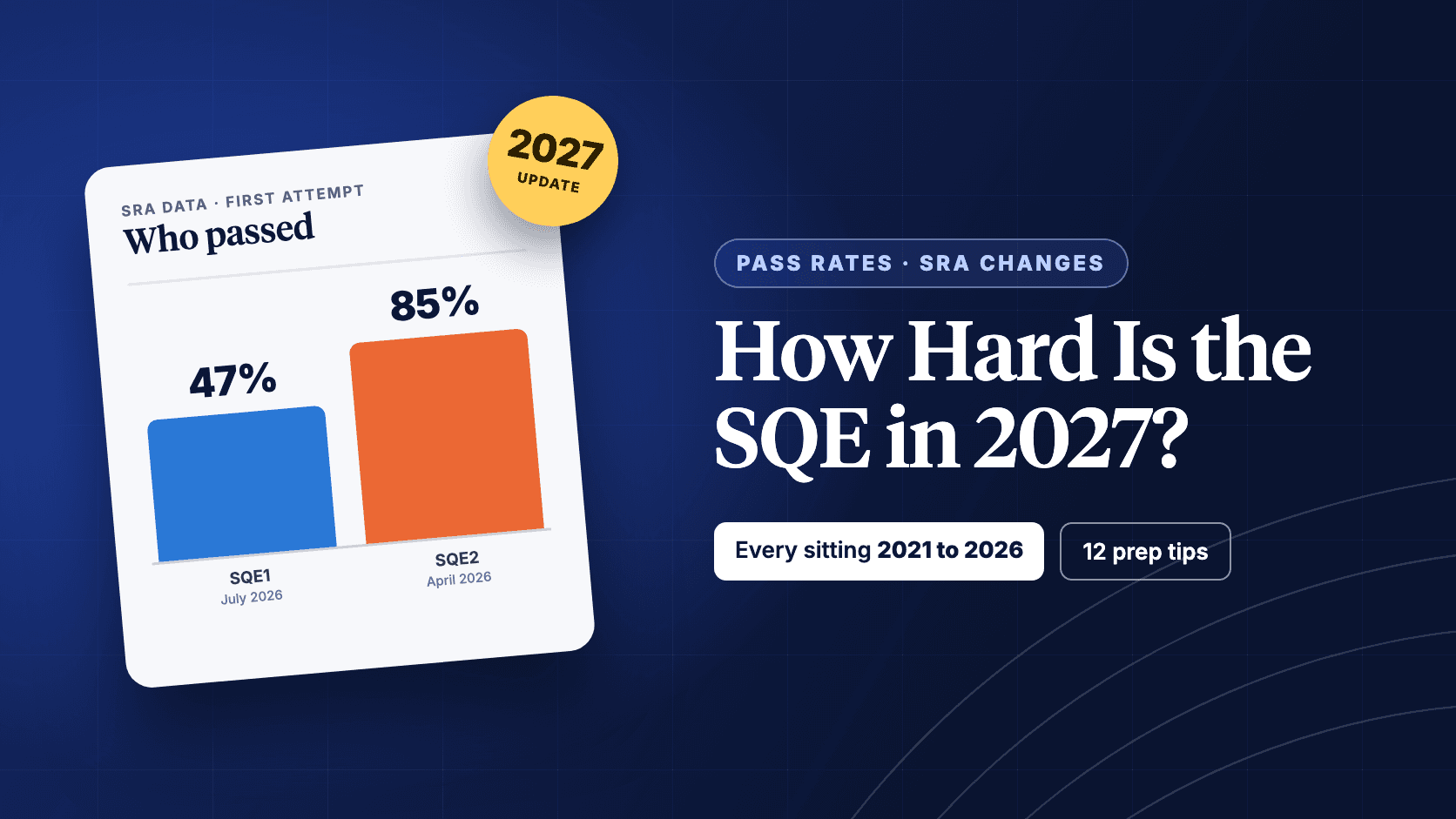
How hard is the SQE? Every SRA pass rate since 2021, why SQE1 fails half of first-timers, what changes in 2027, and 12 preparation tips built on the data.
Read the article
The SQE2 format is not changing, but the marking is. Every change from September 2026, the SRA's 30 September clarifications, and what is proposed for 2027.
Read the article
Your SQE2 January 2027 seat reservation form is emailed from 6pm on 13 October 2026 and closes at 5pm on the 16th. Three days, then a 48-hour payment window.
Read the article