Official facts and product information checked on 18 October 2026.
A twelve-week SQE1 study plan should begin with the work you need, not a fixed quota copied from another candidate. July 2027 gives you a clear date to plan towards, but the route depends on what you have already studied and how much suitable time you can protect. This framework helps you build the runway and then revise the plan using evidence.
- The suggested twelve-week block runs from 19 April to 11 July 2027. It is not a universal preparation requirement.
- The published FLK1 window begins on 12 July; use your own booked dates once confirmed.
- Booking details and the July results date were still TBC when this draft was checked.
Check the official dates and the version of the law
The published timetable lists FLK1 on 12–16 July and FLK2 on 19–23 July 2027, with a law cut-off of 12 March 2027. Mark the relevant dates in your plan and check the current booking instructions before making commitments. As checked on 18 October 2026, further July booking details and the results date were not yet confirmed.
The proposed twelve-week block begins on 19 April. You can use the earlier weeks to assess your resources, starting knowledge and available support. Do not wait until the first study day to discover that substantial areas of the syllabus are new or that your materials need updating.
| Block | Purpose | Decision at the end |
|---|---|---|
| Weeks 1–3 | Map coverage, test familiar material and repair early gaps. | Which areas need fuller teaching or clarification? |
| Weeks 4–6 | Connect recall with targeted and broader questions. | Which distinctions remain unreliable on new facts? |
| Weeks 7–9 | Add suitable timed work and review pacing. | What decision habits need correction? |
| Weeks 10–12 | Narrow recurring gaps and complete practical checks. | What should the final sessions prioritise? |
Build around your starting position
Create a coverage map from the official specification. Label material as not yet studied, studied but uncertain, or reasonably secure in unfamiliar practice. These are planning labels, not official readiness grades. A topic that feels familiar from reading may still need application practice.
If you are starting significant material for the first time, allocate teaching and clarification work explicitly. If you are returning after an earlier attempt, use the available evidence to decide what should change. Repeating the whole old timetable without a diagnosis may reproduce the same preparation problem.
Allocate sessions rather than imaginary hours
Write down the blocks you can keep alongside work and other responsibilities. Give demanding work a setting that supports it. Use a small contingency block for review that runs over, and avoid assuming that every spare minute is interchangeable with a quiet sustained session.
A practical weekly plan might contain focused learning, unfamiliar questions, recall and a review block. That is an example of categories, not a prescribed workload. Choose the amount and balance based on your gaps, and reassess it when the practice record changes.
Practise the current question format
The January 2027 format change also applies to later sittings: 170 questions per FLK, in two sessions of 85, with the standard 2 hours 33 minutes for each session. Use appropriately structured practice when testing pacing. Older questions may still help with learning, but an older paper count should not control your timing rehearsal.
Record mistakes and uncertain correct answers before reviewing explanations. Identify the fact, condition or reasoning step that mattered. Then decide whether the next task is a revision section, a targeted question or a broader timed attempt.
Make mobile sessions support the plan
Use the FQPS app for a defined recall or short question session when it suits the setting. Before you finish a protected block, choose what you will revisit on the phone. That handover connects small sessions to the larger preparation rather than creating a separate stream of random activities.
The free account currently includes two one-off signup mocks, five daily questions, ten daily flashcards, a sample syllabus and a seven-day plan. Check current features and full-plan access. A set of samples can help you evaluate the tools, but does not replace a coverage decision.
Review the plan every week
- What did unfamiliar practice reveal?
- Which entries in the error log are now resolved?
- What remains uncertain and what resource will address it?
- Which planned session was unrealistic?
- What one change should next week contain?
Keep the answers short enough to use. The plan should become more precise as you learn about your own preparation. If a gap remains large or unclear, seek suitable support instead of assuming that adding more hours to an unchanged timetable will solve it.
Take the next revision task with you.
Explore the FQPS app and its current free practice options. Full access depends on your plan.
Frequently asked questions
When does the suggested twelve-week plan begin?
It begins on 19 April 2027 and ends on 11 July, ahead of the first published FLK1 window. Adapt it to your own dates and starting point.
When is SQE1 July 2027?
The published windows are FLK1 on 12–16 July and FLK2 on 19–23 July 2027.
What is the July 2027 law cut-off?
The official timetable lists 12 March 2027. Recheck the specification and current official information.
Is twelve weeks enough for everyone?
No. It is a planning framework, not a universal minimum or guarantee. Starting knowledge, coverage, available time and support needs vary.
Continue your preparation
Sources and information checked
- Official SQE assessment dates and booking windows
- Official SQE1 assessment specification
- SRA: SQE1 changes from January 2027
- FQPS app availability and free access
Information checked on 18 October 2026. Dates, booking details, assessment guidance and product availability should be rechecked before relying on them. Study routines are editorial suggestions. FQPS Academy is an independent preparation provider, not affiliated with or endorsed by the SRA or Kaplan.
Stay up to date
Never miss the latest SRA updates. Receive product updates, news and customer stories right into your inbox.

Keep reading
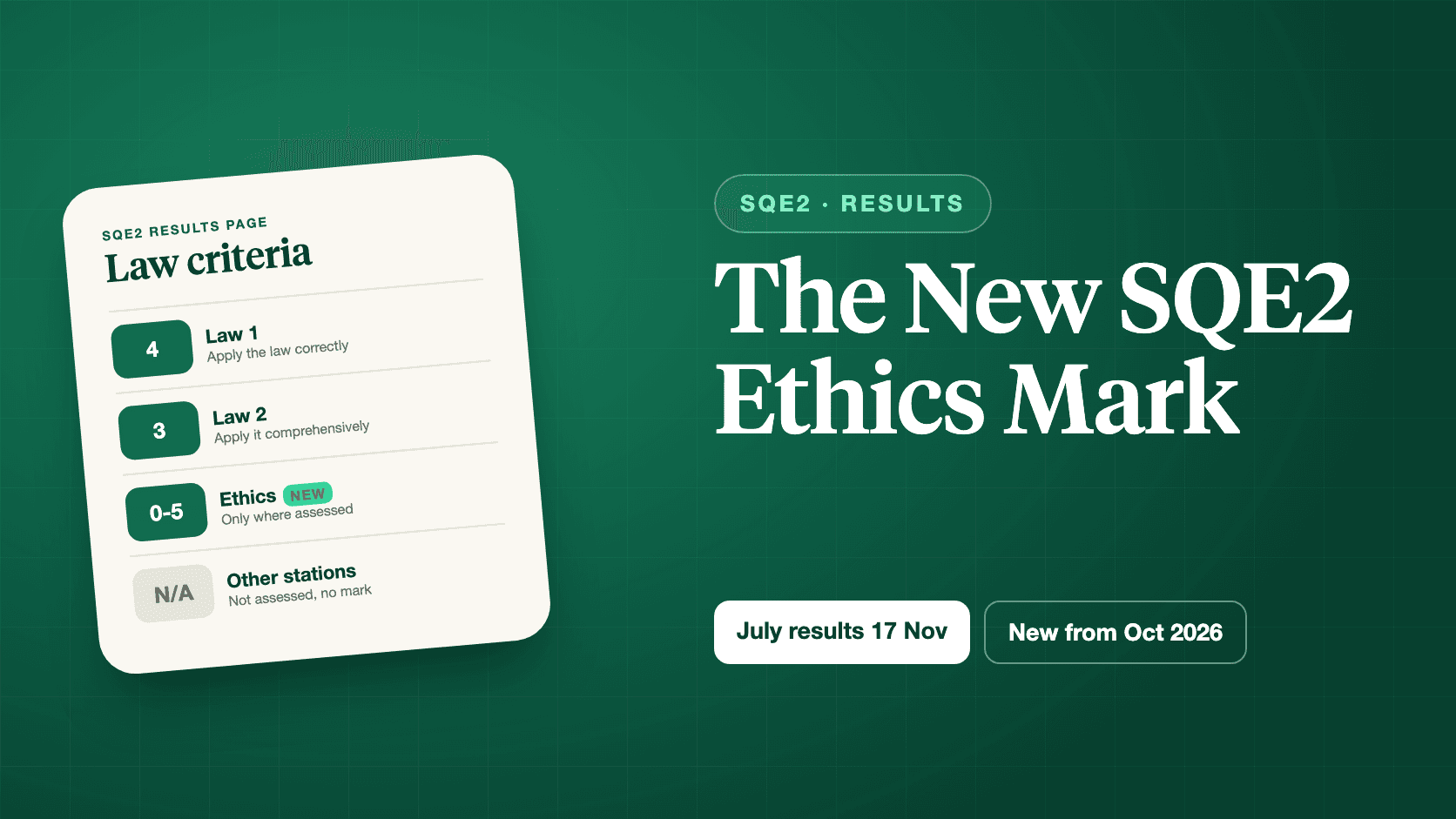
July SQE2 results arrive on 17 November in the old format. From the October 2026 sitting, a separate ethics mark appears. Who sees what, and how it adds up.
Read the article

No law degree, no training contract, and maybe no degree at all. How career changers qualify through the SQE, what the SRA data shows, and how to prepare.
Read the article

Make SQE revision while working more manageable with a mobile study routine, protected practice blocks and a useful fallback for disrupted days.
Read the article