
Official facts and product information checked on 18 October 2026.
An eight-week SQE1 revision plan works best when it starts with evidence. Which topics can you apply to a new problem, which answers are guesses, and which sessions can you protect in your diary? This plan turns those answers into a manageable run-up to January 2027, with room for question review as well as question attempts.
- The suggested eight-week block runs from 16 November 2026 to 10 January 2027. It is a revision framework, not a promise to teach the syllabus from scratch.
- January SQE1 has separate FLK1 and FLK2 assessment windows. Check your booked dates rather than assuming you sit on the first day.
- Protect review time: uncertain correct answers belong in your error log alongside mistakes.
Start with your actual exam and your actual week
The official timetable lists FLK1 on 11–15 January and FLK2 on 18–22 January 2027. Your booking identifies your own assessment days. Write those dates at the top of your plan, then work backwards from the first one. A plan built around the wrong day creates avoidable pressure in the final week.
List the study blocks you can reliably keep. Include work, caring responsibilities, travel and the December break before allocating topics. If a week contains only three usable evenings, plan three evenings. Leave a small recovery block for unfinished review rather than assuming every task will take exactly the time you expect.
Weeks one and two: diagnose before you accelerate
Begin with unfamiliar questions across material you have already studied. Record whether each answer was confident, uncertain or a guess before reading the explanation. This separates a reliable answer from a lucky selection. The purpose is to decide what to revise, not to produce an impressive opening score.
For each weakness, name the problem narrowly. “Property is weak” gives you little direction. “I missed the condition that changes this outcome” gives you a specific revision task. Revisit the explanation and your learning material, then test the point on another question where available. Keep new topics visible rather than hiding them inside a broad average.
| Block | Main work | Evidence to keep |
|---|---|---|
| 16–29 November | Diagnose gaps and repair foundations. | Topic-level errors and uncertain answers. |
| 30 November–13 December | Alternate targeted practice with broader review. | Rules you can now explain and apply. |
| 14–27 December | Use realistic holiday blocks; revisit recurring gaps. | A smaller, current list of unresolved points. |
| 28 December–10 January | Timed practice, review and exam logistics. | Pacing decisions and a clear final-week plan. |
Weeks three and four: connect recall to application
Use a short recall session before a larger question set. Explain a principle without looking at your notes, then check whether you can use it when the facts change. If the explanation sounds familiar but the question still defeats you, the next task is application practice rather than another pass through the same card.
The 2027 format update confirms 170 questions per FLK, divided into two sessions of 85, with 2 hours 33 minutes per session. Subjects are allocated by session, with questions mixed within those groups. Match longer practice to the format for your sitting. Do not build your pacing plan around an older question count.
Weeks five and six: make the December plan survivable
Choose a minimum session you can complete on a disrupted day: for example, review one mistake and explain one rule. This is a suggested fallback, not a replacement for the longer blocks in your plan. Use it to preserve direction when a journey or family commitment changes the day.
Keep a separate list for tasks needing a desk, a quiet room or uninterrupted concentration. A full timed session belongs there. Short mobile sessions can help maintain recall, but trying to squeeze every type of preparation into spare moments makes it difficult to evaluate pacing or sustained attention.
Weeks seven and eight: practise the decisions you will make
A timed attempt should lead to a practical review. Where did you lose time? Did you reread a problem without deciding what mattered? Did you change an answer for a reason you could explain? Record the decision pattern, then make one change in the next session. Treat a familiar repeated mock cautiously because remembering its answers can inflate the apparent improvement.
Finish logistics before the last study evening: check the candidate instructions, booked venue, travel and identification requirements directly with the official guidance. Use the remaining revision blocks for selected gaps. Adding a new resource at the last minute creates a new backlog without necessarily addressing the problem you already know you have.
Topic · my answer and confidence · the rule or fact I missed · why the best answer follows · one follow-up task · date to revisit.
Where the FQPS app fits
Use the FQPS Android app for a planned short question or flashcard session, then return to longer work on the device that suits it. A free account currently includes one full FLK1 mock and one full FLK2 mock at signup, five daily questions, ten daily flashcards, a sample syllabus and a seven-day plan. Those are starting resources; full access depends on your plan.
An eight-week schedule should change when practice reveals a gap. Keep the purpose of each block clear enough that you can move it without losing the thread. If you need a complete teaching programme or feedback on persistent difficulties, address that need separately rather than assuming a timetable alone will resolve it.
Take the next revision task with you.
Explore the FQPS app and its current free practice options. Full access depends on your plan.
Frequently asked questions
Is eight weeks enough for SQE1?
That depends on your starting knowledge, coverage and available time. This is a revision framework for material you have studied, not a guarantee that eight weeks is sufficient for every candidate.
When does this eight-week plan start?
The suggested block begins on 16 November 2026 and ends on 10 January 2027. Adjust the final days to your own confirmed FLK1 and FLK2 bookings.
Should I spend all my time taking mocks?
No. A useful plan includes learning or repairing gaps, recall, unfamiliar questions, timed attempts and review. The balance should follow what your practice reveals.
Can I use the app alongside this plan?
Yes. Use the app for focused recall and short practice sessions, alongside longer protected blocks for timed work and review. Access depends on your account and plan.
Continue your preparation
Sources and information checked
- Official SQE assessment dates and booking windows
- SRA: SQE1 changes from January 2027
- Official SQE1 assessment specification
- FQPS app availability and free access
Information checked on 18 October 2026. Dates, booking details, assessment guidance and product availability should be rechecked before relying on them. Study routines are editorial suggestions. FQPS Academy is an independent preparation provider, not affiliated with or endorsed by the SRA or Kaplan.
Stay up to date
Never miss the latest SRA updates. Receive product updates, news and customer stories right into your inbox.

Keep reading
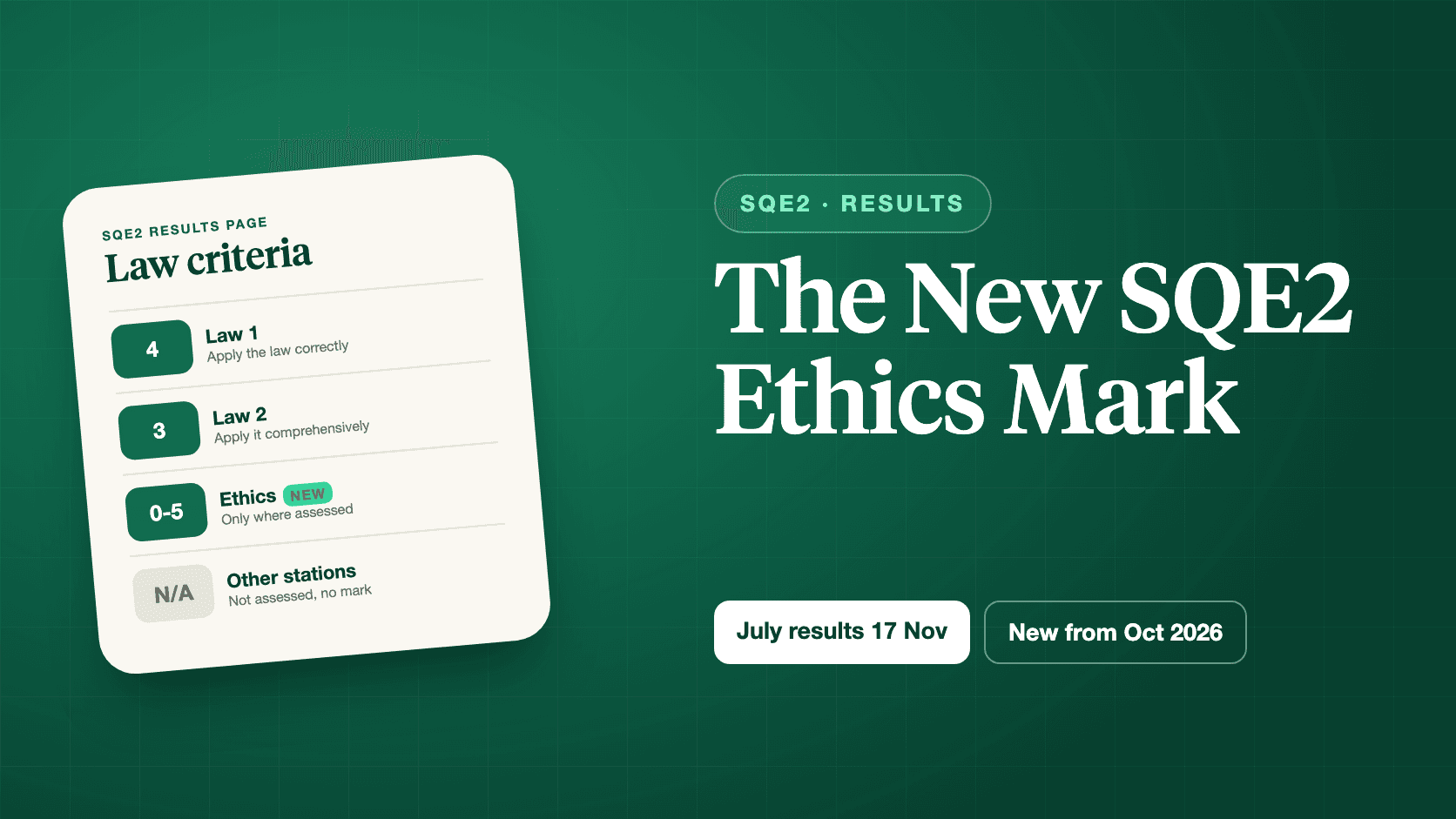
July SQE2 results arrive on 17 November in the old format. From the October 2026 sitting, a separate ethics mark appears. Who sees what, and how it adds up.
Read the article

No law degree, no training contract, and maybe no degree at all. How career changers qualify through the SQE, what the SRA data shows, and how to prepare.
Read the article

Build an SQE2 legal writing practice routine for the standard 30-minute task. Plan the reader, write useful advice and review the actual submitted answer.
Read the article