 SQE in Bangladesh
The SQE for Bangladeshi law graduates and advocates
Bangladeshi law graduates and advocates can become solicitors of England and Wales through the SQE, with two things to know first. No city in Bangladesh is on the SRA’s list of test cities, so every assessment is sat abroad. And the title is not a way into the Bangladesh Bar: the 1972 Order that governs enrolment names barristers and is silent on solicitors.
- 0
- cities in Bangladesh on the SRA’s list for SQE1 and SQE2 written, read 12 November 2026
- 18
- months of legal work after enrolment before a Bangladeshi advocate can apply for an SQE2 exemption
- 6
- University of London LLB teaching centres in Bangladesh, all of them in Dhaka
- 10,000+
- University of London students in Bangladesh and Pakistan together, over 80% on undergraduate Laws (University of London, August 2024)
Is the SQE open to candidates in Bangladesh?
Facts checked against the regulators’ own pages. Last updated .
- Yes. The SRA’s admission criteria are a degree, the SQE assessments, qualifying work experience unless you are already a qualified lawyer, and character and suitability. They do not include a UK residence or nationality requirement.
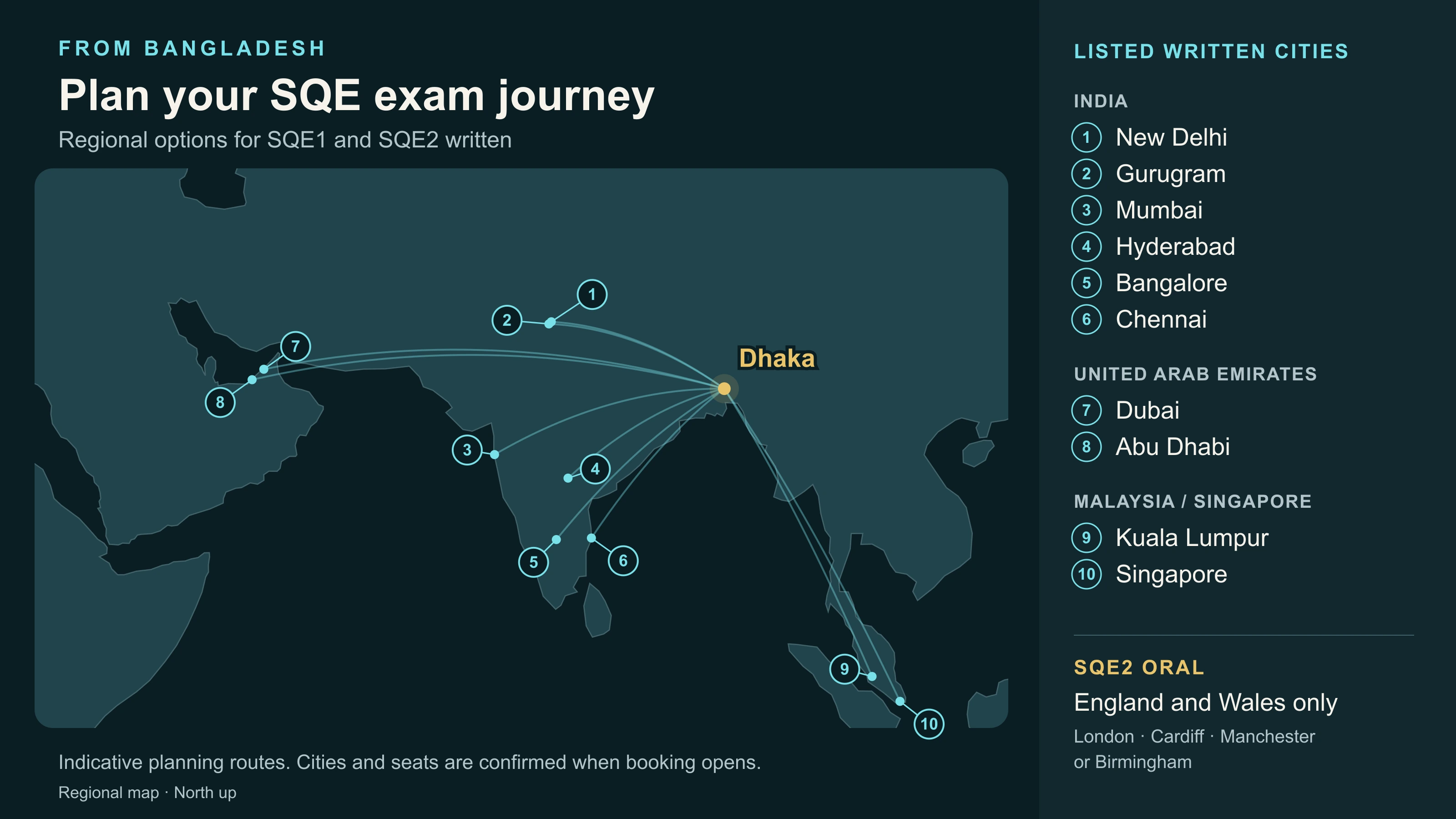
- No part of it can be sat in Bangladesh. Dhaka is not on the SRA’s list of cities for SQE1 or the SQE2 written papers, and the SQE2 oral assessments are held only in England and Wales.
- India and the United Arab Emirates are the nearest countries on the list. Kuala Lumpur and Singapore are on it too.
- An advocate with 18 months of legal work after enrolment can apply for an individual SQE2 exemption under the SRA’s "Bangladesh (Dhaka)" entry. It is not automatic, and SQE1 still has to be passed.
- An English solicitor qualification does not, by itself, let you enrol as an advocate in Bangladesh. Article 27 of the 1972 Order accepts a Bangladeshi law degree, a recognised foreign law degree, or the status of barrister.
- Everyone who enrols in Bangladesh, barristers included, has to pass the Bar Council’s own examination.
Article 27: who can be enrolled as an advocate in Bangladesh
One article of the 1972 Order settles what a foreign qualification does for you at home.
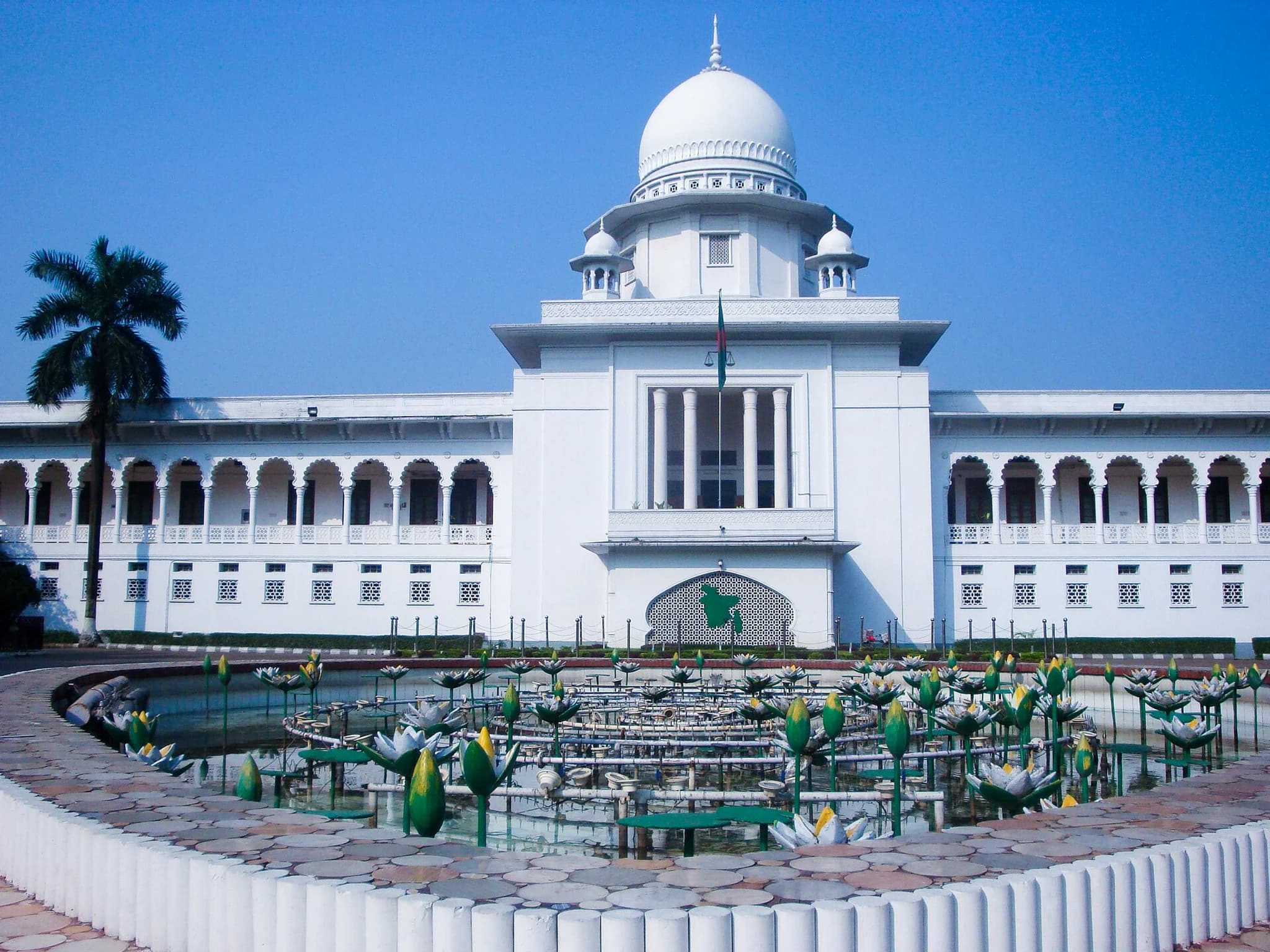
Under article 27 of the Bangladesh Legal Practitioners and Bar Council Order 1972, a person may be admitted as an advocate if they are a citizen of Bangladesh aged 21 or over, hold one of three qualifications, have passed the examination the Bar Council prescribes and have paid the enrolment fee.
| Qualification | In article 27? | What still has to be done |
|---|---|---|
| Law degree from a university in Bangladesh | Yes. | The Bar Council’s enrolment examination. |
| Bachelor’s degree in law from a university outside Bangladesh | Yes, if the university is recognised by the Bar Council. | Recognition of the university by the Bar Council, then the same examination. |
| Barrister | Yes, named in its own right. | The same examination. The article contains no exemption for barristers. |
| Solicitor of England and Wales | No. The article does not mention solicitors. | A solicitor relies on the law degree behind the title, if the Bar Council recognises it, and sits the examination like any other candidate. |
The Bar Council’s syllabus page sets the examination out in three stages: a multiple choice paper, a written paper and a viva voce. Article 27(2) also lets the Bar Council require a course of training before admission. Go to the Bar Council’s own notices for the current stages, dates and any training period. We found no official Bangladeshi source that gives the English solicitor qualification a recognised standing for enrolment.
Where the title does count
- In England and WalesIt is the qualification for practising as a solicitor there. It does not carry a right to work in the UK: that is a visa matter for GOV.UK, and the SRA’s pages do not deal with it.
- In the GulfThe Law Society counted 8,273 solicitors based outside England and Wales in July 2024 and found the largest share of any place it lists, 15%, in the United Arab Emirates. Source: Law Society, international data insights report 2025.
- As a basis for a Dubai legal consultant licence, on our readingThe Dubai bylaw accepts an academic law qualification together with a valid professional membership where the applicant is authorised to practise, and names no jurisdiction. Admission as an English solicitor looks like such a membership to us. The bylaw also asks a foreign national with a degree from outside the UAE for three continuous years of practical legal experience, a UAE residence permit and a full-time job with a firm licensed in Dubai. A consultant cannot appear before the Dubai Courts. See the UAE guide.
- In English-law disputes workThe same Law Society report says 78% of London Court of International Arbitration cases in 2024 were governed by English law.
The University of London LLB in Dhaka, the Bar Council and the SRA
The University of London says more than 10,000 of its current students are in Bangladesh and Pakistan together, and that over 80% of them study undergraduate Laws (figures from August 2024). Three bodies have a say over what the degree does next.
| Body | What it decides | What we could confirm |
|---|---|---|
| Bangladesh Bar Council | Whether a foreign law degree counts for enrolment under article 27. | It runs an equivalency certificate process for foreign law degrees. We could not confirm from its website whether, or on what terms, it currently recognises the University of London LLB. |
| Solicitors Regulation Authority | Whether you hold a degree or equivalent for admission as a solicitor. | It accepts a degree in any subject at UK level 6 or equivalent. It does not name the University of London LLB, which is a level 6 honours degree. |
| University of London | The award itself. | It tells students to check with the relevant regulatory body. The only English recognition it states is by the Bar Standards Board, for the academic component of Bar training, provided certain criteria are met. |
- The University’s LLB teaching centre finder lists six centres in Bangladesh, all in Dhaka: Bhuiyan Academy, British School of Law, London College of Legal Studies (North), London College of Legal Studies (South), Newcastle Law Academy and Newcastle Law Academy West.
- According to the Bar Council’s page on its equivalency certificate for foreign law degrees, equivalence of law degrees is handled by the Bar Council and not by the University Grants Commission. Put the question about your own degree to the Bar Council before you count on enrolling with it.
- Reading the SRA’s rule and the University’s programme specification together, a completed London LLB is the kind of degree the SRA describes. That is our reading of two official pages, and like every degree it is checked through mySRA before admission.
- A degree is needed to be admitted as a solicitor, not to sit the assessments, so a student can take SQE1 before the LLB is awarded.
More on the degree itself is in the SQE after a University of London LLB. Sources: SRA, degree or equivalent and the University of London LLB programme specification.
Bangladeshi advocates: the individual SQE2 exemption and its limits
The SRA’s exemption finder has one entry for the country, "Bangladesh (Dhaka)", for the qualification "Advocate". It is an individual exemption, not an agreed one, and there is no SQE1 exemption to go with it.
- Check the entry against your record. The SRA asks for proof of your professional qualification, a reference that covers 18 months or more of legal work since you qualified as a Bangladeshi advocate, and proof that your referee is professionally qualified.
- Apply before you book SQE2. The application costs £265. An advocate who sits SQE2 first and fails it loses the chance of an exemption from it.
- Sit SQE1 in the meantime. The SRA’s target for a decision is 180 days from a complete application, and you may take SQE1 during that time.
- Be ready to prove your English. A lawyer exempt from SQE2 has not shown English through the assessment. The SRA then wants evidence that your professional qualification was assessed in English. Without that, it accepts a secure English test from a Home Office approved provider, taken in the last three years: for IELTS Academic UKVI the score is 7.5 overall.
- Apply for admission. The SRA asks every qualified lawyer for a certificate of good standing, less than three months old, from each jurisdiction where they are admitted.
An application can be refused. The SRA’s general conditions ask for practising rights in at least one of criminal litigation, civil litigation, property practice, wills and probate or business organisations, and for experience that covers every SQE2 skill. A refused applicant can reapply only with new evidence. The finder does not explain the "(Dhaka)" label. What the SRA does say is that lawyers whose qualification is not on its list may still apply individually. Sources: SRA, SQE exemptions and SRA, applying for an SQE2 exemption.
If you hold a law degree but have not been enrolled, the SRA does not treat you as a qualified lawyer. You take SQE1 and SQE2 and record two years of qualifying work experience. Legal work done in Bangladesh can count, and it need not involve English law, but it has to be confirmed by an English solicitor or by a law firm’s compliance officer for legal practice: see who can confirm QWE and the QWE checker.
Sitting the SQE from Bangladesh: the nearest listed cities
Dhaka does not appear on the SRA’s list of cities for SQE1 and the SQE2 written papers. The SRA describes that list as "illustrative only", and its page offers no explanation for the places that are absent.
| Country on the list | Cities | What can be sat there |
|---|---|---|
| India | Bangalore, Chennai, Gurugram, Hyderabad, Mumbai and New Delhi. Kolkata is not among them. | SQE1 and SQE2 written |
| Malaysia | Kuala Lumpur | SQE1 and SQE2 written |
| Singapore | Singapore | SQE1 and SQE2 written |
| United Arab Emirates | Abu Dhabi and Dubai | SQE1 and SQE2 written |
| United Kingdom | Pearson VUE centres for the written papers. London, Cardiff, Manchester or Birmingham for the oral assessments. | All of it. The SQE2 oral assessments are held nowhere else. |
- Treat the table as a guide for planning and not as a booking. Cities are confirmed when booking opens for a sitting, some run only at certain times of year, and if yours is full you are offered the closest alternative that has seats.
- Whether you can enter one of those countries depends on your passport. Their entry rules are outside this page, so check with the country concerned before you pay an exam fee.
- Each SQE1 paper is offered on five consecutive days, FLK1 in one week and FLK2 in the next, and you pick one day in each week if seats allow. Not every centre opens on every day.
- You book through your SQE account and bring your passport on the day. The name on it must match the account exactly: a candidate without the right identification is turned away and loses the fee.
- SQE2 has no way round the UK. The oral assessments run over two consecutive days in England or Wales, in the same assessment window as the three written days.
- For that visit, taking an exam is on GOV.UK’s list of things a Standard Visitor may do, though the Immigration Rules do not mention the SQE by name. Read the Standard Visitor page for your nationality before you commit to a sitting.
Sources: SQE1 and SQE2 written locations, SQE2 oral locations and SQE ID requirements. Sitting dates are on our SQE1 and SQE2 exam dates page.
Bar-at-Law or the SQE for a Bangladeshi graduate
In Bangladesh "barrister" is a word in the 1972 Order and "solicitor" is not. The comparison starts there.
If you want to practise in Bangladesh
Barrister is one of the three qualifications article 27 accepts, so the Bar course leads to a status the Order names. You still sit the Bar Council’s examination. The SQE gives you nothing to enrol with at home beyond the law degree you already hold.
If you want to work as a solicitor
The SQE is the route to admission as a solicitor of England and Wales. For an enrolled advocate it asks for no qualifying work experience, and the SRA may exempt an advocate from SQE2 after 18 months of practice.
What each asks of you
The Bar course is taught at sites in England and Wales, with 2026/27 fees from £13,550 to £19,950 at UK-fee rates, membership of an Inn of Court and ten qualifying sessions. The SQE is assessment fees of £2,006 and £3,086, study you can do from Dhaka, a trip to a listed city for the written papers and two days in England or Wales for the oral assessments.
According to the Bar Standards Board, most Bar students whose home was overseas do not appear to look for pupillage in England and Wales once the course is over. Its report cites earlier survey evidence in which around 16% of them gave practising at the Bar of England and Wales as their main motivation. Source: Bar Standards Board, Bar Training 2026. The longer comparison, with costs side by side, is in SQE or the Bar course.
SQE fees for candidates in Bangladesh, in pounds and US dollars
The SRA’s assessment provider charges one fee in pounds wherever you sit. Travel to a listed city, and to England or Wales for SQE2, comes on top.
In pounds, with US dollarsUSDPaid to the SRA, the same wherever you sit
- SQE1 assessment feeFLK1 and FLK2, paid to the SRA’s assessment provider when you book£2,006US$2,660
- SQE2 assessment feeWritten and oral, paid when you book SQE2£3,086US$4,090
- Both assessments£5,092US$6,750
Preparing with FQPS
- FQPS SQE1 RevisionA month, no minimum term, cancel anytime£79US$105
- FQPS SQE2 PreparationA month, includes 6 live 1:1 mocks with a solicitor£189US$251
SRA fees are for assessments from September 2026. FQPS prices include VAT. USD figures are a guide at the European Central Bank rate of 12 November 2026: you pay in pounds, and your card provider sets the final rate.
Studying for the SQE from Bangladesh
FQPS is an online course, so the only flights you pay for are the ones to the assessments. Each SQE1 paper has 170 single best answer questions from January 2027.
Start free, from anywhere
One full FLK1 and one full FLK2 mock (2 × 85 questions each, January 2027 format), free on sign-up with no card.
Create a free account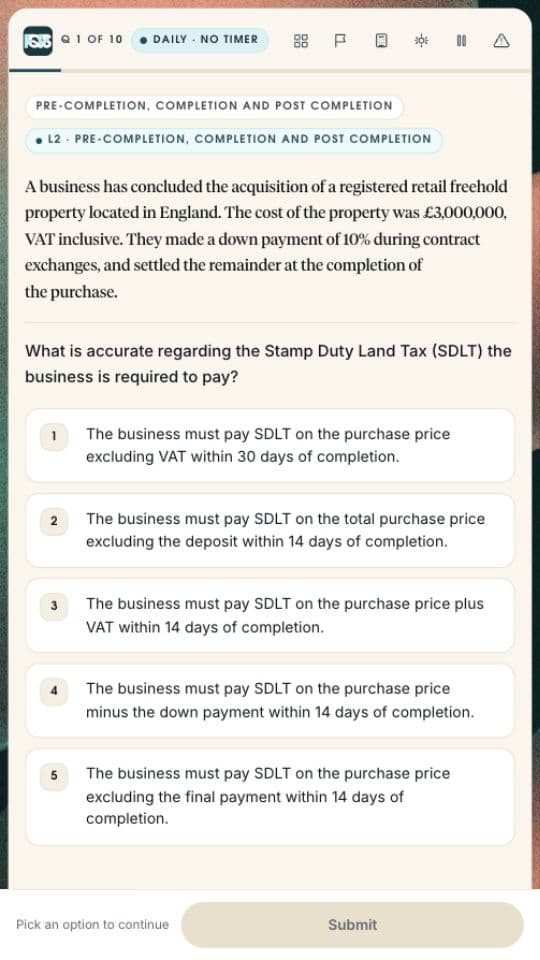
Study at your own hours
Revision cards for the whole SQE1 syllabus, 2,500+ practice questions, flashcards and full FLK1 and FLK2 mocks are there whenever you open the platform, on the web and in the mobile app.
The SQE1 courseA mentor who knows your route
Every paid plan includes a designated mentor and a personal study plan from Cleo, the FQPS study planner, built around your exam date.
How the mentor worksFree questions, no account needed
Try free SQE1 practice questions with answers and full explanations, across FLK1 and FLK2, before you spend anything on fees or travel.
Free SQE1 practice questionsPrepare for the 2027 format
From January 2027 each SQE1 paper is 170 questions in two sessions. A first sitting from Bangladesh will be in that format, so revise for it from the start.
The SQE 2027 changesListen as well as read
Audiobooks of the revision material come with the SQE1 Practice and SQE1 Master plans and with both SQE2 plans.
Plans and pricesSQE1 preparation from £79 a month
5 plans, billed monthly with no minimum term. In your currency, that first plan is £79 a month.
A UK course with students well beyond the UK
FQPS is online from the first revision card to the last mock, so where you live changes your time zone and nothing else.
- 29
- countries our paying students’ cards were issued in, in the 12 months to November 2026
- 44%
- of those students paid with a card issued outside the UK
Lit: the UK and 14 of the other countries, among them France, United States, Singapore, Germany, South Korea, Türkiye.
Seven months of prep was plenty, and audiobooks made studying actually enjoyable.
 ClemenceNetherlands, read the review on Trustpilot
I received my results a few weeks ago and am thrilled to share that I passed!
 MarceauxMalaysia, read the review on Trustpilot
Honestly, it is value for money.
 Yosheel Bala BangarooCanada, read the review on Trustpilot
These are three of our reviews, chosen because the reviewers are outside the UK. Read every FQPS review on Trustpilot, good and bad. Country counts are from our payment records on .
Who in Bangladesh should think twice about the SQE
We would rather you chose the right route than our course.
- You want to appear in the courts of Bangladesh. The 1972 Order names barristers and is silent on solicitors, so for court practice at home the Bar-at-Law route has a recognition the solicitor title lacks. Either way, you sit the Bar Council’s own examination.
- You cannot travel abroad at all. SQE1 has no listed city in Bangladesh, and SQE2 without an exemption means two days of oral assessments in England or Wales.
- You are an advocate hoping enrolment will excuse you from SQE1. It will not, and the SQE2 exemption is individual, needs 18 months of legal work after enrolment and can be refused.
- You have no sure way to pay in pounds. The SQE takes card payment in full at booking, and the news reports of Bangladesh Bank’s education-card facility do not say it covers exam fees or an online course. Settle that with your bank first.
- You expect the skills assessment to be the easy half. In 2024/25, 71% of candidates whose first language is not English passed SQE2, against 84% of those whose first language is English.
Bangladesh and the SQE: common questions
Your situation not here? A free 30-minute call with our team goes through your route and your dates.
Book a free callCan I sit the SQE in Bangladesh?
Not at present. The SRA’s list of cities for SQE1 and SQE2 written, as it stood on 12 November 2026, has no city in Bangladesh, and the oral part of SQE2 runs only in England and Wales. India and the United Arab Emirates are the closest countries that are listed.
Can an English solicitor practise law in Bangladesh?
Not on the strength of that title. Article 27 of the Bangladesh Legal Practitioners and Bar Council Order 1972 allows enrolment as an advocate with a Bangladeshi law degree, a law degree from a foreign university the Bar Council recognises, or the status of barrister. It does not mention solicitors, and every applicant must pass the Bar Council’s examination.
Do Bangladeshi advocates get an SQE2 exemption?
They can apply for one. "Bangladesh (Dhaka)" advocates appear in the SRA’s exemption finder with the option of an individual SQE2 exemption. The SRA wants a reference that shows 18 months or more of legal work since qualification. Each application is assessed individually, the fee is £265, and SQE1 must still be passed.
Can I do the SQE after a University of London LLB in Bangladesh?
On our reading of the rules, yes. The SRA’s requirement is a degree in any subject, at UK level 6 or the equivalent, and the London LLB is an honours degree at that level. The SRA does not name it, so expect the usual degree check through mySRA. You need the degree to be admitted, not to sit the assessments.
Does the Bangladesh Bar Council recognise the University of London LLB?
We could not confirm the Bar Council’s current position from its own website. The 1972 Order accepts a foreign law degree only from a university the Bar Council recognises, and the Bar Council runs an equivalency certificate process for foreign law degrees. Ask the Bar Council about your own degree before relying on it for enrolment.
Should a Bangladeshi graduate choose Bar-at-Law or the SQE?
For practice in Bangladesh, Bar-at-Law: barrister is a status the 1972 Order names, and solicitor is not. If the plan is a solicitor’s career in England and Wales, or with an English-law practice overseas, the SQE. A barrister must still pass the Bangladesh Bar Council’s examination before enrolling.
Where is the nearest SQE test centre to Dhaka?
The nearest countries on the SRA’s list are India, with Bangalore, Chennai, Gurugram, Hyderabad, Mumbai and New Delhi, and the United Arab Emirates, with Abu Dhabi and Dubai. Kuala Lumpur and Singapore are also listed. The list is illustrative, and cities are confirmed only when booking opens for a sitting.
Do I need IELTS for the SQE as a Bangladeshi advocate?
Only in one case. Candidates who pass SQE2 have shown their English by doing so. An advocate exempted from SQE2 has to show it another way: a professional qualification that was assessed in English or, failing that, a Home Office approved test taken in the last three years, for example IELTS Academic UKVI with 7.5 overall.
How do I pay SQE fees from Bangladesh?
By debit or credit card, in pounds, in full when you book. From September 2026 that is £2,006 for an SQE1 sitting and £3,086 for SQE2. There are no payment plans. Ask your bank in advance whether your card can make a foreign-currency payment of that size.
Other routes to the English title
Sources for this page (32)
- Laws of Bangladesh: Legal Practitioners and Bar Council Order 1972, article 27
- Bangladesh Bar Council: enrolment examination syllabus
- Bangladesh Bar Council: equivalency certificate for foreign law degrees
- SRA: SQE exemptions by jurisdiction
- SRA: applying for an SQE1 exemption
- SRA: applying for an SQE2 exemption
- SRA: SQE exemptions, questions and answers
- SRA: English or Welsh language proficiency
- SRA: qualified lawyers
- SRA: admission for qualified lawyers
- SRA: Authorisation of Individuals Regulations
- SRA: degree or equivalent
- SRA: SQE questions and answers
- SRA: qualifying work experience
- SQE: assessment locations
- SQE: SQE1 and SQE2 written locations
- SQE: SQE2 oral locations
- SQE: SQE2 assessment days
- SQE: booking windows
- SQE: booking SQE assessments
- SQE: ID requirements
- SQE: costs and fees
- SQE: payment methods
- SQE: annual report 2024/25
- University of London: LLB course page and teaching centre finder
- University of London: LLB programme specification 2026-27
- University of London: the LLB in Bangladesh and Pakistan (August 2024)
- Bar Standards Board: Bar Training 2026 statistics report
- Bar Standards Board: the vocational component of Bar training
- Law Society: international data insights report 2025
- Government of Dubai Legal Affairs Department: Administrative Resolution No. (51) of 2022
- GOV.UK: Standard Visitor
Each source was read on or before 12 November 2026. Rules change: check the regulator's own page before you act on anything here. This page is general information, not legal or immigration advice. FQPS Academy is an independent SQE preparation provider, not affiliated with or endorsed by the Solicitors Regulation Authority or Kaplan. The SQE and SOLICITORS QUALIFYING EXAMINATION trade marks are the property of and are used under licence from the Solicitors Regulation Authority.