
Official facts and product information checked on 18 October 2026.
SQE2 legal writing practice should help you produce something a real recipient could use. That means deciding what the task asks for, what the reader needs to know and how to communicate the answer within the time available. The standard legal writing task is 30 minutes; a practical routine needs to include reading and review within that allowance.
- The official legal writing sample gives a standard task time of 30 minutes.
- The suggested minute-by-minute allocation below is an editorial practice method, not an SRA rule.
- Review accuracy and usefulness before polishing the surface of the prose.
Begin with the instruction, recipient and purpose
The official sample page describes a computer-based legal writing task lasting 30 minutes. Read the specific instruction before deciding whether the output should look like a letter, email or another communication. A fluent answer in the wrong format or aimed at the wrong reader misses an important part of the task.
Write a short private prompt before drafting: “I am writing to [recipient] so they can understand or do [purpose].” Use it to decide how much explanation belongs in the answer. A client and a supervising solicitor may need different language and detail even when the underlying issue is the same.
| Time | Focus | Useful check |
|---|---|---|
| Minutes 0–5 | Read the instruction and relevant source material. | What must this communication achieve? |
| Minutes 5–8 | Choose an order for the answer and key points. | Which conclusion or action does the reader need first? |
| Minutes 8–25 | Draft the requested communication. | Does each paragraph serve that purpose? |
| Minutes 25–30 | Review substance, clarity and key details. | Are the names, dates, conclusion and next steps accurate? |
This allocation is a starting experiment. A dense file may require a different balance. Keep the overall task time fixed for a standard timed simulation, then record where your chosen allocation helped or failed.
Make a plan that earns its time
An outline should make drafting easier, not become an unfinished first answer. Identify the central advice, the reasoning the reader needs and the action or information required next. If the task involves several issues, choose an order that helps the recipient understand their position.
Avoid a generic opening that delays the answer. In a fictional practice example, an email asking a client for missing information should make that request clear and explain why the information matters. It should not begin with several paragraphs of unrelated background merely because that background appeared in your notes.
Draft for a reader who was not in your study session
The reader cannot see the reasoning you left in your head. Make the important connection between the facts and your conclusion visible. Use familiar language where it communicates the point accurately, and explain a technical term when the recipient needs it. Shorter wording is useful only if it keeps the necessary meaning.
Read a paragraph and ask what the recipient can do with it. A paragraph that only restates the file may need analysis. A paragraph that gives a conclusion without a reason may need explanation. A paragraph containing several different tasks may need a clearer sequence.
Protect a real final review
Leave time to check the parts most likely to cause practical confusion: the recipient, names, dates, the advice requested and the next action. Check that the answer responds to the task rather than a nearby question you prepared for. If you changed your analysis while drafting, make sure the conclusion and the body still agree.
Do not rely on the presence of browser tools in a home setup as proof that the examination has the same functionality. Use the official platform and current guidance to familiarise yourself with the assessment interface. The SRA has specific guidance on copy and paste; software details should be checked before the sitting.
Review one answer before starting the next
- Preserve the answer completed at the stop time.
- Mark where it addresses the requested purpose and where it drifts.
- Identify the most consequential legal omission or error, if any.
- Identify one clarity problem that made accurate advice harder to use.
- Choose a short corrective drill and then a fresh task.
A corrective drill might be rewriting one paragraph for a client, making a conclusion consistent with the analysis or reorganising an unclear request. It is not necessary to rewrite the whole answer repeatedly. Keep the original version so you can distinguish improved drafting from a new untimed answer written with the exemplar open.
Choose the right practice mode and timer
Use guided work while learning an unfamiliar task, and independent timed work to inspect what you can produce without the guidance. In FQPS, check the selected exercise duration and mode before starting; the platform contains learning and simulation options, and access depends on your plan.
Explore SQE2 self-assessment mocks for structured practice, alongside official samples. A practice result should tell you what to do next. It should not be presented as an SRA grade or a guarantee that a particular writing style will pass.
Give your next practice session a clear purpose.
Explore FQPS SQE2 self-assessment mocks and check the access included in your plan.
Frequently asked questions
How long is SQE2 legal writing?
The standard published task time is 30 minutes. Verify the current specification and any approved personal adjustments.
Is the 5–3–17–5 time split an SRA requirement?
No. It is a suggested practice allocation within 30 minutes. Adjust it based on the task and what your review shows.
Should I use a model answer during a timed attempt?
Keep it closed for independent timed practice. Use it afterwards, with the relevant criteria, to review what your submitted answer demonstrates.
Does a higher word count mean a stronger answer?
No. Focus on answering the task accurately and usefully for the recipient. A word count alone does not show that the necessary analysis is present.
Continue your preparation
Sources and information checked
- SRA: legal writing sample and timing
- SRA: individual SQE2 assessments and criteria
- Official SQE2 samples and Performance Indicators
- SRA: SQE2 copy-and-paste functionality
- FQPS SQE2 self-assessment mocks
Information checked on 18 October 2026. Dates, booking details, assessment guidance and product availability should be rechecked before relying on them. Study routines are editorial suggestions. FQPS Academy is an independent preparation provider, not affiliated with or endorsed by the SRA or Kaplan.
Stay up to date
Never miss the latest SRA updates. Receive product updates, news and customer stories right into your inbox.

Keep reading
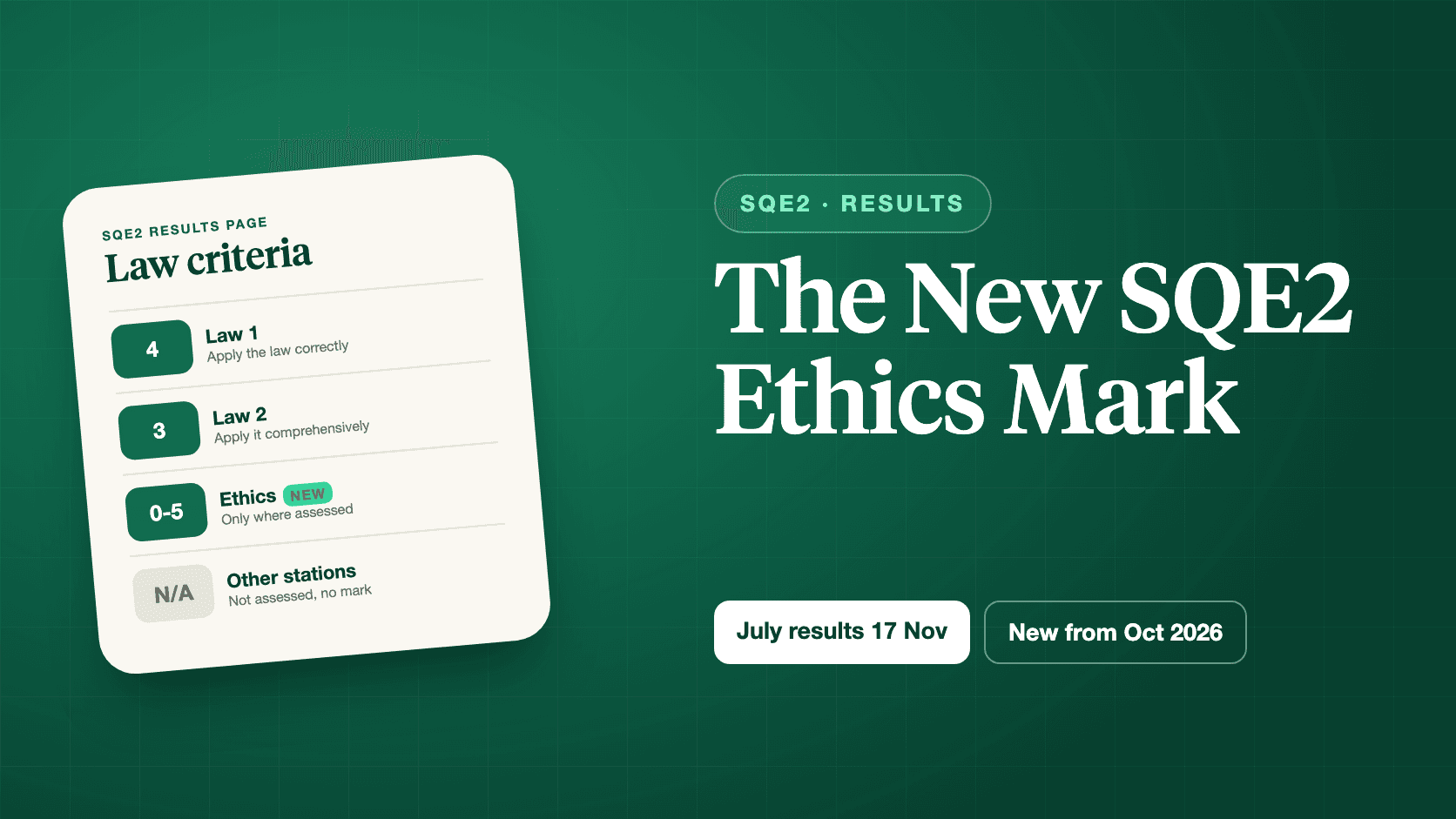
July SQE2 results arrive on 17 November in the old format. From the October 2026 sitting, a separate ethics mark appears. Who sees what, and how it adds up.
Read the article

No law degree, no training contract, and maybe no degree at all. How career changers qualify through the SQE, what the SRA data shows, and how to prepare.
Read the article

Make SQE revision while working more manageable with a mobile study routine, protected practice blocks and a useful fallback for disrupted days.
Read the article