
Official facts and product information checked on 18 October 2026.
SQE2 legal research practice can become misleading if every difficult point sends you to an open-web search. The assessment asks you to work with the materials and functionality provided, then produce the output in the task. A useful rehearsal tests how you select, understand and apply those sources—not only whether you can find a familiar statement somewhere online.
- The standard legal research assessment lasts 60 minutes.
- For an independent simulation, use the task’s supplied sources rather than adding an unrestricted web search.
- Practise the official platform’s search functionality as well as the underlying research and advice task.
Identify the question you have been asked to answer
Begin by reading the instruction for the legal issue, requested output and intended reader. Write a narrow working question before opening sources. A clear question helps you decide whether a passage answers the task or is merely related to the general topic.
The official legal research sample provides the task and supporting material. Use it to understand the expected activity. For a first independent attempt, keep the answer discussion closed. Opening it while searching changes the task from independent research to guided learning.
Use the supplied materials as the practice boundary
The official SQE2 sample guidance links to the Pearson VUE practice platform, including its legal research search function. It also explains that the actual assessment platform is closed and does not provide ordinary internet browsing. A home session with unrestricted tabs is therefore testing a different process.
For learning, you may need to clarify an unfamiliar point using reliable material. Do that in a separate stage and label it. For a standard timed simulation, keep the source boundary intact so that the work shows what you could select and apply from the provided material.
| Stage | Suggested allowance | Output |
|---|---|---|
| Define the task | First 5 minutes | The issue, reader and requested form of answer. |
| Search and select | Next 20 minutes | Relevant passages and reasons for using them. |
| Analyse and draft | Next 25 minutes | An answer connecting sources to the client facts. |
| Check | Final 10 minutes | Source accuracy, conclusion and task coverage. |
The split is an editorial method, not an SRA rule. Keep the standard overall time for a simulation, but adjust how you divide it after reviewing the difficulties in a particular task.
Separate a promising source from a useful source
When a passage looks relevant, check what question it actually addresses and whether its conditions fit the task. Do not treat a keyword match as the end of the research. Record why the passage matters and which part of the answer it supports.
A simple source note can have three lines: proposition, conditions and application to the facts. This encourages you to move beyond collecting extracts. If two sources appear to pull in different directions, identify the distinction you need to resolve rather than choosing whichever passage sounds more helpful to the desired conclusion.
Write the application, not a research diary
The requested reader needs the answer to the task, with the legal support necessary to understand it. An account of every search you attempted can obscure that answer. Choose a structure that makes the relevant issue, reasoning and conclusion easy to follow.
In a fictional practice example, you may locate a rule quickly but still need to explain whether a condition is met on the information supplied. The useful output identifies the condition, applies the known facts and makes any material uncertainty visible. Simply pasting the rule does not complete that reasoning.
Check source use and practical functionality
Review quotations, references and conclusions against the source material. If you copied a passage, make sure it supports the proposition you attached to it. Verify any names, dates or figures used in the answer rather than assuming they transferred correctly.
The SRA publishes separate guidance on copy and paste functionality. Familiarise yourself with the official platform and current instructions before the sitting. Do not assume a browser extension or feature on your own computer will be available in the assessment.
- Did the answer address the precise issue in the instruction?
- Which source passage supports each important proposition?
- Where did I apply the source to the specific facts?
- Did I identify an uncertainty that affects the advice?
- Which search or reading decision cost time without helping the answer?
Use repeated practice to improve one decision
After reviewing an attempt, select a targeted change: a better working question, a clearer source note or a more direct application paragraph. Use a short corrective exercise if appropriate, then inspect whether the change appears in another unfamiliar task.
Explore FQPS self-assessment mocks alongside official resources, checking the mode, sources and duration of the selected exercise. Treat the practice platform as an independent preparation tool, and use official platform practice for examination-interface familiarity.
Give your next practice session a clear purpose.
Explore FQPS SQE2 self-assessment mocks and check the access included in your plan.
Frequently asked questions
How long is standard SQE2 legal research?
The standard legal research task is 60 minutes. Check current official guidance and any approved personal arrangements.
Can I use Google during an independent mock?
For an assessment-style simulation, work within the task’s supplied source boundary. Open-web learning can be useful separately, but changes what the attempt demonstrates.
Where can I practise the official research search function?
The official SQE2 samples page links to the Pearson VUE practice platform, which includes legal research functionality.
Is finding the right passage enough?
You still need to produce the requested output and apply relevant material to the task. Review the reasoning and conclusion, not only the search result.
Continue your preparation
Sources and information checked
- SRA: legal research sample
- Official SQE2 samples and Performance Indicators
- SRA: individual SQE2 assessments and criteria
- SRA: SQE2 copy-and-paste functionality
- FQPS SQE2 self-assessment mocks
Information checked on 18 October 2026. Dates, booking details, assessment guidance and product availability should be rechecked before relying on them. Study routines are editorial suggestions. FQPS Academy is an independent preparation provider, not affiliated with or endorsed by the SRA or Kaplan.
Stay up to date
Never miss the latest SRA updates. Receive product updates, news and customer stories right into your inbox.

Keep reading
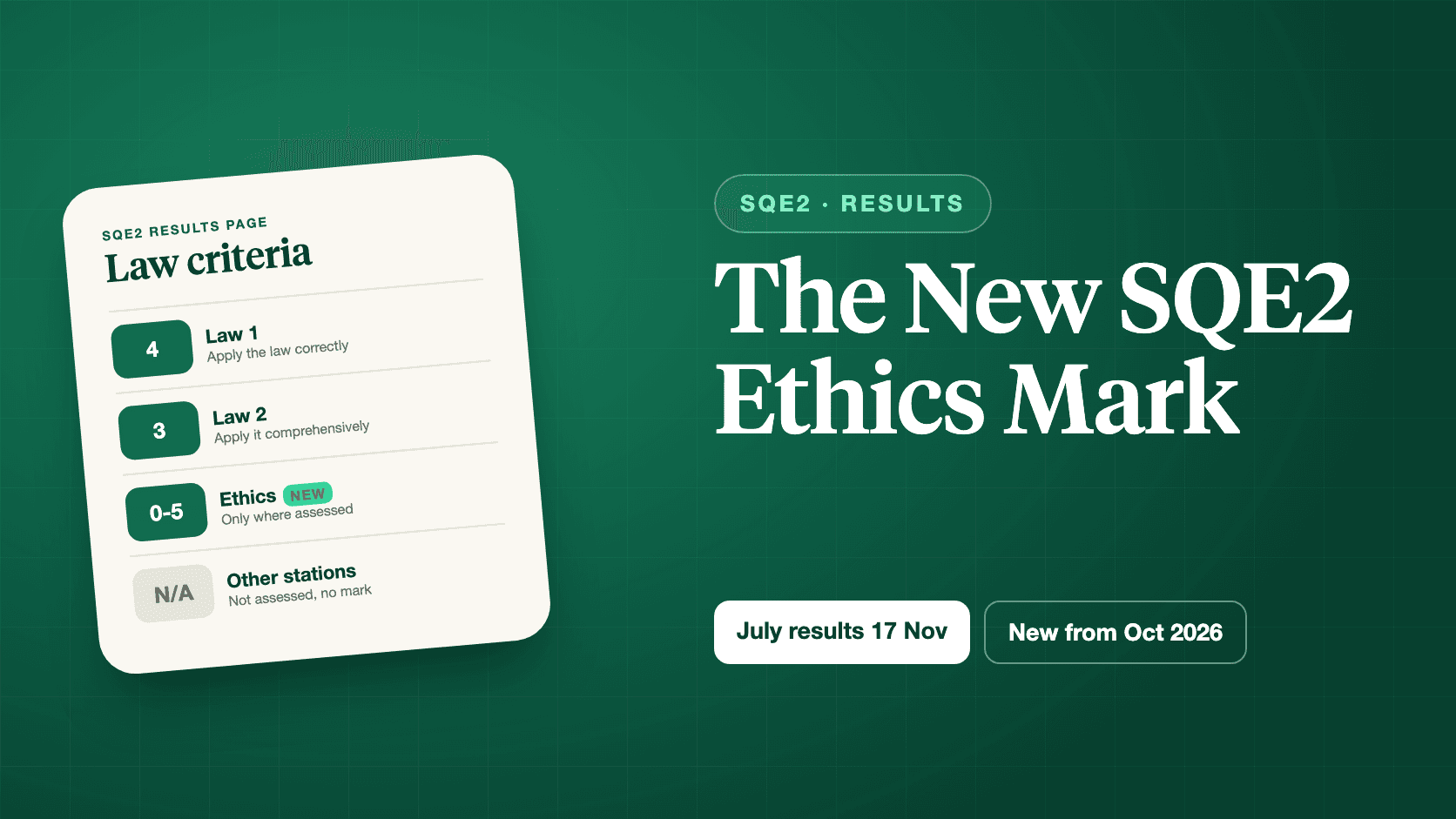
July SQE2 results arrive on 17 November in the old format. From the October 2026 sitting, a separate ethics mark appears. Who sees what, and how it adds up.
Read the article

No law degree, no training contract, and maybe no degree at all. How career changers qualify through the SQE, what the SRA data shows, and how to prepare.
Read the article
Make SQE revision while working more manageable with a mobile study routine, protected practice blocks and a useful fallback for disrupted days.
Read the article