Free QWE record template
This is FQPS Academy’s template, not the SRA’s. The SRA publishes its own training template, and neither is compulsory: the SRA calls its template a training and recording aid only. If you prefer it, the SRA’s training template is on its website. Checked against the SRA’s pages on 8 November 2026.
What should a QWE record include?
The SRA asks you to record your QWE so you can show how it gave you the opportunity to develop the competences solicitors need, at least two of them. A good record also holds the details mySRA will ask for, and the name of the person who will confirm it, so nothing is left to memory at the end.
You and the placement
Your name and role, the organisation, the type of experience, your dates, work pattern and hours, and the total time in months and weeks.
Supervisor and confirming solicitor
Who supervises you, and the name, position and SRA number of the solicitor or COLP who will confirm your QWE.
Competence log, A to D
A table for each competence area, with a row for each competence: what I did, evidence, and supervisor comment.
Review meetings
A log of one-to-ones and appraisals: who you met, what you discussed, any gaps and what you will do next.
You do not send this record to the SRA. You record each completed period of QWE in mySRA, and the solicitor or COLP confirms it there. The record is for you and for them.
Sources: SRA: Getting the best out of your qualifying work experience (updated 19 February 2025); SRA: QWE training template (September 2021); SRA: Statement of Solicitor Competence (updated 9 August 2022); SRA: Recording your qualifying work experience (updated 12 April 2023)
SRA QWE template or this one: which should you use?
Either. Neither is compulsory, you submit neither, and both are built on the same Statement of Solicitor Competence. If your organisation has its own system for recording QWE, the SRA suggests you use that.
The SRA’s training template
- A Word document from the SRA, dated September 2021.
- The competences you need to develop, and how to show you have.
- What you need to know about the solicitor or COLP confirming your QWE.
- A training and recording aid only: you do not submit it.
The FQPS QWE record template
- Word and PDF from FQPS Academy, checked against the SRA’s pages.
- All eighteen competences, with their points in the SRA’s words.
- A filled-in example for each area, and the details mySRA asks for.
- A review meetings log. Free to reuse under CC BY 4.0, and not submitted either.
The QWE competences: the SRA Statement of Solicitor Competence
The template’s competence log has a row for each of the SRA’s eighteen competences, in four areas. Your QWE must give you the chance to develop at least two of them, and the SRA does not say which. A role that involves only one competence does not count as QWE.
Ethics, professionalism and judgment
- A1 Act honestly and with integrity, in accordance with legal and regulatory requirements and the SRA Standards and Regulations
- A2 Maintain the level of competence and legal knowledge needed to practise effectively, taking into account changes in their role and/or practice context and developments in the law
- A3 Work within the limits of their competence and the supervision which they need
- A4 Draw on a sufficient detailed knowledge and understanding of their field(s) of work and role in order to practise effectively
- A5 Apply understanding, critical thinking and analysis to solve problems
Technical legal practice
- B1 Obtain relevant facts
- B2 Undertake legal research
- B3 Develop and advise on relevant options, strategies and solutions
- B4 Draft documents which are legally effective and accurately reflect the client’s instructions
- B5 Undertake effective spoken and written advocacy
- B6 Negotiate solutions to clients’ issues
- B7 Plan, manage and progress legal cases and transactions
Working with other people
- C1 Communicate clearly and effectively, orally and in writing
- C2 Establish and maintain effective and professional relations with clients
- C3 Establish and maintain effective and professional relations with other people
Managing themselves and their own work
- D1 Initiate, plan, prioritise and manage work activities and projects to ensure that they are completed efficiently, on time and to an appropriate standard, both in relation to their own work and work that they lead or supervise
- D2 Keep, use and maintain accurate, complete and clear records
- D3 Apply good business practice
The SRA says the statement should be read as a whole: A1e, respecting diversity and acting fairly and inclusively, underpins every competence. The download lists each competence’s points in full, in the SRA’s words.
Sources: SRA: Statement of Solicitor Competence (updated 9 August 2022); SRA: Qualifying work experience for candidates (updated 26 January 2024)
QWE record examples: one entry for each competence area
Each entry names its competences, says what you did, points to evidence and carries your supervisor’s comment. A specific entry is easier to confirm than “assisted with litigation”.
Illustrative example, written by FQPS Academy: a paralegal in the civil litigation team of a law firm, working full time. It is not a real candidate, client or matter. Whether your own role counts: see Paralegal QWE sign-off, or use the Free QWE checker.
Ethics, professionalism and judgment A1 A3
What I did: Ran the conflict check on a new debt claim and found the other side was a former client of the firm, which can raise a confidentiality issue. I stopped work on the file and raised it with my supervisor, who referred it to the compliance team before anything else was done. On another matter I said that a question about extending time for a defence was beyond what I knew, and sat in while my supervisor explained the rule.
Evidence: The conflict check record and my email raising the issue, with client names removed. My file note of the explanation about time limits.
Supervisor comment: Spotted the former-client issue and stopped work at once, which was the right call. Asks for help at the right time rather than guessing.
Technical legal practice B1 B4
What I did: Took first instructions by phone from a client in a dispute with a builder over defective work, using the team’s question checklist, and wrote up an attendance note the same day. Drafted the letter before claim from the firm’s precedent, adapted to the facts, for my supervisor to review and sign.
Evidence: The attendance note and my first draft of the letter before claim with my supervisor’s tracked changes, client details removed.
Supervisor comment: The attendance note picked up the key dates and the amount claimed. The letter needed only light edits to the remedy section.
Working with other people C1 C2
What I did: Gave clients regular updates by phone and email on the matters I worked on. Explained the small claims track timetable to a client in plain English, confirmed it in writing, and set out what would happen next and roughly when.
Evidence: Two client update emails I drafted, with details removed, and the team’s plain-English guide to the small claims track, which I revised.
Supervisor comment: Updates are clear, on time and pitched at the client. Good at setting realistic expectations about timescales.
Managing themselves and their own work D1 D2
What I did: Kept the team’s key dates diary for court deadlines and limitation dates, checked it every Monday and flagged anything due in the next fortnight. Saved and named documents on the case management system under the firm’s filing rules, and closed files in line with its retention policy.
Evidence: A screenshot of the key dates list with client names removed, and the file closing checklist I completed.
Supervisor comment: Reliable with deadlines, and files are always up to date. Next step: more of the case planning on simpler matters.
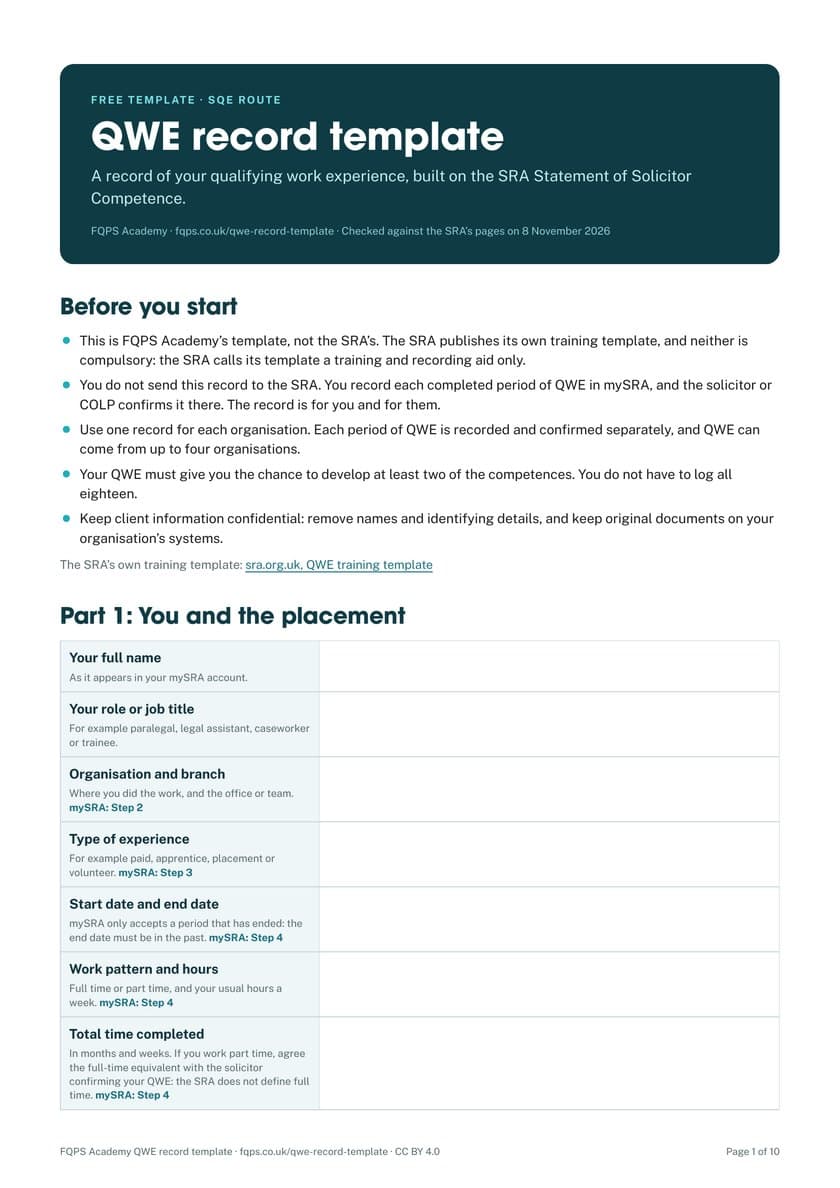
Download the free QWE record template
- Your details and dates, as mySRA asks for them
- Your supervisor and confirming solicitor
- A competence log for areas A to D
- A log of review meetings
- A filled-in example for each area
- The SRA competences in full
No sign-up and no email. Free to reuse with credit to FQPS Academy under CC BY 4.0: copy it, adapt it or hand it out to your own candidates, keeping the credit line. The Word file opens in Word, Pages and Google Docs; the PDF prints on A4.
How to fill in the QWE template
First, ask whether your organisation already has a way of recording QWE: the SRA suggests checking, and says your organisation should help you collate your evidence. If it has nothing, or you want your own copy, here is how to use this template.
- Start one record for each organisation. Each period of QWE is recorded and confirmed on its own, so keep a separate record for each organisation, up to four. Start on day one: it beats rebuilding a year from memory.
- Fill in your details and dates. Organisation, type of experience, start date, work pattern and hours: the details mySRA will ask for.
- Agree who will confirm it. Note the name, position and SRA number of the solicitor or COLP who will confirm your QWE. If your organisation has a COLP or a solicitor, it will be one of them, or the solicitor who supervised you there if they have since left.
- Log your work as you go. Each week or month, add an entry under the competence the work helped you develop: the task, the type of matter and your part in it.
- Add evidence, without client details. An attendance note, a marked-up draft, an email or an appraisal note. The SRA says evidence can be physical, or a description of how you met the competence.
- Review it with your supervisor and the confirming solicitor. Ask your supervisor to comment on your entries at one-to-ones or appraisals. The SRA suggests talking regularly to the solicitor or COLP confirming your QWE too, so you are both clear on how you have evidenced the competences.
- Look for gaps every few months. If an area is thin because your work is narrow, the SRA suggests asking for different tasks or types of legal work.
- Agree the dates, then record it in mySRA. When the period ends, agree the date range with the solicitor confirming it, tell them you are applying, and record it in mySRA. The SRA then contacts them.
| Column | What to write |
|---|---|
| Competence | The code, for example B4. One competence or two per entry. |
| What I did | The task, the type of matter and your part in it, in your own words, with the month. |
| Evidence | An attendance note, a draft with comments, an email or an appraisal note, with client details removed. |
| Supervisor comment | Their feedback, written by them or noted by you at a one-to-one and checked with them. |
Sources: SRA: QWE training template (September 2021); SRA: Getting the best out of your qualifying work experience (updated 19 February 2025); SRA: Recording your qualifying work experience (updated 12 April 2023)
The QWE form in mySRA: what it asks for
The QWE form is online. When a period of QWE has ended, you record it in mySRA using the application called “Notify us of your qualifying work experience”, one for each period of QWE you register. Parts 1 and 2 of the template collect the same details, so you have every answer to hand.
| Step | What mySRA asks | In the template |
|---|---|---|
| Step 1 | Tick the boxes to confirm you understand the SRA’s requirements. | Before you start |
| Step 2 | The organisation’s details. | Part 1: organisation and branch |
| Step 3 | The type of experience, for example paid, apprentice, placement or volunteer. | Part 1: type of experience |
| Step 4 | Start and end date, your work pattern (full or part time) and the total months and weeks completed. | Part 1: dates, work pattern and total time |
| Step 5 | The name and SRA number of the solicitor or COLP confirming your QWE. | Part 2: confirming solicitor or COLP |
There is no fee. Tell the solicitor or COLP before you submit, because the SRA contacts them once you do, and the SRA says it will let you know it has registered your QWE within 30 days. Every step, and what the solicitor checks: How to get your QWE signed off.
Source: SRA: Recording your qualifying work experience (updated 12 April 2023)
How your solicitor uses your QWE record when confirming
The SRA’s guidance for solicitors and COLPs lists several ways they can satisfy themselves before confirming, and reviewing a training template, diary or portfolio is one of them. If you keep a record, it is one of the things they can read.
They may check the work matches the competence
The SRA suggests they can review your QWE template, diary or portfolio and check that what you describe relates to the competence you put it under.
They may check the details
Your dates, role and organisation, for example with your organisation’s HR team, and whether anything arose that raises a question about your character and suitability.
They may speak to your supervisor
Speaking to the people who supervised your work is one of the SRA’s suggestions. A solicitor from outside your organisation must get their feedback before confirming.
Confirming QWE is not a judgement on whether you are competent, how well you were trained or how good your work was. The SQE assessments test competence, and the SRA checks suitability when you apply for admission. What the solicitor or COLP does confirm, and who can confirm in each situation: Who can confirm QWE?
If there is no COLP and no solicitor where you worked
The COLP or a solicitor in the organisation where you did the work confirms your QWE, or the solicitor who supervised you there, even if they have since left. Only if the organisation has no COLP and no solicitor can a solicitor outside it confirm. That solicitor must have direct experience of your work, and must also review the work you did for the period, which can include a training diary or portfolio such as this record, and get feedback from the people who supervised you. That is where a full record helps most. For that case, FQPS offers QWE confirmation by a solicitor. If your organisation has a COLP or a solicitor, FQPS cannot confirm your QWE, and nor can any outside solicitor except your former supervisor. If a solicitor there will not confirm, read Employer won’t sign off your QWE?
Sources: SRA: Solicitors and COLPs confirming qualifying work experience (updated 29 September 2021); SRA: Qualifying work experience for candidates (updated 26 January 2024); SRA Authorisation of Individuals Regulations, regulation 2; SRA: Qualifying work experience questions and answers (updated 3 October 2023)
QWE record template: common questions
Is there an official SRA QWE template?
Yes. The SRA publishes a training template, a Word document called the Qualifying work experience record, and says using it is not a regulatory requirement: it is a training and recording aid only. The template on this page is FQPS Academy’s own, built on the same Statement of Solicitor Competence.
Will the SRA ask to see my QWE record?
You do not need to send it: the SRA says its training template does not need to be submitted when you record your QWE or apply for admission. The solicitor or COLP confirming your QWE can say what evidence they need to see, and may ask to see your record.
Is there a QWE form to fill in?
The form is the mySRA application called Notify us of your qualifying work experience. It asks for the organisation, the type of experience, your dates and work pattern, the total months and weeks, and the name and SRA number of the solicitor or COLP confirming it. There is no fee.
How many competences does my QWE record need to show?
At least two. The SRA does not say which ones, and a role that involves only a single competence does not count as QWE. You do not have to log all eighteen.
What counts as evidence in a QWE record?
The SRA says evidence can be physical or a description of how you met the competence. Attendance notes, drafts with your supervisor’s comments, emails, file notes and appraisal notes all work, with client names and details removed.
How do I build a QWE record for a past job?
Gather what survives, such as your job description, appraisals, emails and file notes, and log it against the competences as you would for a current role. QWE can be claimed for a past role with no limit on how far back, though the SRA accepts that a solicitor may not be able to confirm it if no records were kept.
Do I need a separate QWE record for each employer?
It is the easiest way to work, though no rule requires it. Each period of QWE is confirmed separately and needs its own mySRA application, and one record per organisation keeps those periods easy to match.
Can I change the template or share it?
Yes. It is free to use, adapt and share under CC BY 4.0, as long as you credit FQPS Academy. A law clinic, firm or university can hand it out to its own candidates.
The SRA pages behind this page, read on 8 November 2026: SRA: Statement of Solicitor Competence (updated 9 August 2022); SRA: QWE training template (September 2021); SRA: Getting the best out of your qualifying work experience (updated 19 February 2025); SRA: Solicitors and COLPs confirming qualifying work experience (updated 29 September 2021); SRA: Recording your qualifying work experience (updated 12 April 2023); SRA: Qualifying work experience for candidates (updated 26 January 2024); SRA Authorisation of Individuals Regulations, regulation 2; SRA: Qualifying work experience questions and answers (updated 3 October 2023). More on QWE: our QWE guide and QWE jobs.
No COLP and no solicitor where you did your QWE?
Where the organisation you worked for has no COLP and no solicitor, a designated FQPS solicitor reviews your work, including this record, gets feedback from your supervisor and, if satisfied, confirms your QWE in mySRA. You start with a guidance call, get unlimited support, and get a full refund if the solicitor finds you are not ready.
More on getting your QWE confirmed
No COLP or solicitor where you did your QWE? An FQPS solicitor reviews your work, speaks to your supervisor and, if satisfied, confirms it in mySRA.
The SRA rule on who confirms: the COLP, a solicitor where you worked, or an outside solicitor only if there is neither.
Getting QWE signed off in mySRA, step by step: what to prepare, what the solicitor checks and how long it takes.
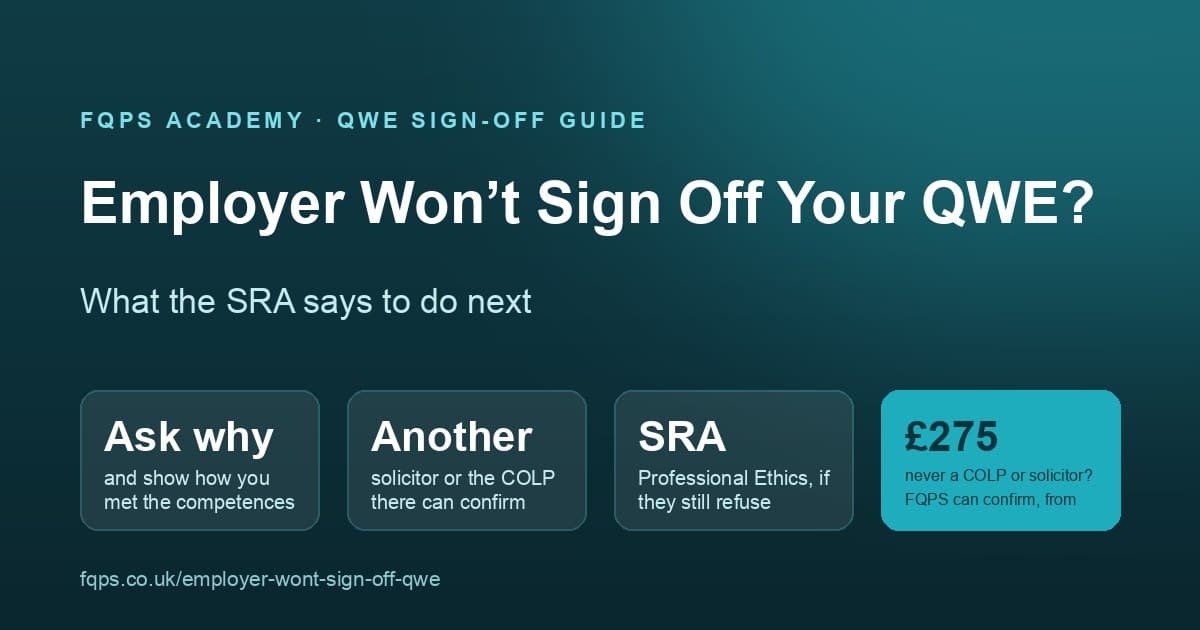
What to do when your firm refuses to confirm, your supervisor has left, or there is no solicitor to sign off.
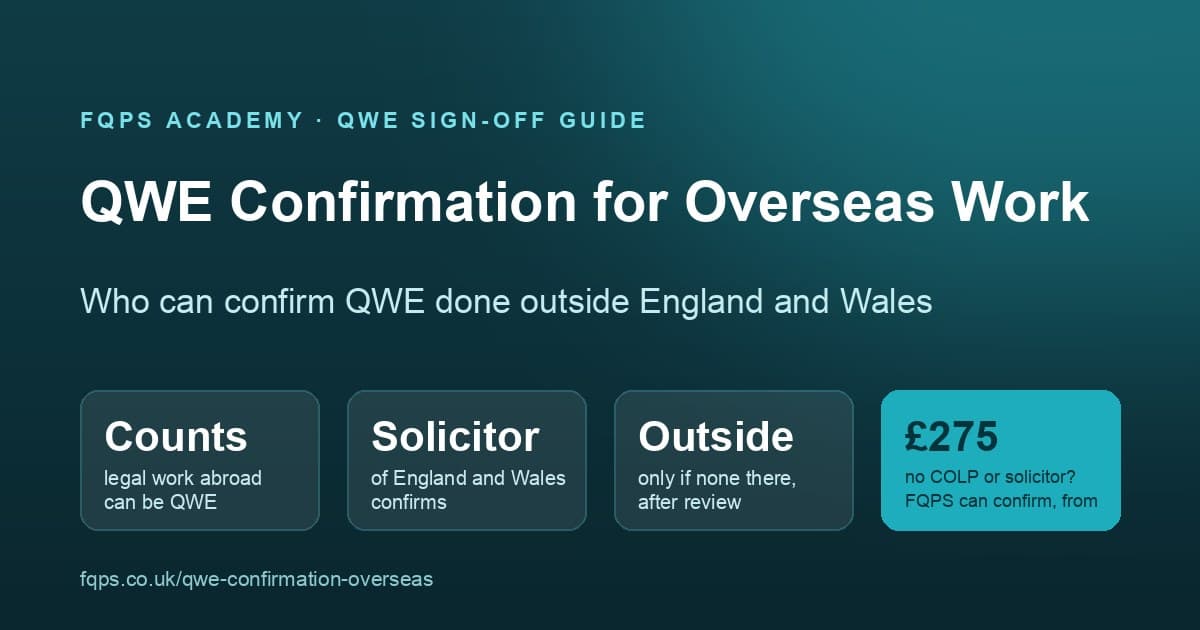
Overseas legal work can count as QWE. Who can confirm it, and when an outside solicitor can because there is no COLP and no solicitor.
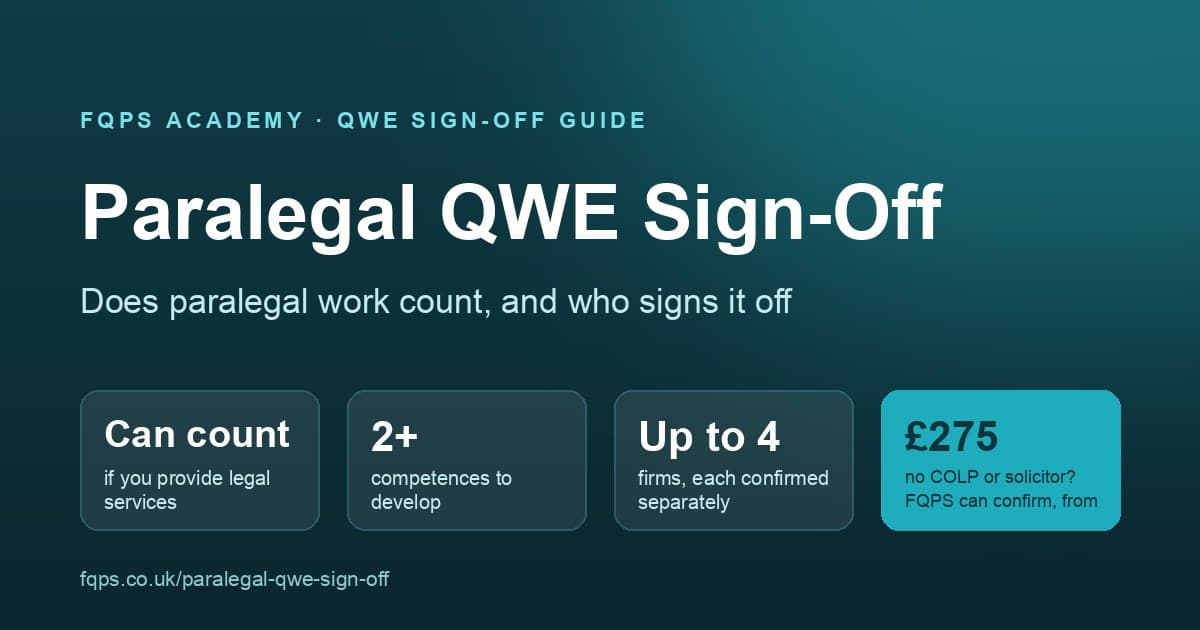
Paralegal and legal assistant work can count as QWE. Who signs it off, and what to do if your firm has no COLP and no solicitor.
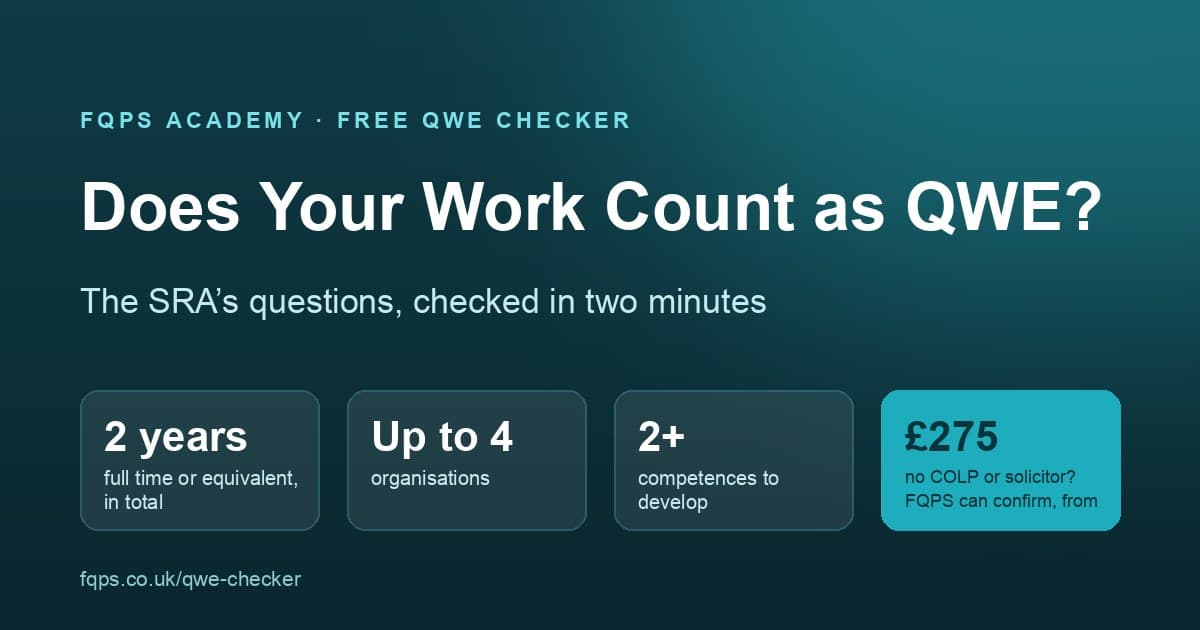
Check your work against the SRA’s QWE questions in two minutes, and see who can confirm it.