

Official facts and product information checked on 18 October 2026.
The final two weeks before SQE2 are a time to make preparation more specific. You need to know which task to practise next, what the last attempt actually showed and which arrangements should already be settled. A useful final fortnight combines selected timed work, focused corrections and a workable routine rather than simply increasing the number of mocks.
- Count backwards from your own first appointment, not the name of the assessment month.
- Use preserved work and the relevant criteria to choose corrections.
- Keep independent attempts, guided work and feedback clearly labelled so you know what the evidence means.
Set the correct start point for your final fortnight
The April 2027 window begins with a written sitting on 20–22 April, while another written sitting is on 4–6 May. Oral sittings also run across April and May. Check your own allocation on the official timetable and booking record. A fortnight planned for someone else’s appointment may be the wrong fortnight for you.
Put the appointments and current candidate instructions in one place. Check travel, venue and identification requirements early enough to resolve a problem. Keep the instructions for each component distinct if your oral and written arrangements differ. Provider materials support preparation but do not confirm your official booking.
Choose the most consequential remaining problems
Review recent unfamiliar attempts and select a short list of recurring weaknesses. Name each one precisely: an important issue missed, advice that does not follow from the analysis, an unclear structure, or a stage of the task regularly left unfinished. A label such as “writing is weak” is too broad to guide the next session.
Give each weakness an action that could change it. You may need clarification of the law, a short communication drill, a complete timed task or external feedback. Avoid setting the same remedy—another full mock—for every type of problem.
| Period | Work to prioritise | Record to keep |
|---|---|---|
| Days 14–10 before your first appointment | Selected unfamiliar tasks and careful review. | The most important repeated issues. |
| Days 9–5 | Focused correction, then an appropriate fresh attempt. | Whether the correction appears in the new work. |
| Days 4–2 | Narrow review and practical checks. | A short list of unresolved questions and confirmed arrangements. |
| Day before | Follow your planned routine and candidate instructions. | The essentials you need for the appointment. |
This is a suggested organisation method, not an SRA-prescribed schedule. Adapt it to your stage, commitments and approved assessment arrangements.
Make each mock produce a decision
Before the attempt, choose whether you are testing independent performance or learning the approach. For independent timed work, use the proper task duration, keep model answers closed and preserve the submission at the stop time. If something interrupts the session, note it instead of treating the timing as uninterrupted.
During review, use the official Performance Indicators and sample discussions to find evidence in the answer or recording. What is present? What is missing? Which change would make the biggest practical difference? End with one specific next task rather than an instruction to “be better next time”.
Keep the oral and written demands visible
For oral work, include practice that requires you to speak to someone or deliver a submission, not only read a script silently. For written work, practise producing the requested output while handling the task materials. Different skills need different forms of rehearsal.
The client interview also leads into an attendance note/legal analysis; the official sample specifies a handwritten note. If that sequence is relevant to your remaining work, include the complete task rather than stopping after the conversation. For advocacy, keep preparation and delivery blocks distinct. Use the relevant official task description for the standard timing.
Avoid a misleading final-week comparison
A remembered task, a guided answer and an unfamiliar timed task are not equivalent evidence. You can learn from all three, but a higher score on a familiar exercise may reflect memory of the answer. Keep the conditions in your log so that the comparison is meaningful.
Similarly, a self-awarded grade is not an official examination outcome. Use practice information to direct work and seek feedback where your judgment is uncertain. Do not build a final-week decision on a provider’s pass prediction or an unexplained percentage threshold.
- Confirm your own appointments and current candidate instructions.
- Select the remaining problems using evidence from recent practice.
- Match each problem to a specific correction or source of feedback.
- Keep appropriate time for review after any full task.
- Recheck the selected practice timer and materials before starting.
- Protect a realistic routine in the final days.
Use FQPS practice for a defined purpose
Explore FQPS self-assessment mocks and the support included in your plan. Select guided or independent work to match the purpose, and inspect the duration of the actual task. Use official platform practice alongside provider exercises for familiarity with the examination interface.
The aim of the fortnight is a clearer set of decisions and more focused preparation. If an important gap remains, acknowledge it and seek the appropriate help. A full calendar of completed mocks is less informative than work that shows whether your specific corrections have taken effect.
Give your next practice session a clear purpose.
Explore FQPS SQE2 self-assessment mocks and check the access included in your plan.
Frequently asked questions
When should my final two-week plan start?
Count back from your own first booked appointment. The April 2027 window includes different April and May sittings, so candidates may need different dates.
Should I do a full mock every day?
Choose the amount and form of practice based on your gaps and available review time. More attempts without correction may repeat the same problem.
Can I compare a guided score with an independent timed attempt?
Label the conditions clearly. Guided work, familiar repeats and independent timed tasks provide different kinds of evidence.
Does this plan replace the official joining instructions?
No. Use your current official instructions for appointments, venues, identification and permitted arrangements.
Continue your preparation
Sources and information checked
- Official SQE assessment dates and booking windows
- Official SQE2 samples and Performance Indicators
- SRA: client interview and attendance note sample
- SRA: advocacy samples and timing
- FQPS SQE2 self-assessment mocks
Information checked on 18 October 2026. Dates, booking details, assessment guidance and product availability should be rechecked before relying on them. Study routines are editorial suggestions. FQPS Academy is an independent preparation provider, not affiliated with or endorsed by the SRA or Kaplan.
Stay up to date
Never miss the latest SRA updates. Receive product updates, news and customer stories right into your inbox.

Keep reading
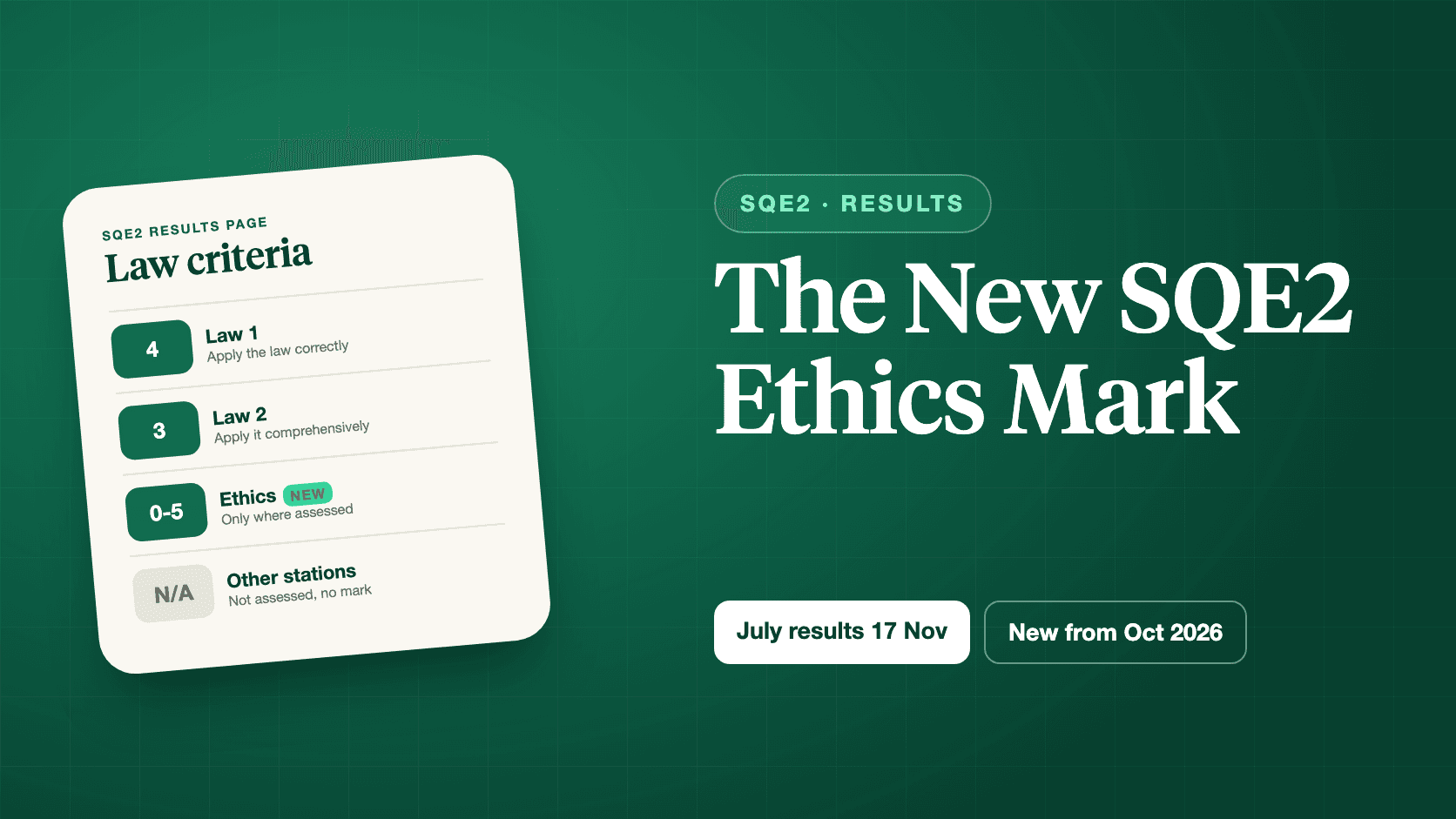
July SQE2 results arrive on 17 November in the old format. From the October 2026 sitting, a separate ethics mark appears. Who sees what, and how it adds up.
Read the article

No law degree, no training contract, and maybe no degree at all. How career changers qualify through the SQE, what the SRA data shows, and how to prepare.
Read the article

Make SQE revision while working more manageable with a mobile study routine, protected practice blocks and a useful fallback for disrupted days.
Read the article