
Official facts and product information checked on 18 October 2026.
SQE2 advocacy practice needs two connected routines: one for turning the file into a submission plan and one for presenting that submission clearly. The standard task gives 45 minutes for preparation and 15 minutes for delivery. Rehearsing the complete sequence shows whether your notes help you reason and respond, rather than simply read aloud.
- The official advocacy sample specifies 45 minutes of preparation and 15 minutes for the submission.
- The allocation within preparation below is a suggested method, not a prescribed SRA timetable.
- Review the legal reasoning and the communication of it; a polished opening is only one part of the work.
Read the task before building the speech
The official advocacy samples are set in Criminal Litigation and Dispute Resolution. Start by identifying the decision you are asking the judge to make and the material relevant to it. Do not assume a remembered structure supplies the legal test or the requested outcome for a new task.
Write a short purpose statement in your private plan. It should connect the requested outcome to the case you need to present. If that statement is unclear, drafting a longer script usually spreads the uncertainty rather than resolving it. Return to the instruction and the relevant materials first.
| Block | Work | What to have at the end |
|---|---|---|
| First 10 minutes | Read the task and orient yourself in the file. | The requested decision and key source locations. |
| Next 15 minutes | Identify the reasoning, relevant facts and adverse points. | A reasoned order for the submission. |
| Next 15 minutes | Build concise speaking notes and check the support for key points. | A navigable plan rather than a full essay. |
| Final 5 minutes | Rehearse the opening, conclusion and route through the argument. | A clear start and requested outcome. |
Adjust the allocation if the task demands it, while keeping the overall standard preparation block intact for a simulation. Note afterwards whether the division helped or whether an earlier stage consumed too much time.
Build notes you can use while speaking
Use headings, source references and short prompts that help you find your place. A complete written script can feel reassuring during preparation but may be harder to navigate if you lose your place or need to change the order. Test the notes by speaking from them before deciding they work.
Keep the supporting material traceable. If a point depends on a document, your plan should make it easy to identify that document and the relevant fact. Distinguish an assertion from a supported proposition. The exercise is to present a reasoned submission, not to produce the largest possible volume of notes.
Practise handling a difficult point
Include the facts or arguments that make the requested outcome harder to obtain. Decide how they affect your submission rather than omitting them from the plan. If you are unsure of a legal point during review, check it with reliable material or appropriate teaching support before rehearsing it again.
In a fictional practice example, a document may contain a fact that appears inconsistent with the client’s preferred account. The preparation task is to notice it, consider its significance and decide how to address the issue accurately. This example illustrates a review question; it is not a legal answer to a particular application.
Deliver the complete 15-minute task
Use a listener where possible and agree the role they will play. Deliver the submission rather than explaining what you would have said. Record the attempt if everyone involved agrees, then use the recording as evidence during the review.
Check whether your opening identifies the purpose, whether the reasoning can be followed and whether the conclusion states what you ask the court to do. Watch for points where reading becomes detached from communicating. Speaking more quickly is not the only response to a submission that does not fit the time; the structure or selection of material may need work.
Review more than confidence
- Find where the submission states the decision sought.
- Check that important propositions are supported by the task materials and law.
- Identify any important adverse point ignored or mishandled.
- Review the sequence and whether the listener could follow it.
- Choose one short delivery drill and one substantive correction if needed.
Use the official Performance Indicators and sample discussion as the reference point. Confidence can make a submission easier to deliver, but it does not show that the reasoning is accurate or complete. Keep the review attached to what was actually said.
Use further practice without memorising one performance
FQPS SQE2 practice options can support repeated work on appropriate tasks, according to your plan. Decide whether you need an independent attempt, guided preparation or feedback from another person. A familiar scenario is useful for a corrective drill; use a fresh task to inspect whether the change transfers.
The official videos provide another example to analyse, not a personality to imitate. Identify what makes a passage effective and why it meets the task. Then return to your own notes and delivery with a specific improvement target.
Give your next practice session a clear purpose.
Explore FQPS SQE2 self-assessment mocks and check the access included in your plan.
Frequently asked questions
What is the standard SQE2 advocacy timing?
The official sample gives 45 minutes of preparation and 15 minutes for the submission.
Is the suggested 10–15–15–5 preparation split compulsory?
No. It is an editorial practice method within the standard 45-minute block. Adjust it to the task and what your review shows.
Should I write a full script?
Test whether your notes help you reason, navigate the file and communicate. A full script may be useful for a learning exercise but should not be assumed to be the best delivery aid.
Can an advocacy practice score predict a pass?
No. Use it to identify specific work and seek feedback where needed. It is not an official examination result.
Continue your preparation
Sources and information checked
- SRA: advocacy samples and timing
- SRA: individual SQE2 assessments and criteria
- Official SQE2 samples and Performance Indicators
- FQPS SQE2 self-assessment mocks
Information checked on 18 October 2026. Dates, booking details, assessment guidance and product availability should be rechecked before relying on them. Study routines are editorial suggestions. FQPS Academy is an independent preparation provider, not affiliated with or endorsed by the SRA or Kaplan.
Stay up to date
Never miss the latest SRA updates. Receive product updates, news and customer stories right into your inbox.

Keep reading

Understand the SRA consultation, compare the current assessment rules and work through the practical decisions facing candidates planning their next SQE sitting.
Read the article

The July 2026 SQE2 results are out. Read the official pass rates, make sense of your marks and check the urgent January resit deadline for this cohort.
Read the article
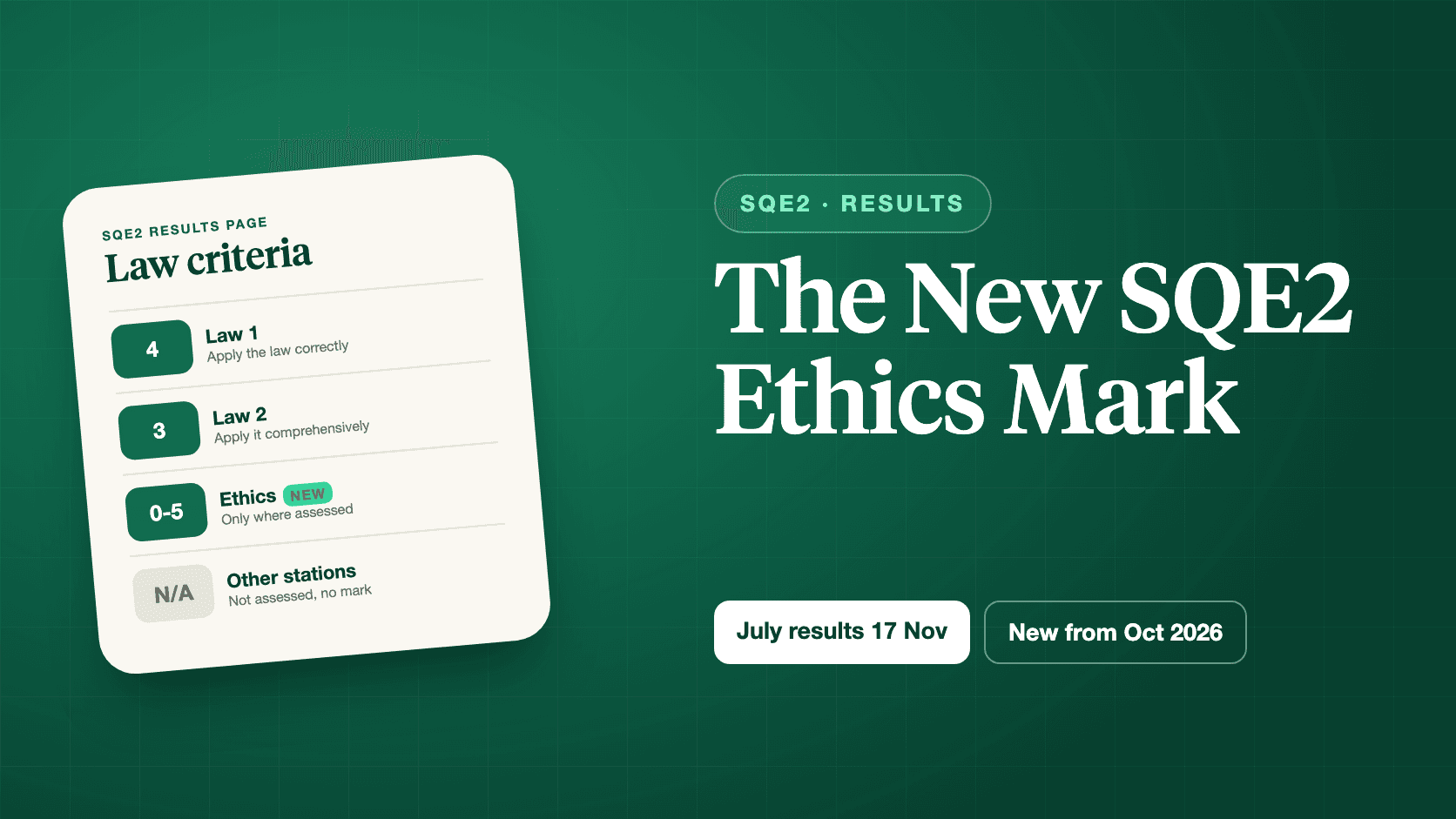
July SQE2 results arrive on 17 November in the old format. From the October 2026 sitting, a separate ethics mark appears. Who sees what, and how it adds up.
Read the article