Published 16 October 2026. Every law change below is dated and linked to an official or primary source at the end.
ChatGPT can answer most SQE1 sample questions correctly. That sounds reassuring until you look at the ones it gets wrong, and at how it gets them wrong: confidently, fluently, and often on exactly the points that have changed most recently. This guide looks at how general AI tools have performed on SQE1 material, the five places they most often go wrong on English law, a table of recent changes to check, and a five-step routine for checking anything an AI tells you before it goes into your notes.
- Good, not good enough. GPT-4 answered 78% of the SRA's 90 sample SQE1 questions correctly in a 2023 test. Roughly one answer in five was wrong.
- It does not know it is wrong. Researchers found models cannot always tell when they are producing legal hallucinations, and often go along with a user's false legal assumptions.
- Recent law is the weak spot. The SQE1 format, SQE fees, section 21 notices, inheritance tax reliefs and arbitration law have all changed since 2024.
- Your sitting has a law cut-off date. SQE1 tests the law in force four calendar months before the assessment window. AI tools do not work to that date.
- Check, then trust. Use the five-step routine below for any legal point an AI gives you.
How has ChatGPT done on SQE1 questions?
The best-known test was run by Dr Andrew Gilbert and reported in the Law Society Gazette. He gave the SRA's original 90 sample SQE1 questions to successive AI models.
| Model | Date reported | Score on 90 sample questions |
|---|---|---|
| ChatGPT (GPT-3.5) | January 2023 | 45 / 90 (50%) |
| ChatGPT (GPT-4) | March 2023 | 70 / 90 (78%) |
| Google Bard | March 2023 | 40 / 90 (44%) |
Source: Andrew Gilbert, Law Society Gazette, 19 January and 24 March 2023. An informal test by one author on the published sample questions, not a controlled study. Bard declined to answer seven questions on death, wills and estates.
Models have improved since 2023, and a current model would probably score higher. But the sample questions are public, the test is small, and the real exam is not made of questions the model may already have seen. More importantly, a high score on answering questions tells you little about how reliable the same tool is when it explains the law to you or writes questions for you, which is how most candidates use it.
Why 78% is not good enough for revision
If a study partner was wrong about one point in five and never told you which, you would stop asking them. Three things make AI errors particularly costly for SQE candidates:
- The errors look exactly like the right answers. Gilbert warned that ChatGPT still makes things up in a self-assured way. There is no change in tone when it is guessing.
- It cannot reliably tell you when it is wrong. The Stanford "Large Legal Fictions" study found that models cannot always predict, or do not always know, when they are producing legal hallucinations. The SRA's advice is never to trust an AI system to judge its own accuracy.
- It agrees with you when you are wrong. The same study found that models often fail to correct a user's incorrect legal assumptions. Ask "why does a section 21 notice need two months?" and you may get a confident explanation instead of a correction.
The courts have now seen what happens when people rely on unchecked AI output. In Ayinde v Haringey and Al-Haroun v Qatar National Bank (2025), the Divisional Court found that 18 of 45 citations in one set of submissions did not exist, and said freely available generative AI tools are not capable of conducting reliable legal research. In August 2026 the SRA issued a warning notice on the misuse of AI, reminding solicitors that they must check AI output and remain responsible for its accuracy.
Five ways AI gets English law wrong
1. It teaches the law as it used to be
A model learns from text written over many years, and most of what it has read describes the law before the latest changes. Unless it is connected to a reliable, current source, it will often describe the old rule as if it were the current one, without a date. SQE1 tests the law at a fixed cut-off date, so "mostly right, a year ago" is not good enough. The table below lists recent changes worth checking.
2. It mixes up jurisdictions
Much of the legal text on the internet is American, and a good deal is Scottish, Irish or Australian. Watch for attorneys, felonies, the US Model Rules of Professional Conduct, Scottish conveyancing terms, or EU law described as if it still applied in the UK in the same way. SQE1 tests the law of England and Wales.
3. It invents or misplaces authority
Fictional cases, wrong section numbers and real cases cited for the wrong proposition are the most common legal hallucinations. In Harber v HMRC (2023), a taxpayer relied on nine tribunal decisions that did not exist. For SQE1 you rarely need case names, but a wrong section or a non-existent exception can quietly corrupt your notes.
4. It gets professional conduct subtly wrong
Ethics and professional conduct run through every SQE1 session. The rules are in the SRA Standards and Regulations, which replaced the old SRA Handbook and its Code of Conduct in November 2019. AI tools often blend the old "outcomes" language, general business ethics and foreign professional rules into answers that sound plausible but would not be the best answer under the SRA Codes of Conduct.
5. It gives you numbers you do not need, and some that are wrong
Under the assessment specification that applies from September 2026, where a tax question needs a rate, threshold, exemption or relief figure, the figure is provided in the question. Memorising AI-supplied tax figures is wasted effort, and some will be out of date anyway. Focus on how the reliefs and rules work.
Recent changes to check: where AI tools often go wrong
These are recent changes where an AI answer is likely to be out of date or confused. This is a list of things to check, not a statement of what your sitting examines: that depends on the SQE1 assessment specification and the SRA's cut-off date for your sitting.
| Change | Date | What an AI tool might tell you instead |
|---|---|---|
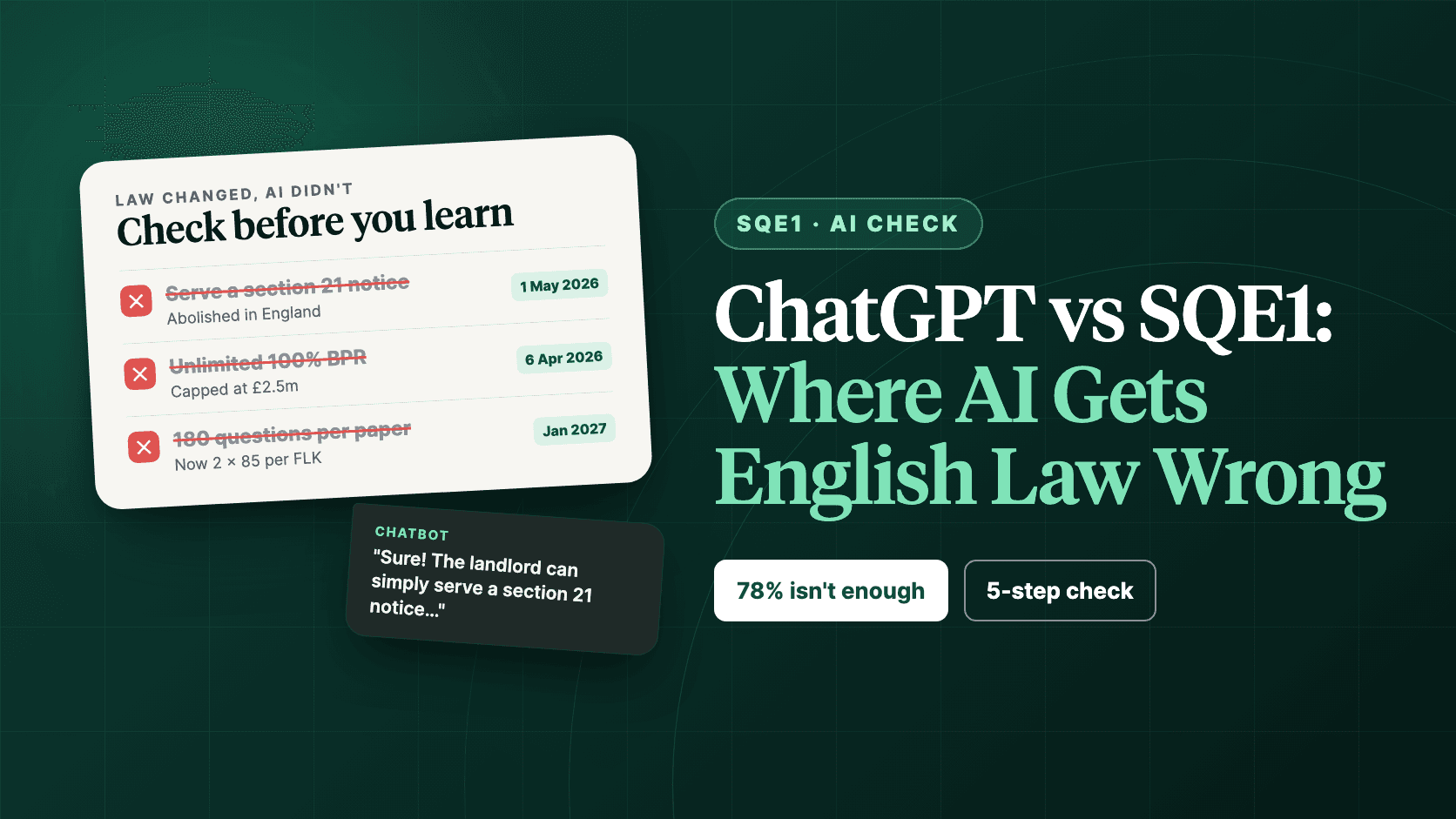
| SQE1 format: each FLK paper has 170 questions in two sessions of 85, with fixed subjects per session | From January 2027 (announced 10 Sept 2026) | 180 questions per paper in two sessions of 90 |
| SQE fees: £2,006 for SQE1 (both FLK papers, booked together), £3,086 for SQE2; £1,003 to resit one FLK paper | Assessments from September 2026 | Earlier fees, such as £1,934 for SQE1 |
| Tax figures provided in SQE1 and SQE2 questions that need a rate, threshold, exemption or relief value | Assessments after 1 September 2026 | That you must memorise rates and allowances |
| Section 21 "no fault" possession notices abolished for private tenancies in England; assured shorthold tenancies became assured periodic tenancies | 1 May 2026 (Renters' Rights Act 2025) | That a landlord can serve a section 21 notice with two months' notice |
| Agricultural and business property relief: 100% relief capped at £2.5 million of qualifying property, 50% above that | 6 April 2026 | Unlimited 100% relief, or the £1 million cap first announced and later raised |
| Unused pension funds brought into the estate for inheritance tax | Deaths on or after 6 April 2027 (not yet in force) | That pensions are always outside the estate, or that the change already applies |
| Arbitration Act 2025: the law of the seat governs the arbitration agreement unless the parties expressly choose otherwise | Arbitrations started on or after 1 August 2025 | The old common law approach from Enka v Chubb |
| Companies House identity verification mandatory for new directors and persons with significant control | 18 November 2025 | That anyone can be appointed a director without verification |
| Failure to prevent fraud offence for large organisations (Economic Crime and Corporate Transparency Act 2023) | 1 September 2025 | That the offence is not yet in force |
Sources: SRA and SQE website; GOV.UK guidance on the Renters' Rights Act roadmap, APR and BPR, pensions and inheritance tax, and the failure to prevent fraud offence; Arbitration Act 2025 (Commencement) Regulations 2025; Companies House. Full links at the end. Checked 14 October 2026.
SQE1 examines the law in force four calendar months before the first assessment in the window, and the SRA publishes the exact date for each sitting on the SQE website. For January 2027, FLK1 starts on 11 January. Note the cut-off date at the top of your notes and check every recent change against it.
The five-step checking routine
Use this for any legal rule an AI tool gives you before it goes into your notes or flashcards.
- Is it on the syllabus? Find the topic in the SQE1 assessment specification. If it is not there, you may not need it at all.
- What is the source? Ask the tool which statute, section or regulation the rule comes from. If it cannot say, treat the rule as unverified.
- Check the primary source. Look up the provision on legislation.gov.uk, and check the banner for changes not yet applied. For tax and government schemes, use GOV.UK. For professional conduct, use the SRA Standards and Regulations on sra.org.uk.
- Check the date. When did the rule start, and is that before your sitting's cut-off date? If a change is announced but not yet in force, note both versions.
- Test it on a real question. Find an official sample question or an expert-written practice question on the point and check that your understanding produces the best answer.
It takes a few minutes per point. It is much faster than unlearning a wrong rule in the final week, or discovering it in the exam room.
How FQPS Academy keeps content right
Every FQPS Academy question, explanation and revision card is written and reviewed by legal experts before students see it, and follows the SRA's single best answer format and the SQE1 assessment specification. AI can be a useful tool for revision; it should not be the author of the material you rely on to pass.
The bottom line
ChatGPT knows a lot of English law, and it is wrong often enough to matter. Its mistakes cluster on recent changes, other jurisdictions, professional conduct and invented authority, and it will not warn you when it makes one. Use AI to explain and organise, check every legal point against a primary source and your sitting's cut-off date, and practise on questions written and reviewed by people who know the standard.
Practise on expert-reviewed SQE1 questions
Create a free FQPS account and sit one full FLK1 and one full FLK2 mock in the January 2027 format (2 × 85 questions each). No card needed.
Keep reading
ChatGPT and SQE1: FAQs
Can ChatGPT pass the SQE1?
In a 2023 test reported by the Law Society Gazette, GPT-4 answered 70 of the SRA's 90 sample SQE1 questions correctly (78%), and GPT-3.5 scored 50%. That was an informal test on public sample questions, not the real exam. Even at 78%, roughly one answer in five was wrong, and the model gave no sign of which ones.
Is ChatGPT accurate on English law?
Often, but not reliably. General AI tools describe out-of-date law, mix in other jurisdictions, invent or misplace authorities and often accept a user's false legal assumptions. English courts have dealt with submissions containing citations to cases that do not exist, and the SRA advises never to trust an AI system to judge its own accuracy.
Which law does SQE1 test?
SQE1 tests the law in force four calendar months before the first assessment in the window. The SRA publishes the exact cut-off date for each sitting on the SQE website. Check any recent change against that date.
Do I need to memorise tax rates for SQE1?
Under the assessment specification updated in 2026, where a tax question needs a rate, threshold, exemption or relief figure, the figure will be provided. Focus on how the taxes and reliefs work rather than memorising figures, especially figures supplied by an AI tool that may be out of date.
How do I check if an AI answer about the law is right?
Find the topic in the SQE1 assessment specification, ask the tool for the exact statutory source, check that source on legislation.gov.uk (or GOV.UK for tax, or the SRA Standards and Regulations for conduct), check the date the rule took effect against your sitting's cut-off date, and test your understanding on an official or expert-written question.
Is section 21 still in the SQE?
Section 21 "no fault" possession notices were abolished for private tenancies in England from 1 May 2026 under the Renters' Rights Act 2025. Whether and how a topic is examined depends on the SQE1 assessment specification and the cut-off date for your sitting, so check the specification rather than relying on an AI answer.
Should I use ChatGPT to write SQE practice questions?
Not to judge your readiness. Research on AI-written multiple-choice questions found more factual errors, more flawed questions and easier, more recall-based questions than expert-written ones. Use official sample questions and expert-written mocks to measure progress, and keep AI for explaining and organising material you can check.
Sources
- Andrew Gilbert, Law Society Gazette, Revealed: could ChatGPT pass the SQE?, 19 January 2023, and ChatGPT aces SQE resit but it's back to school for Bard, 24 March 2023.
- Dahl M, Magesh V, Suzgun M, Ho DE, Large Legal Fictions: Profiling Legal Hallucinations in Large Language Models, Journal of Legal Analysis, 2024.
- R (Ayinde) v London Borough of Haringey; Al-Haroun v Qatar National Bank [2025] EWHC 1383 (Admin); Harber v HMRC [2023] UKFTT 1007 (TC).
- SRA, Risk Outlook: the use of artificial intelligence in the legal market, 20 November 2023, and Misuse of AI: warning notice, 17 August 2026.
- SQE website: cut-off date for the law examined; updated SQE assessment specifications, 30 April 2026; SQE changes from September 2026 (tax figures provided in SQE1 and SQE2); changes to SQE1 from January 2027, 10 September 2026; SQE costs.
- GOV.UK, Renters' Rights Act 2025 implementation roadmap.
- GOV.UK, Agricultural property relief and business property relief changes, updated 3 March 2026.
- GOV.UK, Inheritance tax on unused pension funds and death benefits.
- GOV.UK, Offence of failure to prevent fraud (in force 1 September 2025).
- Arbitration Act 2025, s 6A (inserted into the Arbitration Act 1996), in force 1 August 2025: legislation.gov.uk.
- Companies House, identity verification: Verifying your identity for Companies House.
The SQE and SOLICITORS QUALIFYING EXAMINATION trade marks are the property of and are used under licence from the Solicitors Regulation Authority. FQPS Academy is an independent SQE preparation provider and is not affiliated with or endorsed by the SRA or Kaplan. This article is general information, not legal advice; check the SRA and SQE websites and the primary sources for the rules that apply to you.
Stay up to date
Never miss the latest SRA updates. Receive product updates, news and customer stories right into your inbox.

Keep reading
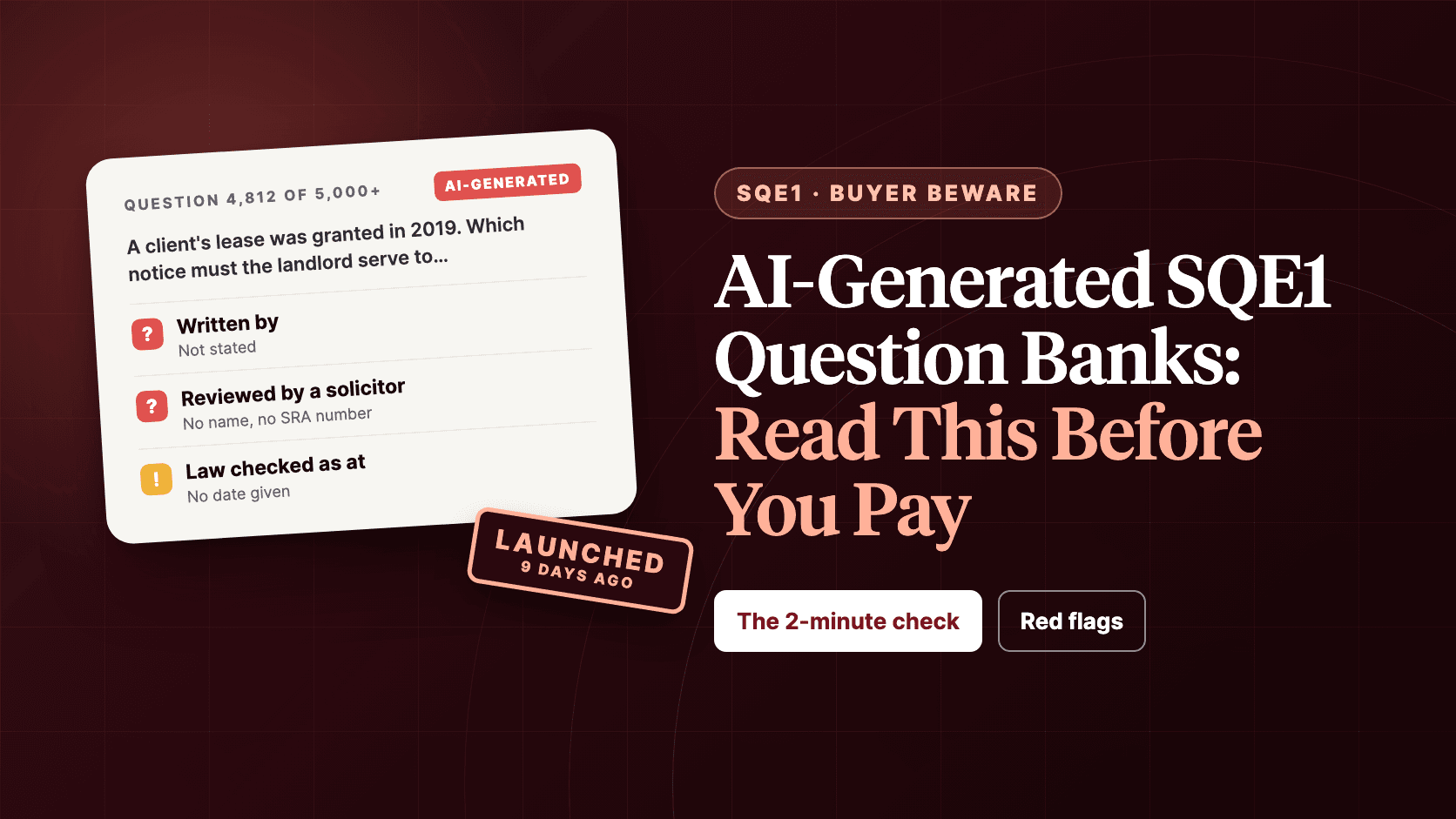
New AI SQE1 question banks appear every week. Why unreviewed AI questions are no better than a free chatbot, what the research shows, and a two-minute check before you buy.
Read the article
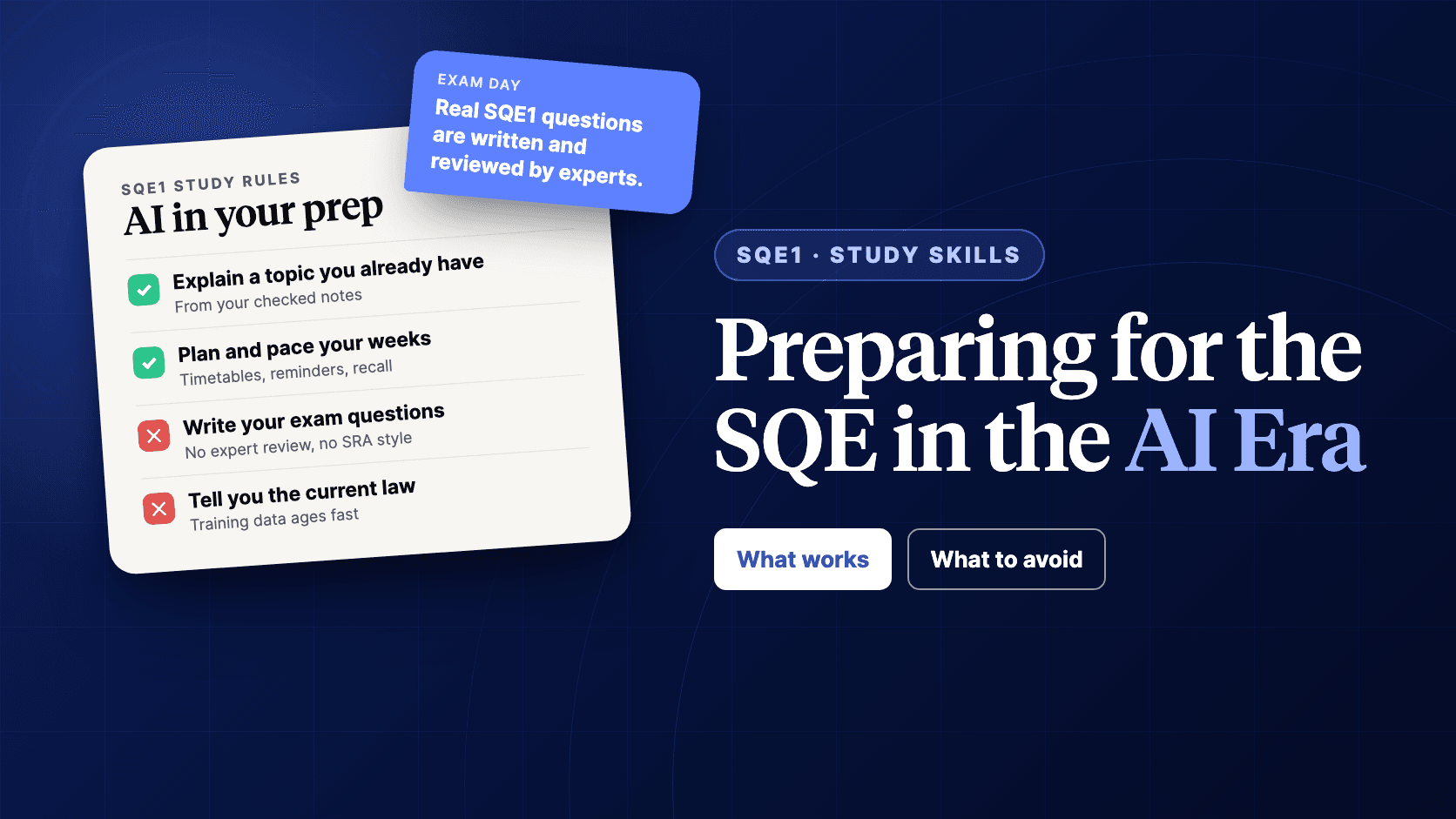
How to use AI in SQE preparation without being misled: what it does well, where it fails on English law, how real SQE1 questions are written, and 10 rules to follow.
Read the article
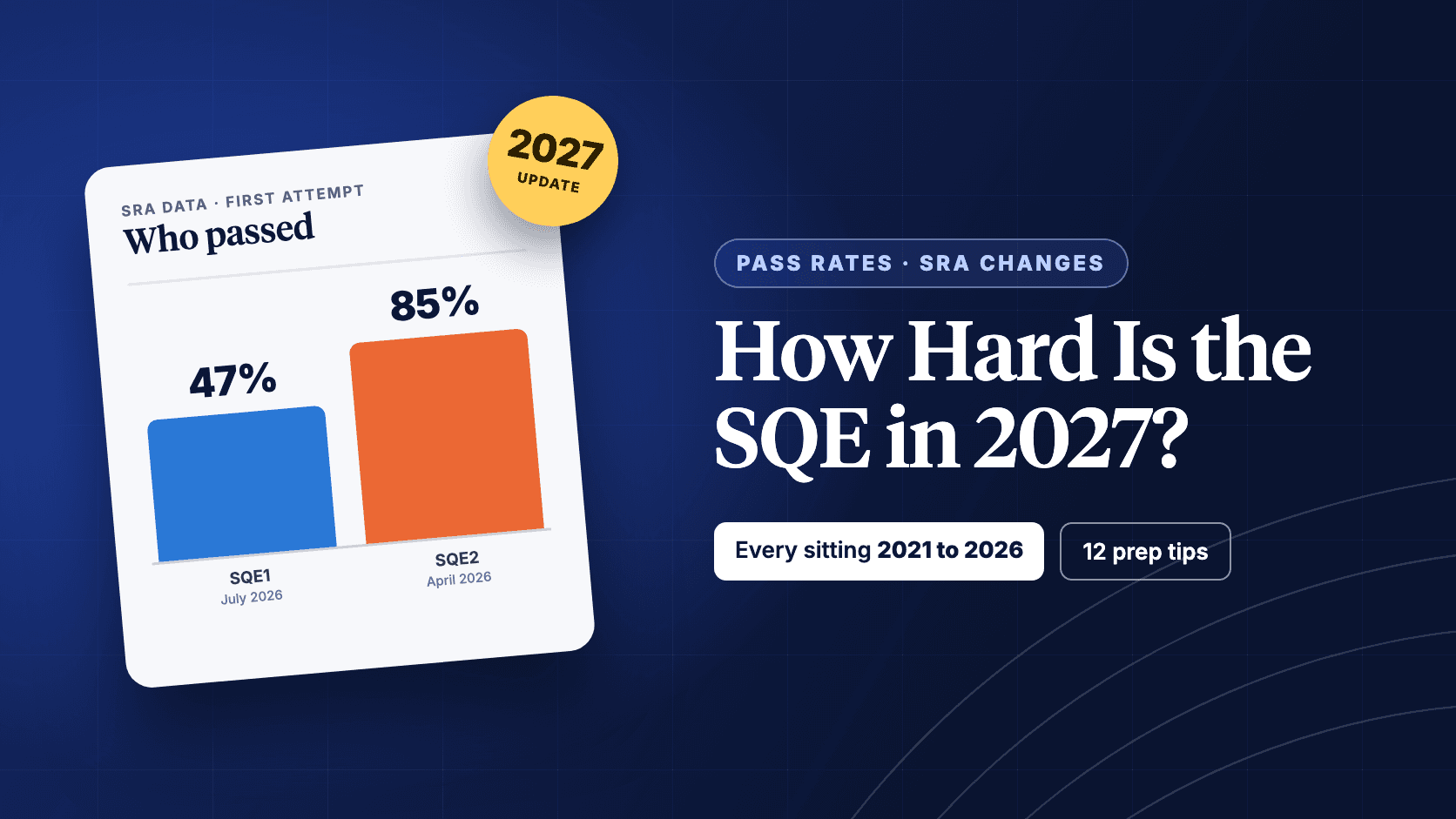
How hard is the SQE? Every SRA pass rate since 2021, why SQE1 fails half of first-timers, what changes in 2027, and 12 preparation tips built on the data.
Read the article